On this page
Every Doppler weather radar has to make a choice before it switches on. If it sends pulses slowly, it can see storms a long way off but reads only gentle winds. If it sends them quickly, it can read strong winds but only close in. Meteorologists call this the Doppler dilemma. It comes from two simple formulas, one for timing and one for phase, and their product depends only on the radar's wavelength.
How does a weather radar measure distance and wind speed?
You may already know the two basic ideas from how Doppler weather radar tracks storms: the echo delay t gives the range d = ct/2, and the Doppler shift gives the speed along the beam. This post is about what happens when a radar has to do both with the same train of pulses.
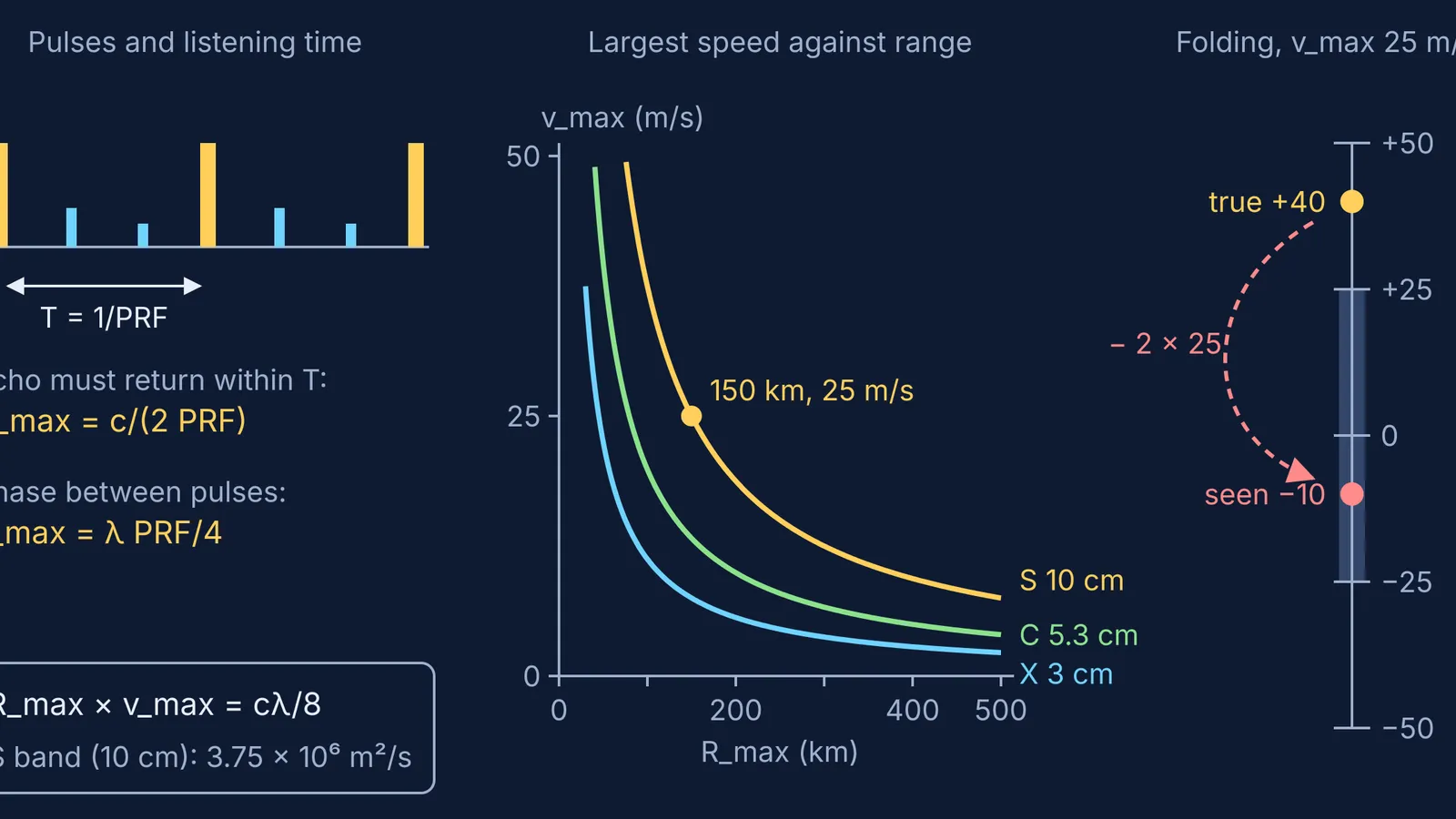
A pulsed radar sends a short burst, listens, then sends the next. The number of bursts per second is the pulse repetition frequency (PRF), and the gap between them is T = 1/PRF.
The Doppler shift of a raindrop moving at a few metres per second is tiny compared with the radar's 3 GHz carrier. So the radar does not measure it directly. Instead, as the WMO Guide to Meteorological Instruments and Methods of Observation (WMO-No. 8, 2008, Part II chapter 9) explains, it compares the phase of the echo from one pulse with the echo from the next. A drop moving at v along the beam travels vT between pulses, so the round-trip path changes by 2vT and the phase changes by Δφ = 4πvT/λ.
Why does the pulse rate limit range?
The radar must hear one pulse's echo before it sends the next. Otherwise it cannot tell which pulse an echo belongs to. Light covers the round trip 2R in time T, so the farthest range it can read without confusion is
R_max = cT/2 = c/(2 PRF)
An echo from beyond R_max arrives after the next pulse has gone out, and the radar puts it at the wrong, shorter range. NOAA calls this range folding. The WMO Guide gives the scale: 600 km at a PRF of 250 Hz, but only about 150 km at the 1,000 Hz typical of Doppler work.
Why does the pulse rate also limit wind speed?
A phase can only be read between −180° and +180°. A change of +200° looks the same as −160°. The WMO Guide states the limit: the fastest speed that can be read without ambiguity is the one at which the target moves a quarter of a wavelength between pulses. Setting Δφ = π gives
v_max = λ/(4T) = λ PRF/4
This is the Nyquist sampling limit in disguise. The radar samples the phase PRF times a second, so it can read a Doppler frequency of at most PRF/2. The Doppler frequency of a radar echo is f_d = 2v/λ, so v ≤ λ PRF/4. The factor 4 is 2 for the round trip times 2 for Nyquist.
Multiply the two limits and the PRF cancels:
R_max × v_max = cλ/8
For an S-band radar (wavelength about 10 cm, frequency 2 to 4 GHz in the WMO's band table), cλ/8 = 3.0 × 10⁸ × 0.10 / 8 = 3.75 × 10⁶ m²/s. You can trade range for speed, but you cannot raise both.
How does the trade-off play out for S-band and C-band radars?
For λ = 10 cm:
PRF 600 Hz: R_max = 250 km, v_max = 15 m/s.
PRF 1,000 Hz: R_max = 150 km, v_max = 25 m/s. The WMO Guide quotes this ±25 m/s for a typical S-band radar.
PRF 1,200 Hz: R_max = 125 km, v_max = 30 m/s.
A C-band radar at about 5.3 cm has roughly half the product, 2.0 × 10⁶ m²/s, so at 150 km it reads only 13 m/s. The longer S-band wavelength is one reason coastal cyclone radars use it. IMD's first Doppler radar, at Chennai, was an S-band unit inducted into its cyclone detection network and declared operational in February 2002. We have not found a published PRF for IMD sites, so the numbers here are the standard textbook examples.
The US NEXRAD radars deal with it by scanning the lowest angles twice. NOAA's JetStream page on the Doppler dilemma gives about 320 pulses per second for a long-range pass (about 290 miles, but only 18 mph) and about 1,300 for a velocity pass (72 miles, 71 mph).
Worked example: why does a cyclone's 40 m/s wind look like −10 m/s?
An S-band radar (λ = 0.10 m) runs at PRF 1,000 Hz and looks at the eyewall of a cyclone where the true wind along the beam is 40 m/s toward the radar. Take speeds toward the radar as positive.
Limit. v_max = 0.10 × 1,000 / 4 = 25 m/s. So 40 m/s is out of range.
Phase change per pulse. Δφ = 4πvT/λ = 4π × 40 × 0.001 / 0.10 = 1.6π rad, which is 288°.
What the radar reads. A phase of 288° is indistinguishable from 288° − 360° = −72°.
Back to speed. −72° is −72/180 of the limit: −0.4 × 25 = −10 m/s.
Shortcut. Subtract 2v_max until the answer lies between −v_max and +v_max: 40 − 50 = −10 m/s.
The radar shows a 10 m/s wind blowing away from it in a band where the real wind is 40 m/s toward it. On a velocity map the colours jump sharply from strong inbound to outbound. That is velocity folding, the radar version of the wagon-wheel effect, where a spoked wheel filmed too slowly appears to turn backwards.
How do radars get around the dilemma?
One method is to alternate two pulse rates and compare the two speed estimates. The WMO Guide gives a C-band example: PRFs of 1,200 and 900 Hz have limits of about 16 and 12 m/s. A wind that folds differently in each shows up as a difference between them, and the pair together reads up to
v = λ / (4 (1/900 − 1/1,200)) = 0.053 / (4 × 2.78 × 10⁻⁴) = 48 m/s
That covers a severe cyclone's winds. With noisy data the comparison can pick the wrong fold, so forecasters still check maps by eye. Only the part of the wind along the beam is measured in any case.
This is a clean JEE-style Doppler and timing problem. You can practise similar problems with the step-by-step solver in the Fermi Problem Library, which explains the reasoning at each step. If you are preparing for JEE Main and Advanced, Fermi Test Prep offers personalised preparation with an AI tutor, live classes, adaptive mocks, mentorship and a study plan that updates based on mastery.
Quick checklist
R_max = c/(2 PRF): the echo must return before the next pulse.
v_max = λ PRF/4: the phase change per pulse, 4πvT/λ, must stay within ±π.
R_max × v_max = cλ/8: 3.75 × 10⁶ m²/s at 10 cm, about half that at C band.
A speed beyond v_max folds: subtract 2v_max until it fits.
Two pulse rates together extend the limit, here to 48 m/s.