

On this page
Why do wheels look like they spin backwards on video?
The wagon-wheel effect is an optical illusion where a spinning wheel appears to rotate slowly, stand still, or even spin in reverse, a phenomenon known as temporal aliasing Wikipedia. This happens because video cameras do not record continuous motion; they take a series of still photographs very quickly, usually at 24 or 30 frames per second.
Our brain tries to make sense of these snapshots by assuming the shortest path of motion between two frames. When the wheel spins so fast that the spokes almost complete a full turn between camera flashes, your brain connects the closest spokes and perceives a backward motion.
The five-spoke wheel test
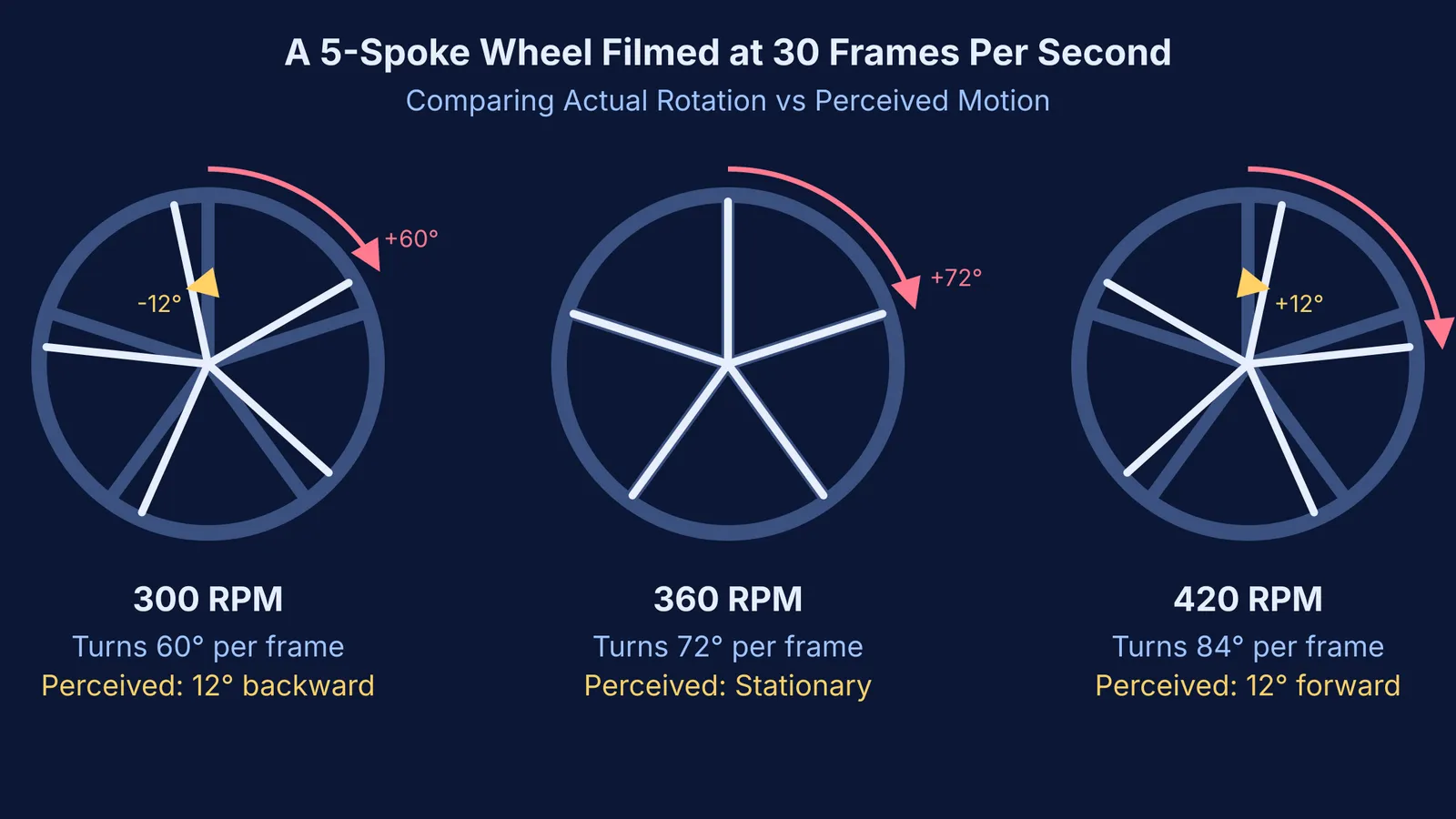
Let's predict what happens when you film a five-spoke car alloy wheel at 30 frames per second Wikipedia. The angle between each spoke is 72 degrees.
In 1/30th of a second (one frame), how far does the wheel turn? It depends on its speed.
The stationary illusion (360 RPM): If the wheel turns at 6 revolutions per second (360 RPM), it rotates exactly 72 degrees between every frame. The next spoke moves into the exact position of the previous one. Because every frame looks identical, the wheel appears completely still.
The backward illusion (300 RPM): At 5 revolutions per second, the wheel only turns 60 degrees between frames. The spoke that was at the top moves forward by 60 degrees, but the spoke behind it moves to -12 degrees. Your brain sees the shortest path—a jump of 12 degrees backwards—and the whole wheel appears to spin slowly in reverse.
The slow forward illusion (420 RPM): At 7 revolutions per second, the wheel turns 84 degrees between frames. A spoke moves past the 72-degree mark by 12 degrees. The brain sees this as a slow 12-degree forward rotation.
How can you calculate the apparent motion?
If you want to solve problems involving temporal aliasing, use this simple three-step framework:
Find the spoke frequency: Multiply the wheel's revolutions per second by the number of spokes. This tells you how many spokes pass a fixed point every second.
Compare it to the frame rate: Look at the camera's frames per second (fps). If the spoke frequency is an exact multiple of the frame rate, the wheel will appear stationary Wikipedia.
Check the remainder: If the spoke frequency is slightly lower than the frame rate, the camera captures the next spoke before it reaches the original position, making the wheel appear to spin backwards.
This calculation is not just for physics exams. Digital cameras recording aircraft propellers or helicopter rotors often capture curved, disconnected blades. Because most modern cameras use a rolling shutter—where the image is scanned line by line rather than all at once—the spinning rotor blades appear distorted as well as aliased.
How to use this for active learning
This phenomenon is a perfect example of why you should test your intuition before reading the final answer. When you study periodic motion, do not just memorise the formulas for angular velocity and frequency. Instead, calculate the frame rate and predict the perceived motion first.
If you are dealing with physics ideas that are easier to see than to read, you can set up experiments in the Fermi Simulation Lab. Change the camera's frame rate, adjust the RPM of the wheel, and watch the aliasing happen in real time to build a genuine intuition for the math. If you want to explore more interactive physics problems, try predicting the outcome of a Doppler effect simulation or testing your intuition with a Simple harmonic motion simulation.
Why does the Nyquist limit matter?
The wagon-wheel effect is more than a film trick; it is a core principle in signal processing. The Nyquist-Shannon sampling theorem states that to capture a periodic signal accurately without aliasing, you must sample it at more than twice its frequency Wikipedia.
When you fail to sample fast enough, the system produces false signals. This is why a video camera shooting at 30 fps cannot accurately record a wheel spinning at 40 revolutions per second; the missing information forces the brain to construct a false reality.
This illusion extends into industrial safety. In a factory lit by single-phase fluorescent lights, the 50 Hz power line causes the light to flicker exactly 100 times per second Wikipedia. If a lathe or drill spins at exactly 100 revolutions per second (6,000 RPM), the machine will appear completely still, posing a severe safety risk to operators Wikipedia. To prevent this, industrial workshops use three-phase power or high-frequency LED lighting so the stroboscopic effect never hides spinning machinery.


