

On this page
When you listen to a song streamed to your headphones, you are listening to numbers. The acoustic wave produced by a singer's vocal cords or a vibrating guitar string is smooth and continuous, but computers can only store discrete digital measurements. The mathematical bridge between that continuous sound wave and digital data was established in 1928 by Swedish-American physicist Harry Nyquist at Bell Telephone Laboratories.
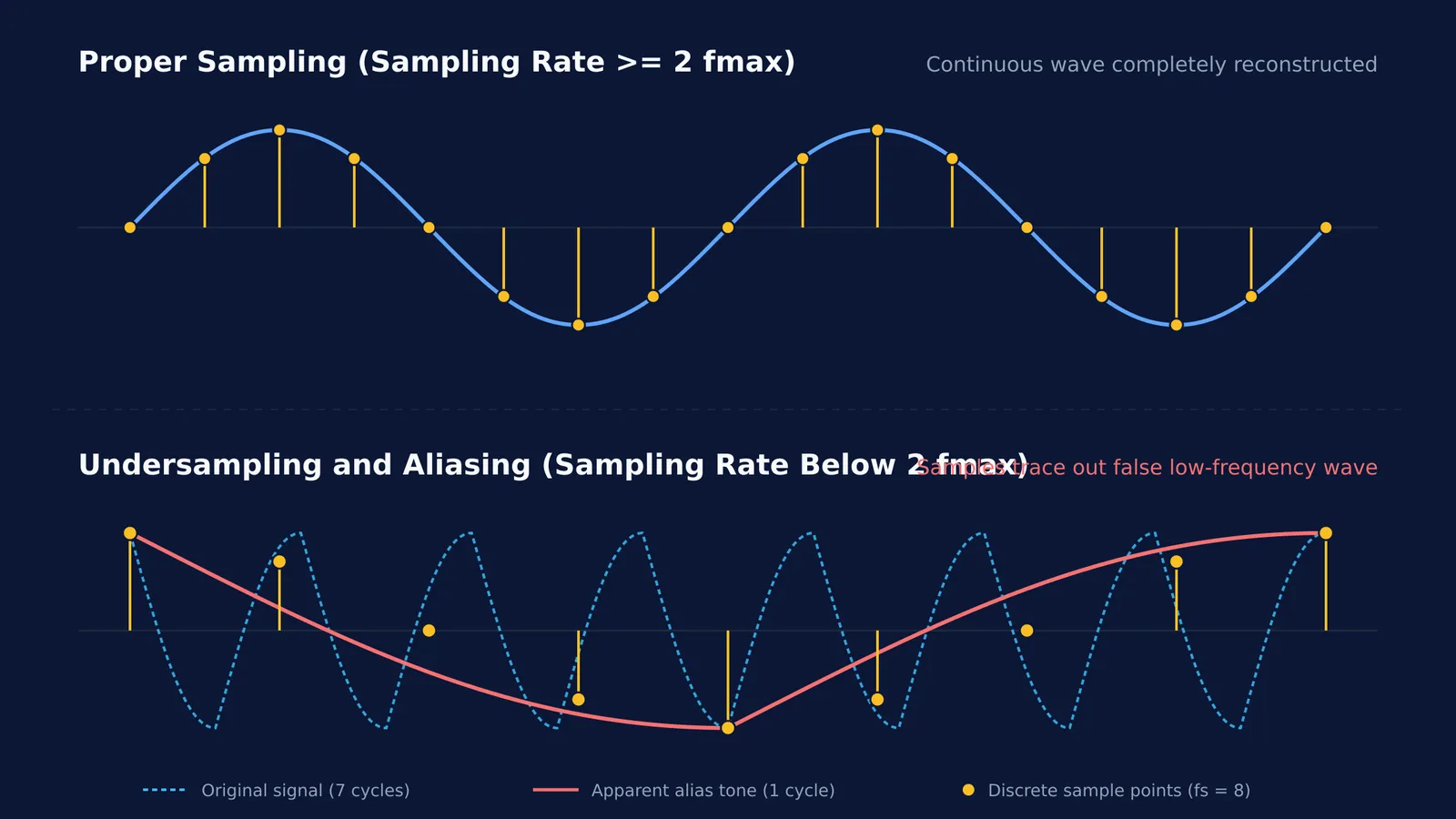
Nyquist's discovery—later formalized as the Nyquist–Shannon sampling theorem—proves that you do not need to record every infinite point of a continuous wave to capture it completely. If you sample the wave at regular intervals at a rate strictly greater than twice its highest frequency, the original analog sound can be reconstructed with zero loss of information.
What is the history of the Nyquist sampling theorem?
Harry Theodor Nyquist was born in Nilsby, Sweden, on 7 February 1889, emigrated to the United States in 1907, and earned his Ph.D. in physics from Yale University in 1917, as recorded by James E. Brittain in the Proceedings of the IEEE. Nyquist spent 37 years at AT&T and Bell Labs, where he produced 138 patents on communications circuits, feedback amplifiers, and transmission lines.
In his April 1928 paper, "Certain Topics in Telegraph Transmission Theory", published in the *Transactions of the American Institute of Electrical Engineers*, Nyquist analyzed how rapidly telegraph pulses could travel over physical wires without interfering with each other. He proved that transmitting independent signal elements across a channel of bandwidth W requires a signaling speed of 2W pulses per second, meaning the pulses must be spaced by an interval of 1/(2W) seconds.
Two decades later, mathematician Claude E. Shannon recognized that Nyquist's telegraph rule held the key to converting continuous waves into digital information. In his 1949 paper, "Communication in the Presence of Noise", published in the *Proceedings of the IRE*, Shannon proved Theorem 1: any signal containing no frequencies higher than W cycles per second is completely determined by measuring its values at points spaced 1/(2W) seconds apart. Shannon named this critical spacing the "Nyquist interval" and the minimum rate of 2W samples per second the "Nyquist rate".
As electrical engineer Hans Dieter Lüke documented in IEEE Communications Magazine, similar sampling principles had been derived independently by Scottish mathematician E. T. Whittaker in 1915 and Soviet engineer Vladimir Kotelnikov in 1933. However, it was Nyquist's transmission analysis combined with Shannon's information theory that became the bedrock of modern digital telecommunications. Just as Edwin Armstrong's FM radio conquered electrical static by expanding signal bandwidth, Nyquist showed how physical channel bandwidth sets hard boundaries on information speed.
Why must a signal be sampled at twice its highest frequency?
To understand why a wave requires two samples per cycle—as formulated by Claude Shannon in the Proceedings of the IRE—picture a simple sine wave. Every complete cycle has one positive crest and one negative trough.
If you sample a wave only once per cycle, you might measure the wave every time it passes through zero, registering a flatline of silence. Even if you sample once at a peak, you cannot determine how fast the wave oscillates between measurements. To establish both the amplitude and the frequency of an oscillation, you need at least two measurements in every cycle: one to capture its upward excursion, and one to capture its downward swing.
In mathematical terms from Shannon's sampling theorem, if a signal has a maximum frequency component f_max, the sampling rate f_s must satisfy:
f_s > 2 × f_max
The threshold f_s / 2 is called the Nyquist frequency. If all frequencies in the original signal lie below this threshold, the original continuous wave can be reconstructed perfectly using mathematical interpolation pulses.
Human hearing spans the range of human hearing, extending from roughly 20 Hz up to 20,000 Hz (20 kHz). Under Nyquist's theorem, an audio recorder must sample at least 2 × 20,000 = 40,000 times per second to capture the highest note a human can detect.
How does aliasing create ghost frequencies in sound?
When an audio system samples a wave at less than twice its frequency, a severe type of distortion occurs called aliasing. Because there are too few points to define the fast wave, the samples inadvertently trace out a completely different, lower-frequency wave. As analyzed in Hans Dieter Lüke's review of sampling theory, the high pitch "folds back" across the Nyquist threshold and appears as a false phantom tone.
The frequency of this alias note follows a simple formula:
f_alias = |f_s − f_signal|
Consider a practical audio recording example:
A singer sings into a microphone, producing vocal harmonics up to 10 kHz, but nearby studio equipment leaks an ultrasonic noise spike at 26 kHz into the wire.
If the audio interface samples the incoming signal at a rate of 32 kHz (32,000 samples per second), the Nyquist frequency is 32 / 2 = 16 kHz.
The 10 kHz vocal frequencies are well below 16 kHz and record cleanly.
The 26 kHz ultrasonic spike is higher than 16 kHz. It aliases to |32 kHz − 26 kHz| = 6 kHz.
When the recording plays back, the listener hears an artificial 6 kHz whistle right in the middle of the singer's voice.
Once an alias tone is sampled, it is indistinguishable from real musical notes at that frequency; no digital equalizer can remove it without damaging the vocals. To prevent this, every digital recorder places an analog low-pass filter—known as an anti-aliasing filter—before the sampler to remove all ultrasonic content before measurements begin.
For students exploring wave mechanics and frequency spectra in physics, the Fermi Simulation Lab provides interactive simulations for the ideas that are easier to see than to read, making it easy to observe how changing the sampling interval distorts or preserves an oscillating wave.
Why did engineers choose 44.1 kHz for digital audio?
If human hearing stops at 20 kHz, why does standard CD audio sample at 44,100 Hz (44.1 kHz) rather than 40 kHz?
The choice reflects practical filter engineering combined with early digital recording technology, as documented by Compact Disc pioneer Hans Peek in IEEE Communications Magazine.
First, real analog filters cannot cut off frequencies like an abrupt vertical brick wall. A physical filter that passes 20 kHz cleanly requires a transition band—a small buffer zone—to roll off to zero before the Nyquist threshold. Choosing a sampling rate of 44.1 kHz places the Nyquist frequency at 22.05 kHz. This gives circuit designers a 2,050 Hz guard band (from 20,000 Hz to 22,050 Hz) for their analog filters to eliminate ultrasonic noise without dulling the audible treble.
Second, in the late 1970s when Sony and Philips developed the Compact Disc, hard drives were too small to hold digital music masters. Engineers had to record digital audio as black-and-white video pulses on magnetic video tape recorders.
To make mastering equipment compatible worldwide, the sampling rate had to match both major television broadcast standards:
European PAL video used 294 lines per field × 50 fields per second × 3 audio samples per line = 44,100 samples per second.
American NTSC video used 245 active lines per field × 60 fields per second × 3 audio samples per line = 44,100 samples per second.
The number 44,100 was the only sampling frequency that fit both television systems while providing the necessary guard band above human hearing.
When working through wave equations, frequency conversions, and sound numericals, the Fermi Problem Library offers worked problems with a step-by-step solver that explains the reasoning rather than printing an answer.


