On this page
The networks unit in Class 12 Computer Science is worth 10 marks, and a good share of it is definitions and comparisons that students half-remember. Two areas cause most of the confusion: the difference between bandwidth and data transfer rate, and which transmission medium suits which job. This post sorts both out, works through three short calculations, and ends with a practice routine.
What does the 2026-27 syllabus include?
The CBSE Computer Science (083) curriculum for 2026-27 gives Unit 2, Computer Networks, 10 marks. It lists "measuring capacity of communication media (bandwidth, data transfer rate)" and "Transmission media: Wired communication media (Twisted pair cable, Co-axial cable, Fiber-optic cable), Wireless media (Radio waves, Micro waves, Infrared waves)". The matching text is NCERT Class 12 Computer Science, Chapter 11, Data Communication.
Network types, topologies, devices and the campus design question are in our post on computer networks for CBSE Class 12. Here we stay with media and capacity.
What is the difference between bandwidth and data transfer rate?
NCERT treats them as two ways to measure a channel's capacity.
Bandwidth is the range of frequencies available on a channel, normally the difference between the highest and lowest frequency. It is measured in hertz: 1 KHz = 1000 Hz and 1 MHz = 1000 KHz.
Data transfer rate (bit rate) is the number of bits sent from source to destination in one second, in bits per second (bps). NCERT defines the larger units in powers of two: 1 Kbps = 2¹⁰ bps = 1024 bps, 1 Mbps = 1024 Kbps, 1 Gbps = 1024 Mbps.
NCERT also says the higher the bandwidth, the higher the data transfer rate. And it flags a classic trap in its margin: MBps means megabytes per second, Mbps means megabits per second. One byte is 8 bits.
Outside the textbook, the prefixes are usually decimal. The US National Institute of Standards and Technology explains that kilo means 1000 and that 1024 has its own IEC prefix, kibi, so 1 kbit = 1000 bit and 1 Kibit = 1024 bit. For the board exam, use NCERT's 1024 and say so in your answer if the question is ambiguous.
Worked examples on capacity
Example 1: bandwidth. A channel uses frequencies from 2.40 GHz to 2.48 GHz. Bandwidth = 2.48 − 2.40 = 0.08 GHz = 80 MHz.
Example 2: required data rate. A user uploads 15 pages every 30 seconds. Each page has 2000 characters and each character is 8 bits.
Bits per page: 2000 × 8 = 16,000.
Bits in 15 pages: 15 × 16,000 = 240,000.
Rate: 240,000 / 30 = 8,000 bps.
In NCERT units: 8,000 / 1024 ≈ 7.81 Kbps. With decimal prefixes it would be exactly 8 kbps.
Example 3: download time. A 45 MB file is sent over an 8 Mbps link.
Convert bytes to bits: 45 MB × 8 = 360 Mb.
Time: 360 Mb / 8 Mbps = 45 seconds.
Because the file size and the link speed use the same prefix, the 1024-versus-1000 question cancels out here. Only the factor of 8 matters.
How do the three wired media compare?
From NCERT section 11.6.1:
Twisted pair: two insulated copper wires twisted like a DNA helix. The twisting reduces interference from nearby pairs. Cheap, and the most common choice for telephone lines and LANs. Comes as unshielded (UTP) and shielded (STP).
Coaxial cable: a copper core, insulation, an outer conductor of copper mesh and a plastic cover. Better shielded and higher bandwidth than twisted pair; carries higher frequencies over longer distances.
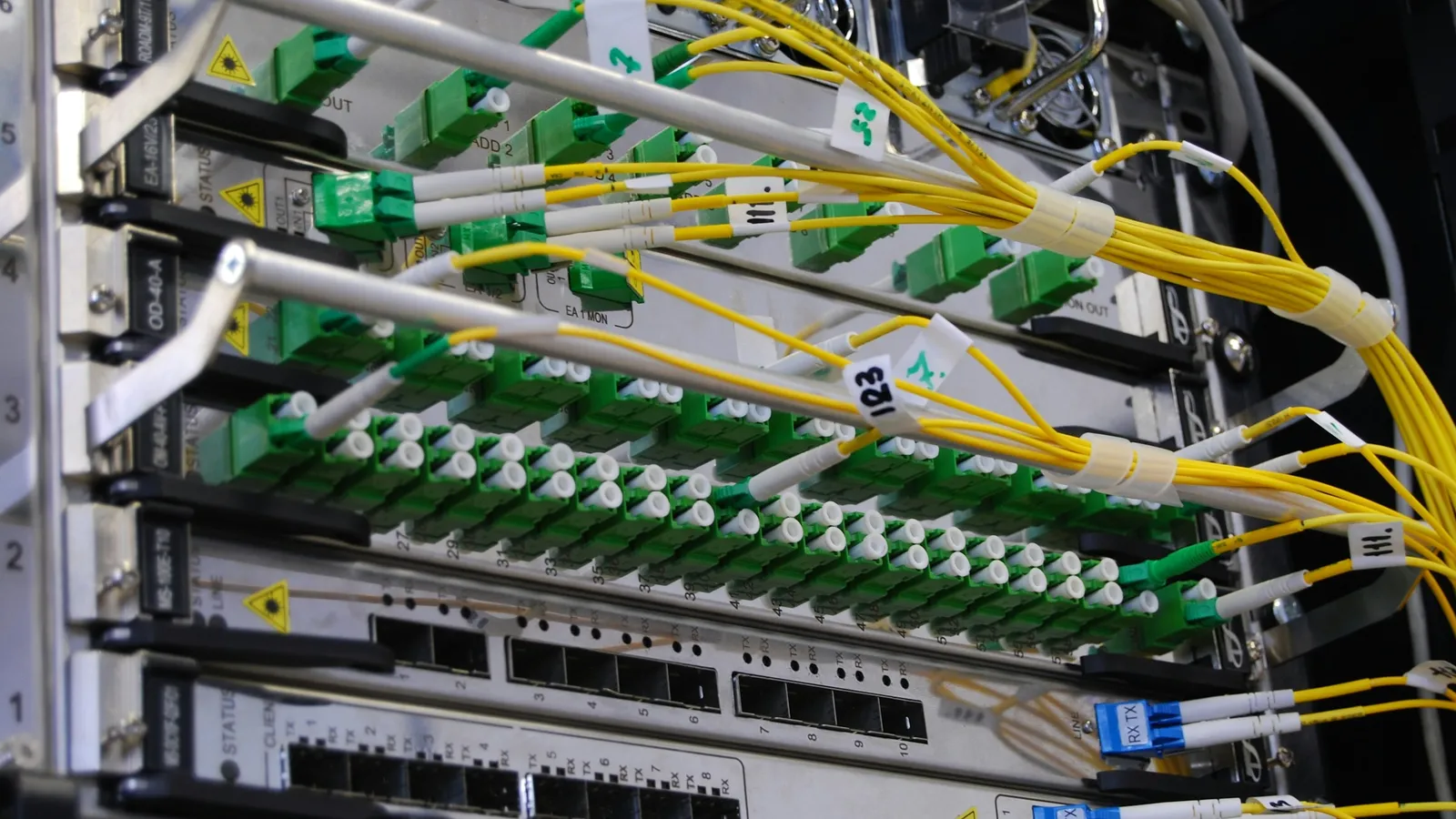
Optical fibre: carries light, not electric signals, through a thin glass core surrounded by less dense cladding. Light weight, higher bandwidth, long distances, and immune to electromagnetic noise. But it is expensive and unidirectional, so full duplex needs two cables. Used in backbone networks.
How do the three wireless media compare?
From NCERT Table 11.1:
Radio waves, 3 KHz to 1 GHz: omni-directional, travel in all directions, can be affected by interference; some ranges travel long distances or pass through walls. Used in AM and FM radio, television and cordless phones.
Microwaves, 1 GHz to 300 GHz: unidirectional, need line of sight, cannot pass through walls or hills. Used for point-to-point links such as radar and satellite.
Infrared, 300 GHz to 400 THz: cannot pass through walls; short-range links such as a TV remote.
The 2026-27 CBSE sample paper asks which medium gives long-distance communication without line of sight; the marking scheme answer is radio waves. In the same paper's campus question, linking a distant study centre in Delhi by a "reasonably high speed guided medium" gets the answer optical fibre.
Which mistakes cost marks?
Giving bandwidth in Mbps. NCERT measures bandwidth in Hz.
Forgetting the factor of 8 when a question mixes MB and Mbps.
Calling microwaves omni-directional. That is radio waves.
Saying fibre carries electric signals. It carries light.
Saying optical fibre works both ways on one strand. NCERT calls it unidirectional and says full duplex needs two cables.
A practice routine for this topic
Day 1: write the six media with one advantage, one limit and one use each.
Day 2: solve five data-rate problems, giving each answer in bps and in Kbps.
Day 3: answer the sample paper's network questions, then check against the marking scheme.
Day 4: explain to someone why fibre is chosen for a backbone.
If you keep choosing the wrong medium in the campus question, the Fermi Problem Library has a step-by-step solver that explains the reasoning rather than printing an answer.
Today, write the three wireless frequency ranges from memory and check them against NCERT Table 11.1.