

On this page
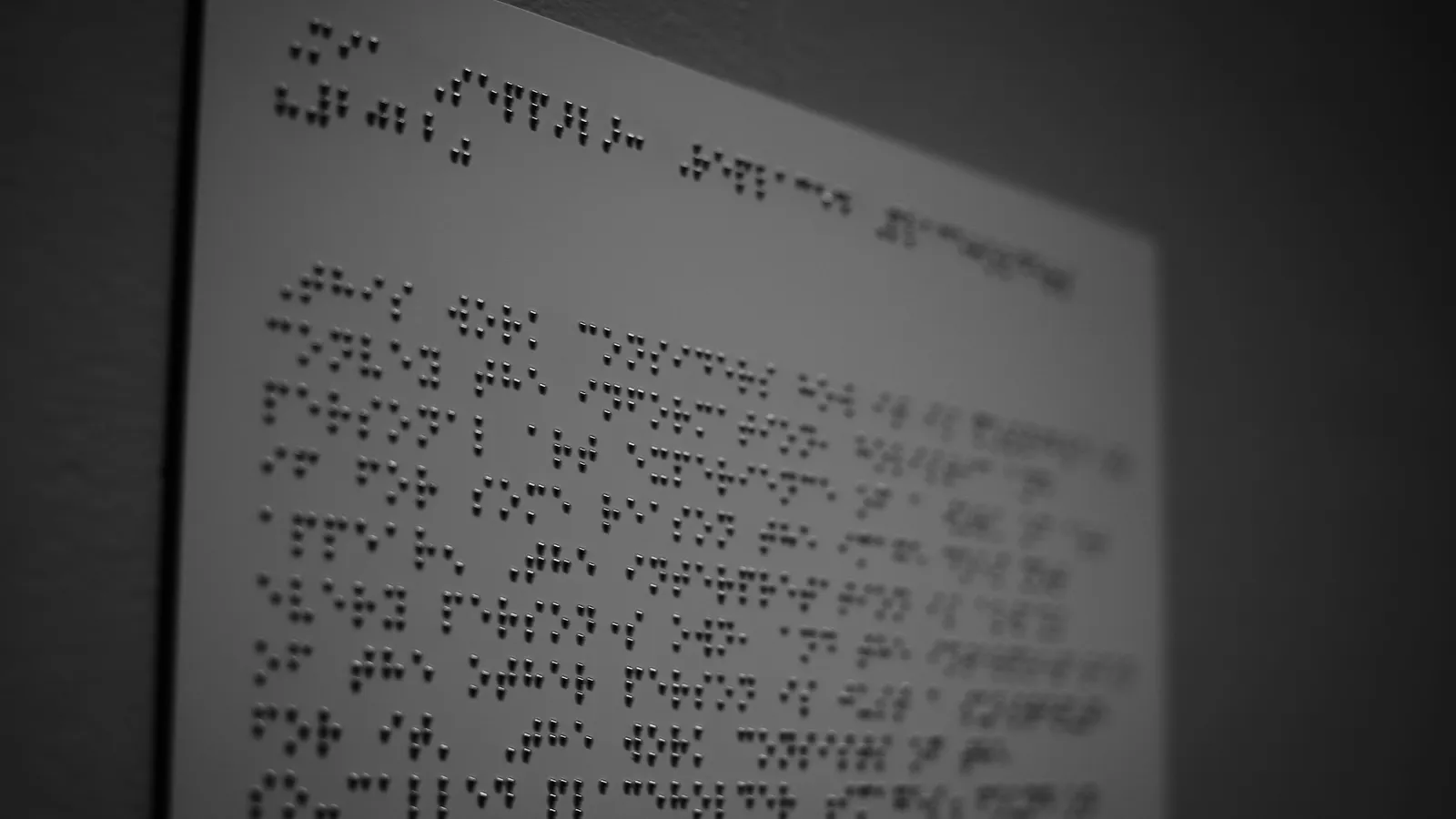
Braille is on lift buttons, medicine boxes and ballot papers, and World Braille Day falls on 4 January, the birthday of the person who invented it. Louis Braille did this as a teenager, in a school with almost no books he could read. This post covers his life, how he simplified an army code, the counting maths behind the six-dot cell, and what his way of working shows about solving hard problems.
Who was Louis Braille?
The Library of Congress records that he was born in Coupvray, near Paris, on 4 January 1809. At three, playing with a sharp tool in the workshop of his father, a harness maker, he injured one eye; an infection later left him totally blind. He studied at the National Institute for Blind Youth in Paris.
The American Foundation for the Blind explains the problem he faced: books for blind readers then used raised print, which was slow to make, hard to read by touch and hard to write.
Where did the idea of dots come from?
The AFB's Louis Braille online museum tells the story. In 1821 the Institute's new director, Dr Alexandre François-René Pignier, invited Charles Barbier, an artillery captain, to speak to the students. Barbier had devised a code of raised dots so soldiers could communicate at night without a sound. It used 12 dots to represent sounds and was called sonography, or "night writing".
Students found it complex, and it was based on the 36 sounds of French, so it could not handle spelling or punctuation. Between the ages of 13 and 16, Braille worked on a better version in his spare time, at weekends and on holidays at home in Coupvray. At 15 he showed Pignier a code based on a six-dot cell.
In 1829, the museum records, the Institute published his book explaining how the code wrote letters, words, punctuation, musical notes and arithmetic symbols. Acceptance was slow. A later director banned the code, and it was a public demonstration on 22 February 1844, when one pupil wrote down dictated poetry and another read it back, that helped win it support. He died on 6 January 1852, two days after his 43rd birthday, according to the same museum.
How does the six-dot cell work?
A braille cell has six dot positions in two columns of three, numbered 1 to 6. Each position is either raised or flat. One cell can stand for a letter, a number, a punctuation mark or a whole word. The United Nations describes braille as using six dots to represent letters and numbers, "and even musical, mathematical and scientific symbols".
Worked example: how many patterns can six dots make?
Choices per dot. Each of the 6 positions has 2 states: raised or flat.
Multiply. By the multiplication principle, the number of patterns is 2 × 2 × 2 × 2 × 2 × 2 = 2⁶ = 64.
Remove the blank. One of these has no raised dots, which works as a space. So 64 − 1 = 63 patterns have at least one dot. The AFB's "sixty-four combinations" counts the blank cell too.
Count by number of dots. Choosing k raised dots out of 6 gives C(6, k): 1 + 6 + 15 + 20 + 15 + 6 + 1 = 64. The most common group is 3 raised dots, with 20 patterns.
Compare with Barbier. A 12-dot cell gives 2¹² = 4,096 patterns. Barbier's problem was never a shortage of patterns: his code was complex and spelt sounds rather than letters.
Contracted braille saves even more space. The AFB gives the phrase "you like him": 12 cells letter by letter, but 6 cells with contractions, a saving of half.
What mistakes do students make with this kind of counting?
Adding instead of multiplying. Independent choices multiply: 2 × 2 × 2, not 2 + 2 + 2.
Forgetting the empty case. Decide whether "no dots" counts before you answer.
Mixing up permutations and combinations. Which dots are raised matters; the order you press them does not. Our post on permutations and combinations works through the difference.
When a counting problem has you unsure whether to multiply, add or divide, the Fermi Problem Library has a step-by-step solver that explains the reasoning rather than printing an answer.
What can you take from how Braille worked?
Improve, do not just copy. He kept Barbier's raised dots and fixed what was wrong with them.
Solve your own problem. He wanted more books to read, and built the tool that made them possible.
Work steadily. Three years of spare-time work, much of it in holidays, produced the code.
Build the whole system. His 1829 book covered music and maths, not just letters.
Practice routine: count the patterns for a 4-dot cell and an 8-dot cell, then list the C(6, k) values from memory and check they add to 64.
Next step: find a braille label near you, such as on a lift or a medicine box, and identify its dot positions using the 1 to 6 numbering.


