

On this page
Optical fibres carry data as pulses of light over long distances. In a simple step-index multimode fibre, light rays can take many different paths, or modes, through the core. Because these paths have different lengths, rays from the same pulse of light arrive at the other end at different times. This spreading out of the signal is called modal dispersion (Wikipedia).
If you are studying for exams, understanding this geometry is just as important as mastering prism problems: minimum deviation, thin prisms and dispersion.
What is the fastest path through the fibre?
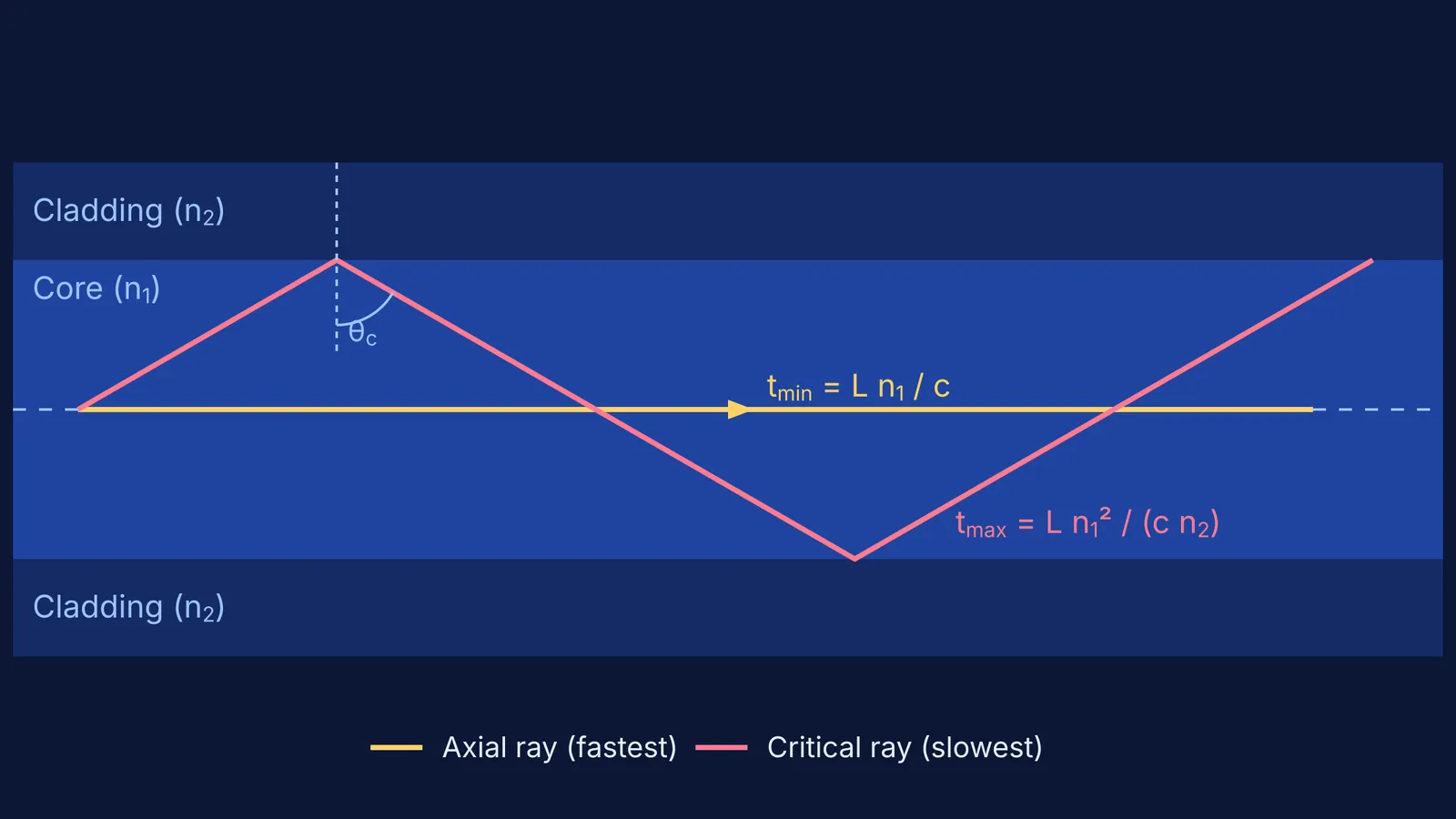
The shortest and fastest route is straight down the central axis of the fibre. This is known as the axial ray.
If the fibre has a length L, the distance the axial ray travels is simply L. The speed of light in the core is v = c / n₁, where c is the speed of light in a vacuum and n₁ is the refractive index of the core.
The minimum time taken by light is therefore:
t_min = L / v = L n₁ / c
How long is the zig-zag path at the critical angle?
Light that enters the fibre at an angle will bounce off the boundary between the core and the cladding (which has a lower refractive index, n₂). To stay trapped inside the core by total internal reflection, the light must strike the boundary at an angle greater than or equal to the critical angle, θ_c.
The ray that strikes the boundary at exactly the critical angle takes the most extreme zig-zag path, bouncing back and forth the most times. This meridional ray travels the longest physical distance.
Using geometry, the actual distance L' this ray travels is L / sin θ_c. From Snell's law, we know that sin θ_c = n₂ / n₁. Substituting this in gives the longest path length:
L' = L n₁ / n₂
The maximum time taken by light along this critical path is:
t_max = L' / v = (L n₁ / n₂) / (c / n₁) = L n₁² / (c n₂)
How do you calculate the time delay?
The difference in arrival time between the slowest ray (the critical ray) and the fastest ray (the axial ray) is the time delay, Δt. This delay dictates how much a pulse of light will spread out as it travels down the fibre.
Δt = t_max - t_min
Δt = (L n₁² / (c n₂)) - (L n₁ / c)
Δt = (L n₁ / (c n₂)) × (n₁ - n₂)
Often, the core and cladding have very similar refractive indices, meaning n₁ ≈ n₂. Engineers define a relative refractive index difference, Δ = (n₁ - n₂) / n₁. Using this, the time delay is commonly approximated as (Wikipedia):
Δt ≈ L n₁ Δ / c
Just as you might study the dispersion of white light by a glass prism, modal dispersion shows how paths through a medium change a signal's behaviour.
Solving optical fibre problems with Fermi
Problems on optical fibres often ask you to calculate the critical angle, the numerical aperture, or the time delay for a given length of fibre. It is easy to get tangled in the geometry of the zig-zag paths.
If you are stuck on a ray optics problem, you can type it into the Fermi Problem Library. Instead of just handing you the final formula, Fermi's AI tutor will guide you through setting up the geometry, helping you see how the critical angle relates to the distance travelled. If you are struggling to picture the different modes, you can explore the Fermi Concept Library to see exactly how total internal reflection traps the light.
A worked example
Problem: An optical fibre of length 1.0 km has a core refractive index of 1.50 and a cladding refractive index of 1.48. What is the time delay between the fastest and slowest rays?
Solution:
Identify the given values: L = 1000 m, n₁ = 1.50, n₂ = 1.48, c = 3 × 10⁸ m/s.
Calculate the minimum time (axial ray):
t_min = L n₁ / c = (1000 × 1.50) / (3 × 10⁸) = 5.00 × 10⁻⁶ s (or 5.00 μs)
Calculate the maximum time (critical ray):
t_max = L n₁² / (c n₂) = (1000 × 1.50²) / (3 × 10⁸ × 1.48) = 5.067 × 10⁻⁶ s (or 5.067 μs)
Find the time delay:
Δt = t_max - t_min = 5.067 μs - 5.000 μs = 0.067 μs (or 67 ns).
This 67 ns delay over just one kilometre shows why modern telecommunications use single-mode fibres (which have a core so narrow that only the axial ray can travel) to eliminate modal dispersion entirely, allowing electromagnetic waves to carry massive amounts of data without overlapping.


