On this page
Most Biomolecules questions that catch students out hinge on one line where NCERT bends its own rule. This post collects nine of those bends from Chapter 9 of NCERT's Class 11 Biology book (Reprint 2026-27), then tests them with 10 original questions. The NEET (UG) 2026 syllabus places this chapter in the Biology section's Unit 3 (Cell Structure and Function) as "chemical constituents of living cells". None of the questions is a prediction.
Which NCERT rules in Biomolecules have exceptions?
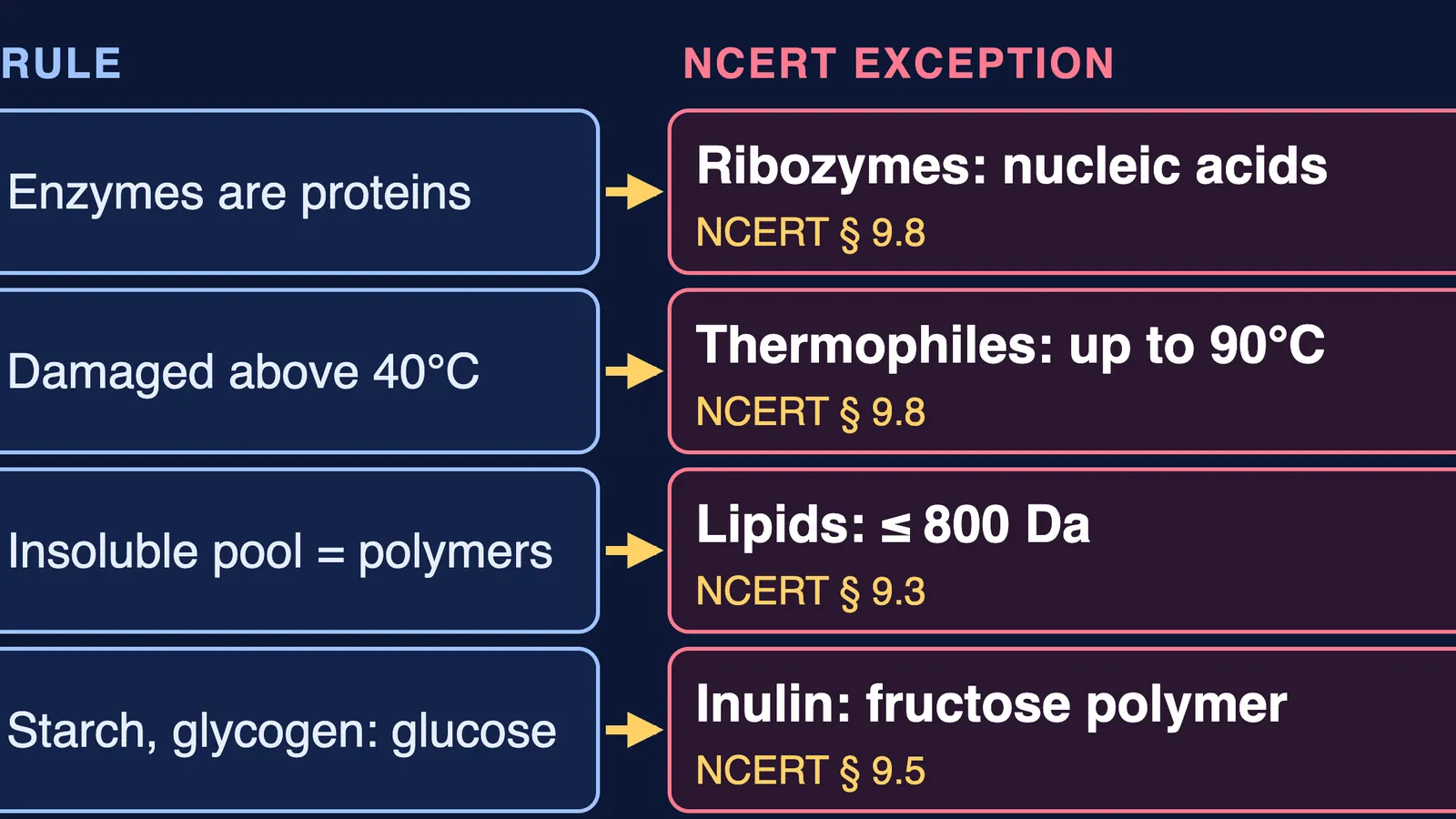
Each line gives the general rule, then the exception that the NCERT chapter itself names, with its section.
Rule: the acid-insoluble fraction holds polymers of ten thousand daltons and above. Exception: lipids, which do not exceed 800 Da, are not polymers, and land there only because broken membranes form insoluble vesicles (9.3).
Rule: enzymes are proteins. Exception: ribozymes, nucleic acids that behave like enzymes (9.8).
Rule: heat above about 40°C damages enzymes. Exception: enzymes of thermophilic organisms from hot vents and sulphur springs remain stable up to 80-90°C (9.8).
Rule: cellulose, starch and glycogen are all built of glucose. Exception: inulin is a polymer of fructose (9.5).
Rule: cellulose, starch, glycogen and inulin are each built from one plain monosaccharide. Exception: complex polysaccharides such as chitin, in arthropod exoskeletons, use amino-sugars and chemically modified sugars (9.5).
Rule: starch's helices hold iodine and turn blue. Exception: cellulose, also made only of glucose, lacks complex helices and cannot hold iodine (9.5).
Rule: prosthetic groups and co-enzymes are organic compounds. Exception: the third kind of cofactor, metal ions, such as zinc for carboxypeptidase (9.8.6).
Rule: co-enzymes join the apoenzyme only for a short time. Exception: prosthetic groups are tightly bound, as haem is in peroxidase and catalase (9.8.6).
Rule: under normal aerobic conditions, glucose ends as pyruvic acid. Exception: skeletal muscle without oxygen forms lactic acid, and yeast fermentation gives ethanol (9.8.1).
How do you handle odd-one-out and exception questions?
Before you look for the odd item, name the property the stem is testing: monomer, chemical nature, size or location.
For each option, ask "does it share that property?" and mark yes or no. The single "no" is your answer.
If two options could be odd for different reasons, reread the stem for the basis it states.
In "which is NOT an exception" items, an option is wrong as soon as NCERT states the rule with no exception, or states its opposite.
Odd-one-out questions on Biomolecules
All answers are traced to the NCERT chapter.
Q1. Odd one out by the monosaccharide it is built from: (1) Glycogen (2) Inulin (3) Starch (4) Cellulose
Answer: (2). Section 9.5: inulin is a fructose polymer; the other three are glucose-based.
Q2. Odd one out by whether NCERT's table of secondary metabolites lists it under "polymeric substances": (1) Rubber (2) Glycogen (3) Gums (4) Cellulose
Answer: (2). Table 9.3 (section 9.2) lists rubber, gums and cellulose there; glycogen, the animal variant of starch, is not in the table.
Q3. Odd one out by the type of macromolecule: (1) Trypsin (2) Carboxypeptidase (3) Catalase (4) Ribozyme
Answer: (4). Section 9.8: ribozymes are nucleic acids; the others are protein enzymes.
Which is NOT an exception?
Q4. Which rule-and-exception pairing does NCERT NOT support?
(1) Almost all enzymes are proteins / ribozymes (2) Complex polysaccharides are mostly homopolymers / chitin, a heteropolymer (3) Enzymes are damaged above about 40°C / enzymes from hot-vent and sulphur-spring organisms (4) Aerobic conditions give pyruvic acid / lactic acid in skeletal muscle without oxygen
Answer: (2). Section 9.5 gives chitin as an example of those complex polysaccharides and names no heteropolymer among them.
Q5. Which is NOT what NCERT says about enzyme cofactors?
(1) Prosthetic groups are organic and tightly bound to the apoenzyme (2) Co-enzymes join the apoenzyme only briefly, usually during catalysis (3) A metal-ion cofactor bonds only to the substrate, never to the enzyme (4) Zinc is a cofactor for carboxypeptidase
Answer: (3). Section 9.8.6: metal ions bond to side chains at the active site as well as to the substrate.
Two-statement questions
Options for Q6 to Q8: (1) Both correct (2) Both incorrect (3) Only I correct (4) Only II correct
Q6. Statement I: NCERT says we do not yet understand the role of every secondary metabolite in its host organism. Statement II: NCERT's Table 9.3 lists vinblastin and curcumin as pigments.
Answer: (3). Section 9.2: the table lists them as drugs; its pigments are carotenoids and anthocyanins.
Q7. Statement I: Compounds of the acid-soluble pool weigh from 18 to about 800 Da. Statement II: Biomolecules below one thousand daltons are usually called micromolecules.
Answer: (1). Section 9.3 states both.
Q8. Statement I: NCERT says every enzyme is a protein. Statement II: A single co-enzyme can serve as cofactor in a number of different enzyme-catalysed reactions.
Answer: (4). Section 9.8 says almost all enzymes are proteins, since ribozymes are nucleic acids; 9.8.6 states II.
Single-answer questions
Q9. Which vitamin does NCERT name as a component of the co-enzymes NAD and NADP?
(1) Riboflavin (2) Thiamine (3) Niacin (4) Vitamin C
Answer: (3). Section 9.8.6.
Q10. In which pair of enzymes does NCERT name haem as the prosthetic group?
(1) Carboxypeptidase and trypsin (2) Peroxidase and catalase (3) Peroxidase and carboxypeptidase (4) Catalase and RuBisCO
Answer: (2). Section 9.8.6: in both, haem is part of the active site.
For matching and two-statement practice on the same chapter, work through our statement and match-the-list questions on Biomolecules. For how temperature and pH shape enzyme activity, see the enzyme activity graph, explained. Starting the chapter from scratch? Begin with our NCERT-first plan for Biomolecules.
Not sure which of these exceptions you already know cold? Fermi's AI tutor works out what you already know and builds a plan for the session.