

On this page
Biomolecules falls under Unit 3 of Biology (Cell Structure and Function) in the NMC's NEET (UG)-2026 syllabus. We wrote all 14 questions below ourselves; none is a prediction. Every key traces back to NCERT Class 11 Biology Chapter 9 (Reprint 2026-27). Haven't read the chapter yet? Our NCERT-first plan for Biomolecules comes first.
How do you answer two-statement questions on Biomolecules?
Write T or F beside each statement, using NCERT, before reading the options. The options are just the four T/F pairs, so the answer follows from your two letters.
Options for Q1 to Q5: (1) Both true (2) Both false (3) Only I true (4) Only II true
Q1. Statement I: Carbon is 18.5% of the human body by weight but only 0.03% of the earth's crust. Statement II: Silicon, 27.7% of the earth's crust by weight, is also a major element of the human body.
Answer: (3). NCERT Table 9.1 gives these carbon figures but lists silicon in the body as negligible.
Q2. Statement I: Glutamic acid is an acidic amino acid and lysine is a basic one. Statement II: Tyrosine, phenylalanine and tryptophan are aromatic amino acids.
Answer: (1). NCERT section 9.1 gives exactly these examples.
Q3. Statement I: A fatty acid carrying at least one C=C double bond is called saturated. Statement II: A fatty acid's R group can hold 1 to 19 carbons.
Answer: (4). Double bonds make a fatty acid unsaturated; NCERT gives the R group 1 to 19 carbons.
Q4. Statement I: The sugar in DNA is ribose. Statement II: Lipids, polysaccharides and polypeptides together form the true macromolecular fraction of a cell.
Answer: (2). DNA has 2' deoxyribose, and NCERT's true macromolecular fraction has nucleic acids, not lipids.
Q5. Statement I: Enzymes from organisms living in hot vents and sulphur springs keep their catalytic power up to 80-90°C. Statement II: Unlike enzymes, inorganic catalysts lose efficiency at high temperature and pressure.
Answer: (3). NCERT: inorganic catalysts work well at high temperature and pressure.
What is the quickest route through a Biomolecules List-I/List-II match?
Read List-II first, since its entries are the clues. Pencil a List-I letter beside each, then compare your guesses with the coded options. If none matches, rethink your shakiest clue.
Q6. Match each secondary metabolite class with an example.
List-I: A. Alkaloids; B. Toxins; C. Lectins; D. Pigments.
List-II: I. Concanavalin A; II. Anthocyanins; III. Codeine; IV. Abrin.
(1) A-IV, B-III, C-I, D-II (2) A-III, B-IV, C-I, D-II (3) A-III, B-IV, C-II, D-I (4) A-II, B-I, C-IV, D-III
Answer: (2). All four pairs are in NCERT Table 9.3.
Q7. Match each protein with its function.
List-I: A. Trypsin; B. Insulin; C. GLUT-4; D. Receptor.
List-II: I. Hormone; II. Sensory reception (smell, taste); III. Lets glucose into cells; IV. Enzyme.
(1) A-IV, B-III, C-I, D-II (2) A-I, B-IV, C-III, D-II (3) A-IV, B-I, C-II, D-III (4) A-IV, B-I, C-III, D-II
Answer: (4). NCERT Table 9.5 lists each of these functions.
Q8. Match each enzyme class with a reaction.
List-I: A. Oxidoreductase; B. Hydrolase; C. Isomerase; D. Ligase.
List-II: I. Splits a glycosidic bond using water; II. Joins two compounds through a C-S bond; III. S reduced + S' oxidised gives S oxidised + S' reduced; IV. Interconverts positional isomers.
(1) A-III, B-I, C-IV, D-II (2) A-III, B-II, C-IV, D-I (3) A-I, B-III, C-II, D-IV (4) A-IV, B-I, C-III, D-II
Answer: (1). NCERT section 9.8.5 defines each class this way.
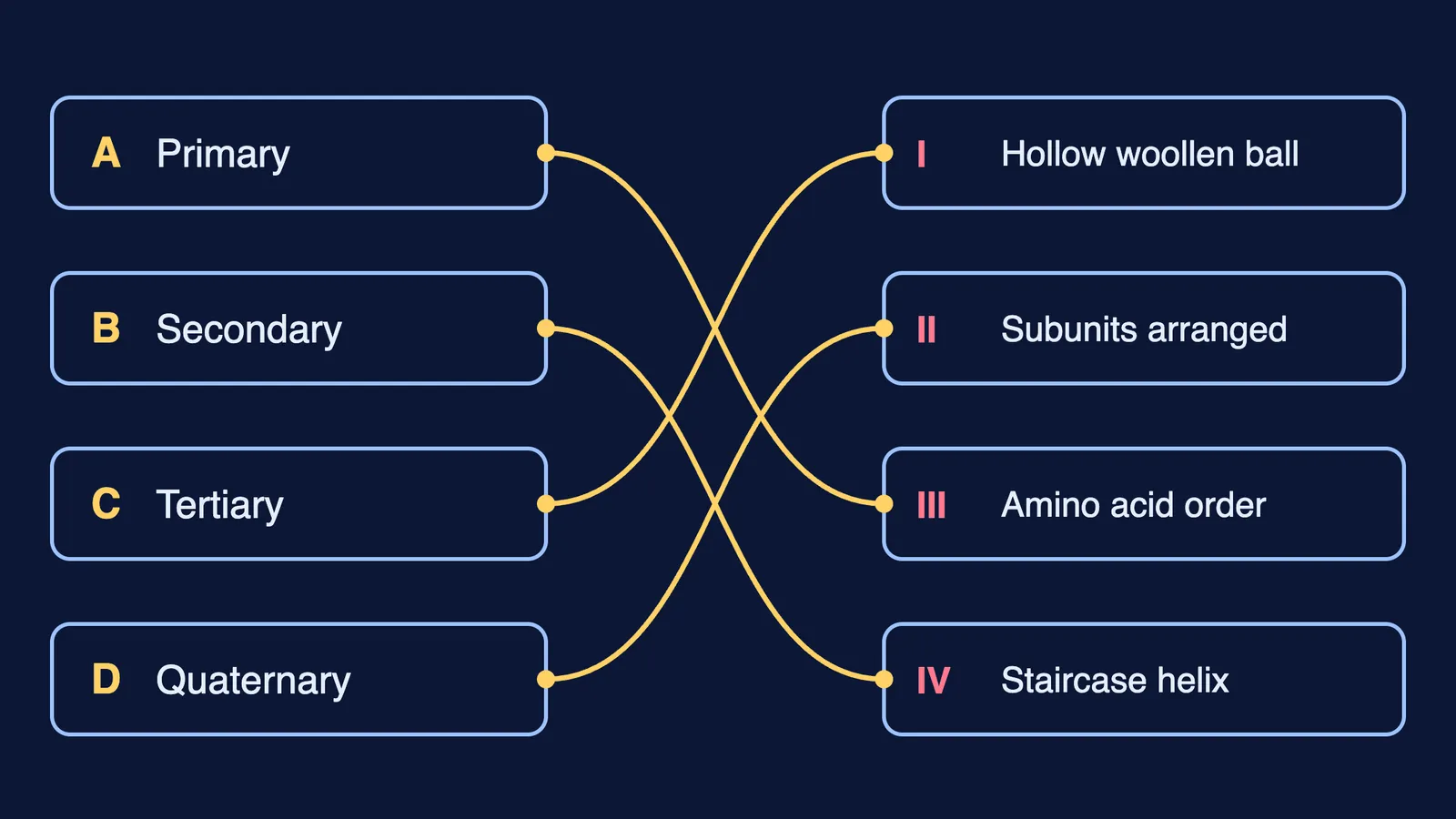
Q9. Match each protein structure level to how NCERT describes it.
List-I: A. Primary; B. Secondary; C. Tertiary; D. Quaternary.
List-II: I. The chain folded on itself like a hollow woollen ball; II. How separate folded subunits sit relative to each other; III. The order of amino acids, first to last; IV. Parts of the thread coiled like a revolving staircase.
(1) A-III, B-I, C-IV, D-II (2) A-IV, B-III, C-I, D-II (3) A-III, B-IV, C-I, D-II (4) A-III, B-IV, C-II, D-I
Answer: (3). Section 9.7 uses these images for the four levels.
Q10. Match each compound with its type.
List-I: A. Uracil; B. Adenine; C. Thymidine; D. Uridylic acid.
List-II: I. Nucleotide; II. Nucleoside; III. Substituted purine; IV. Substituted pyrimidine.
(1) A-III, B-IV, C-II, D-I (2) A-IV, B-III, C-II, D-I (3) A-IV, B-III, C-I, D-II (4) A-II, B-III, C-IV, D-I
Answer: (2). Adenine is a purine, uracil a pyrimidine; thymidine is a nucleoside, uridylic acid a nucleotide.
Which MCQs check lipids, glycogen and enzyme action?
Name the answer first, then pick the option worded as NCERT words it.
Q11. Which statement about lipids matches NCERT?
(1) Lipids are generally water soluble (2) Phospholipids carry phosphorus and a phosphorylated organic compound (3) Fats and oils differ by molecular weight (4) Neural tissues hold the simplest lipids
Answer: (2). Lipids are water insoluble, melting point splits fats from oils, and neural lipids are complex.
Q12. Order NCERT's catalytic cycle. P: the enzyme changes shape to fit more tightly. Q: products are released. R: the substrate settles into the active site. S: bonds break and an enzyme-product complex forms.
(1) R, S, P, Q (2) P, R, S, Q (3) R, P, S, Q (4) R, P, Q, S
Answer: (3). Binding induces the shape change; EP forms before release.
Q13. In NCERT's cartoon of a glycogen chain, the right end is called the
(1) non-reducing end (2) reducing end (3) branch point (4) active site
Answer: (2). Section 9.5 calls the right end reducing and the left end non-reducing.
Q14. On a potential-energy graph, product P sits below substrate S. NCERT calls this reaction
(1) endothermic, so it must be heated (2) uncatalysed by definition (3) a physical change (4) exothermic, so no heating is needed to form the product
Answer: (4). Section 9.8.2: with P below S, no heat input is needed.
Which Chapter 9 sections should you reread?
Missed Q1, Q2, Q3 or Q11: reread section 9.1 and Table 9.1.
Missed Q6, Q7 or Q10: redraw Tables 9.3, 9.5 and Figure 9.1.
Missed Q5, Q8, Q12 or Q14: work through section 9.8 again.
Next, try our Biomolecules assertion-reason questions for NEET, or the graded Biomolecules NEET practice questions with solutions.
Still sorting purines from pyrimidines? Fermi's AI tutor works out what you already know and builds a plan for the session.


