On this page
Six assertion-reason items and four Statement I / Statement II pairs on Biomolecules follow, each block running from easy to hard. Every statement was checked against Chapter 9 of NCERT Class 11 Biology (reprint 2026-27). The NMC NEET (UG)-2026 syllabus lists this chapter in Biology Unit 3: proteins, carbohydrates, lipids, nucleic acids and enzymes.
How do you answer assertion-reason questions on Biomolecules?
Use these keys throughout.
Assertion-reason:
(A) Both A and R are true and R is the correct explanation of A.
(B) Both A and R are true but R is NOT the correct explanation of A.
(C) A is true but R is false.
(D) A is false but R is true.
Statement pairs:
(A) Both statements are correct.
(B) Both statements are incorrect.
(C) Statement I is correct, Statement II is incorrect.
(D) Statement I is incorrect, Statement II is correct.
Judge A alone, then R alone, and only if both are true ask, "Is R the reason NCERT gives for A?" Many false lines here swap look-alike terms, such as ligase and isomerase, so underline the term first.
New to the chapter? Start with our NCERT-first plan to prepare Biomolecules for NEET. For single-answer practice, try the Biomolecules NEET practice questions with solutions.
Assertion-reason questions on Biomolecules
Q1 (easy). Assertion (A): A protein is a heteropolymer, not a homopolymer. Reason (R): Proteins are built from more than one type of amino acid, out of 20 types.
Answer: (A). Both are true, and NCERT section 9.4 gives the 20 types of amino acids as the reason a protein is a heteropolymer. Trap: picking (B) because the reason looks like a restated definition.
Q2 (easy). Assertion (A): Lipids separate into the acid-insoluble fraction when a tissue is ground in trichloroacetic acid. Reason (R): Lipids have molecular weights of ten thousand daltons and above.
Answer: (C). A is true. R is false: NCERT says lipid molecular weights do not exceed 800 Da. Lipids land in the insoluble fraction because ground membranes break into vesicles that are not water soluble. Trap: assuming everything in the macromolecular fraction is a large polymer.
Q3 (medium). Assertion (A): Collagen is the most abundant protein in the whole of the biosphere. Reason (R): Collagen functions as intercellular ground substance.
Answer: (D). A is false: NCERT names RuBisCO as the most abundant protein in the biosphere, and collagen as the most abundant in the animal world. R is true, from Table 9.5. Trap: mixing up "animal world" and "biosphere".
Q4 (medium). Assertion (A): Malonate inhibits succinic dehydrogenase. Reason (R): Competitive inhibitors are often used in the control of bacterial pathogens.
Answer: (B). Both are true, but R does not explain A. Malonate inhibits the enzyme because it closely resembles the substrate, succinate, and competes for the substrate-binding site. Trap: accepting R because it is a true line from the same paragraph.
Q5 (medium). Assertion (A): Low temperature destroys enzyme activity permanently. Reason (R): Each enzyme shows its highest activity at a particular optimum temperature.
Answer: (D). A is false: NCERT says low temperature preserves an enzyme in a temporarily inactive state, while high temperature destroys activity by denaturing the protein. R is true. Trap: treating cold and heat as mirror images.
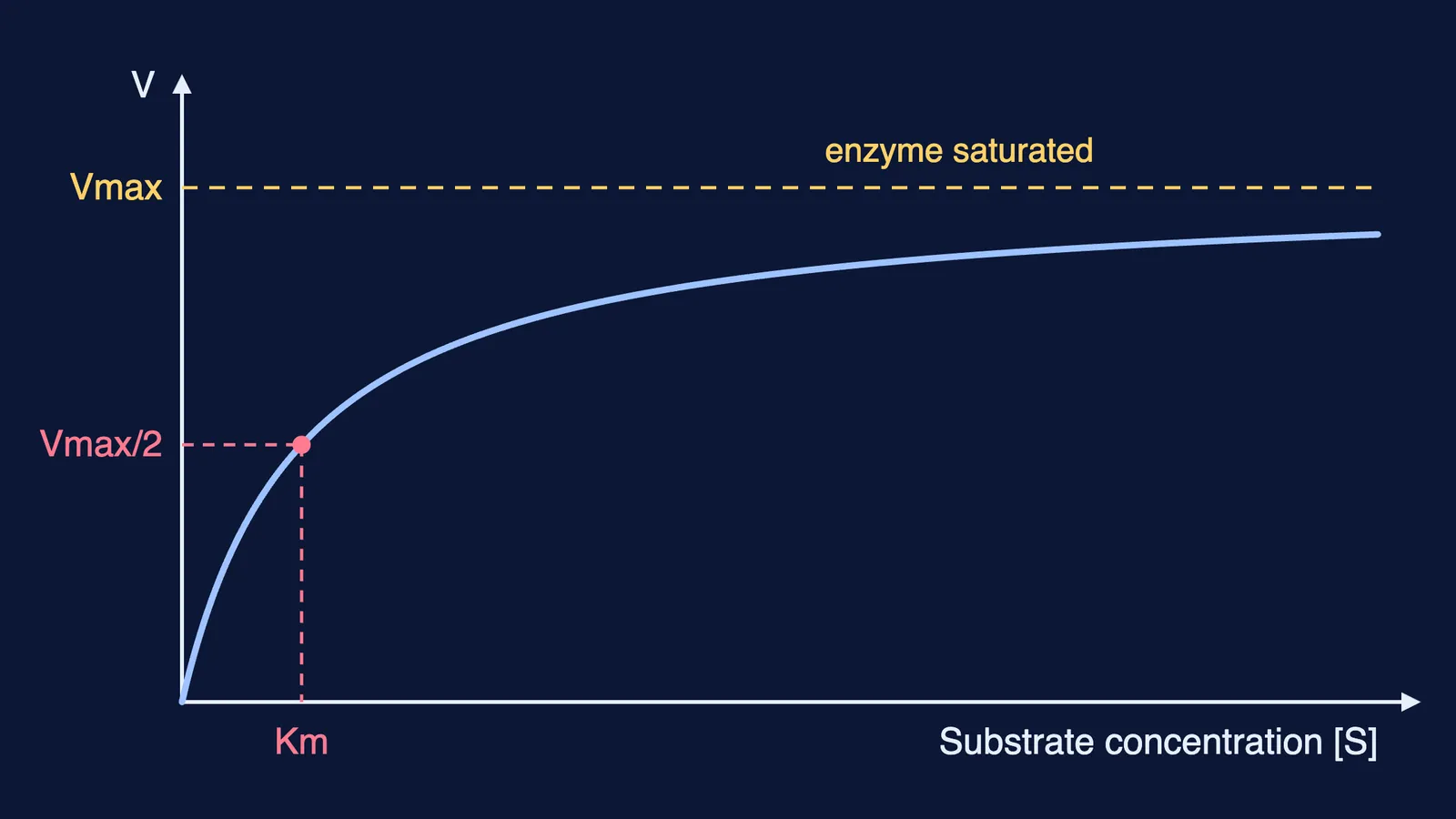
Q6 (hard). Assertion (A): Once an enzyme reaction reaches Vmax, adding more substrate does not raise its velocity. Reason (R): Enzyme molecules are outnumbered by substrate molecules, so once every enzyme molecule is occupied, none is free to take up the added substrate.
Answer: (A). Both are true, and R is the exact reason NCERT section 9.8.4 gives for the plateau in the velocity curve. Trap: thinking the reaction has run out of substrate, when substrate is in excess.
Statement I and Statement II questions on Biomolecules
Q7 (medium). Statement I: In catalase, haem is a prosthetic group, an organic cofactor tightly bound to the apoenzyme. Statement II: Zinc acts as a co-enzyme for carboxypeptidase.
Answer: (C). Statement I matches NCERT. Statement II is wrong: zinc is a metal-ion cofactor, and co-enzymes are organic compounds. Trap: reading "co-enzyme" as any helper of an enzyme.
Q8 (medium). Statement I: In yeast fermentation, the glucose-to-pyruvic acid pathway leads to lactic acid. Statement II: Glucose becomes pyruvic acid through ten different enzyme-catalysed reactions.
Answer: (D). Statement I is wrong: NCERT gives ethanol in yeast and lactic acid in skeletal muscle under anaerobic conditions. Statement II is correct. Trap: knowing both products but pinning each to the wrong organism.
Q9 (hard). Statement I: Isomerases catalyse the linking together of two compounds, such as joining C-O or C-N bonds. Statement II: Each enzyme is named by a three-digit number.
Answer: (B). Both are incorrect. Linking two compounds is the work of ligases; isomerases interconvert optical, geometric or positional isomers. NCERT names each enzyme by a four-digit number. Trap: Statement II sounds like a detail too small to be wrong.
Q10 (hard). Statement I: Without an enzyme, about 200 molecules of carbonic acid form per hour; with carbonic anhydrase, about 600,000 form per second, a rise of roughly ten million times. Statement II: Whether a reaction is exothermic or endothermic, the substrate must pass through a higher-energy transition state.
Answer: (A). Both match NCERT sections 9.8.1 and 9.8.2. In one unit, 600,000 per second is 2.16 billion per hour, and dividing by 200 gives about 10.8 million (checked in Python). Trap: dividing 600,000 by 200 without converting hours to seconds gives 3,000 and makes Statement I look false.
How should you use this set?
Do all ten in 12 minutes without notes, writing T or F above each line before choosing a key.
Score yourself, then sort every miss: a wrong fact (fix it in NCERT) or a wrong link (run the swap test).
Redo the misses two days later, and write a new false version of each by swapping one term for its look-alike.
If a miss comes from a concept gap, such as why an enzyme saturates, the Fermi Concept Library has every concept in biology with its own lesson. For more on the format itself, read our assertion-reason strategy.