On this page
These 8 rule-and-exception pairs and 12 original questions are built on NCERT Class 11 Biology, Chapter 4, Animal Kingdom (Reprint 2026-27). The NEET (UG) 2026 syllabus lists this chapter under Unit 1 of Biology, Diversity in Living World. No question is taken from a past paper, and none is a prediction.
What are the NCERT exceptions in Animal Kingdom?
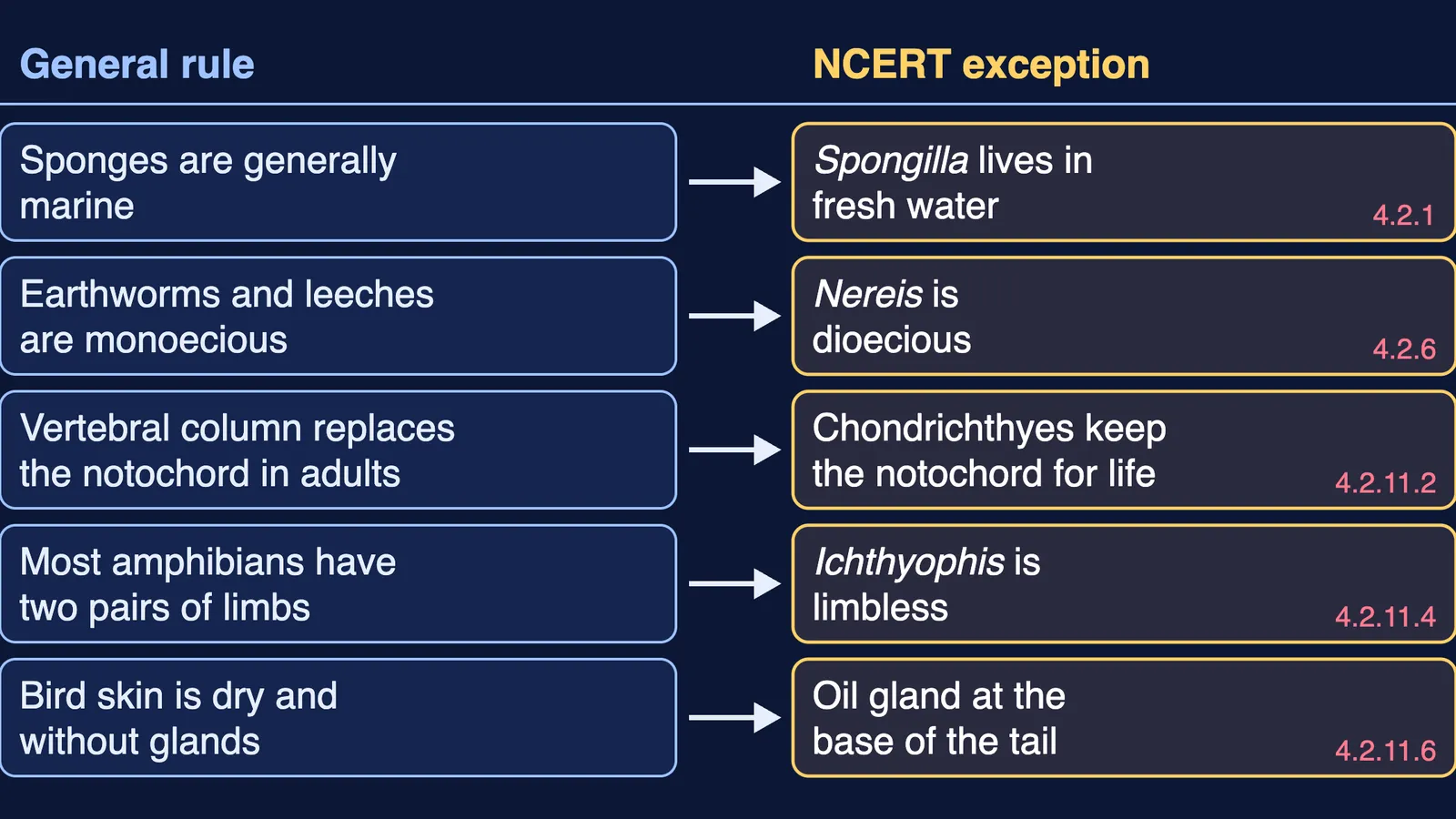
Each line gives a pattern the chapter states or implies, then the animal or group that NCERT itself names as breaking it, with the section number.
Sponges are generally marine; *Spongilla*, the fresh water sponge, is not (4.2.1).
Among NCERT's annelids, earthworms and leeches are monoecious; the aquatic *Nereis* is dioecious (4.2.6).
Non-chordates form no notochord; hemichordates carry a stomochord, a notochord-like structure in the collar, and were once ranked under Chordata (4.1.6, 4.2.10).
In vertebrates, a vertebral column replaces the embryonic notochord in the adult; in Chondrichthyes the notochord persists throughout life (4.2.11, 4.2.11.2).
Vertebrates have paired appendages, as fins or limbs; cyclostomes have no paired fins (4.2.11, 4.2.11.1).
Most amphibians have two pairs of limbs; *Ichthyophis* is the limbless amphibian (4.2.11.4).
Most birds can fly; flightless birds such as the ostrich cannot (4.2.11.6).
Bird skin is dry and has no glands, apart from the oil gland at the tail base (4.2.11.6).
How do you handle odd-one-out and exception questions?
Name what the options share before hunting for the outsider. Put the shared feature in three words.
Test every option against that feature, then against two more: which group it belongs to, and where it lives. If two options fail different tests, re-read the stem for the basis it names.
In "NOT an exception" items, the answer is the ordinary member doing the ordinary thing. For each option, ask whether NCERT marks it with "except", "but" or "only".
Odd-one-out questions
How to attack this format: where the stem names a basis, judge by that basis alone; where it does not, the shared feature is usually the group's headline rule.
Q1. Odd one out: (1) *Corvus* (2) *Struthio* (3) *Columba* (4) *Psittacula*
Answer: (2). The crow, pigeon and parrot fly; NCERT names the ostrich as a flightless bird.
Q2. Odd one out: (1) *Bufo* (2) *Rana* (3) *Hyla* (4) *Ichthyophis*
Answer: (4). The toad, frog and tree frog have two pairs of limbs; NCERT lists *Ichthyophis* as the limbless amphibian.
Q3. Judged only on habitat, which is the odd one out? (1) *Spongilla* (2) *Pleurobrachia* (3) *Asterias* (4) *Ctenoplana*
Answer: (1). Ctenophores are exclusively marine and all echinoderms are marine; *Spongilla* is the fresh water sponge.
Q4. Judged only on whether the sexes are separate, which is the odd one out? (1) *Pheretima* (2) *Hirudinaria* (3) *Nereis* (4) *Sycon*
Answer: (3). Sponges, earthworms and leeches are hermaphrodite; *Nereis* is dioecious.
Which is NOT an exception?
How to attack this format: three options are flagged departures from a group rule; pick the one that simply obeys its group.
Q5. Which of these is NOT an exception NCERT names? (1) *Petromyzon* having no paired fins (2) *Struthio* being unable to fly (3) *Ascaris* having separate sexes (4) *Scoliodon* keeping its notochord for life
Answer: (3). NCERT gives all roundworms separate sexes, so *Ascaris* follows its phylum.
Q6. Which of these is NOT an exception? (1) *Ichthyophis* lacking limbs (2) *Rana* having a three-chambered heart (3) Bird skin bearing an oil gland (4) *Spongilla* living in fresh water
Answer: (2). NCERT gives the amphibian heart three chambers, with no exception named.
Two-statement questions
How to attack this format: judge each statement on its own, and check the hedge word. "All" or "always" in place of NCERT's "mostly" or "usually" makes a statement wrong.
Options for Q7 to Q10: (1) I and II are both right (2) both are wrong (3) only I is right (4) only II is right.
Q7. Statement I: Cnidarians are aquatic and mostly marine. Statement II: Every flatworm bears hooks and suckers.
Answer: (3). NCERT gives hooks and suckers to the parasitic forms only.
Q8. Statement I: Molluscs are usually dioecious. Statement II: Reptiles are mostly terrestrial.
Answer: (1). Both match NCERT's wording.
Q9. Statement I: Arthropods are mostly monoecious. Statement II: In bony fishes, the mouth is mostly terminal.
Answer: (4). NCERT calls arthropods mostly dioecious.
Q10. Statement I: Sponges are always asymmetrical. Statement II: Bony fishes are all oviparous.
Answer: (2). NCERT says sponges are mostly asymmetrical and bony fishes mostly oviparous.
Single-correct questions
How to attack this format: find the general rule hidden in the stem, then look for the option NCERT treats differently.
Q11. For which class does NCERT say that many members are viviparous? (1) Chondrichthyes (2) Amphibia (3) Aves (4) Reptilia
Answer: (1). NCERT calls amphibians, birds and reptiles oviparous; many cartilaginous fishes are viviparous.
Q12. How does NCERT describe fertilisation in arthropods? (1) Always internal (2) Usually internal (3) Always external (4) Usually external
Answer: (2). The word is "usually", so an "always" option is a trap.
What should you do after this set?
Cover the answers and redo all twelve, writing the shared feature beside each odd-one-out item.
For every miss, write the rule and its exception as one line, in the style of the list above.
Then switch formats: try the statement and match-the-list set on Animal Kingdom, the diagram-based Animal Kingdom questions and the Animal Kingdom assertion-reason questions.
Which exception keeps slipping away? Fermi's AI tutor works out what you already know and builds a plan for the session.