

On this page
These 12 original questions follow the Animal Kingdom chapter of NCERT Class 11 Biology, 2026-27 reprint, part of Unit 1, Diversity in Living World, in the NMC's NEET (UG)-2026 syllabus. The NEET (UG)-2026 bulletin gives Biology 90 of 180 questions, at +4 and −1. New to the chapter? Use our six-question method for placing any phylum.
How do you solve Statement I and II questions on Animal Kingdom?
Options for Q1 to Q3: (1) Both correct. (2) Both incorrect. (3) I correct, II incorrect. (4) I incorrect, II correct.
Q1 (easy). Statement I: Platyhelminthes show tissue level organisation. Statement II: Their gut has one opening serving as mouth and anus.
Answer: (4). Flatworms show organ level; tissue level is coelenterates. Their incomplete gut has one opening.
Q2 (medium). Statement I: Hemichordates have a stomochord in the collar region. Statement II: Hemichordates have closed circulation.
Answer: (3). NCERT gives hemichordates open circulation.
Q3 (hard). Statement I: Mammals are poikilothermous. Statement II: Bird skin is rich in glands.
Answer: (2). Mammals are homoiothermous. Bird skin is dry, glandless except the oil gland at the tail base.
How do you handle "which statements are correct" questions?
Mark each line T or F first. One certain F often removes two options.
Q4 (easy). Which are correct about Aschelminthes? A. The body is circular in cross-section. B. The alimentary canal is complete. C. They are monoecious. D. Fertilisation is internal. E. Development is always indirect.
(1) A, B and D only (2) A, B, C and D only (3) B, D and E only (4) A, C and E only
Answer: (1). Roundworms are dioecious, and development may be direct or indirect.
Q5 (medium). Which are correct? A. The chordate nerve cord is dorsal, hollow and single. B. The non-chordate heart is ventral. C. Chordates have a post-anal tail. D. The non-chordate nerve cord is ventral, solid and double. E. The chordate heart is dorsal.
(1) A, B and C only (2) A, C and D only (3) B, D and E only (4) A, C, D and E only
Answer: (2). NCERT's Table 4.1 is the reverse: chordate heart ventral, non-chordate heart (if present) dorsal.
Q6 (hard). Which are correct about Vertebrata? A. Every chordate is a vertebrate. B. Vertebrates have a ventral muscular heart. C. Vertebrates have a notochord in the embryo. D. Gnathostomata splits into the super classes Pisces and Tetrapoda. E. Chondrichthyes belongs to Agnatha.
(1) A, B and C only (2) B, D and E only (3) B, C and D only (4) A, B, C and D only
Answer: (3). Protochordates are not vertebrates. Chondrichthyes has jaws, so it is a gnathostome.
How do you crack match-the-list questions on this chapter?
Read the coded rows, fix your surest pair, then test only the pair that splits the rest (full method).
Q7 (easy). List-I: A. *Laccifer* B. *Pinctada* C. *Saccoglossus* D. *Limulus*. List-II: I. King crab, a living fossil II. Hemichordate III. Lac insect IV. Pearl oyster.
(1) A-III, B-IV, C-II, D-I (2) A-III, B-II, C-IV, D-I (3) A-I, B-IV, C-II, D-III (4) A-IV, B-III, C-I, D-II
Answer: (1). All four are NCERT examples.
Q8 (medium). List-I: A. No excretory system B. Proboscis gland C. Excretory pore D. Kidneys. List-II: I. Aschelminthes II. Vertebrata III. Echinodermata IV. Hemichordata.
(1) A-III, B-I, C-IV, D-II (2) A-II, B-IV, C-I, D-III (3) A-III, B-IV, C-I, D-II (4) A-IV, B-III, C-II, D-I
Answer: (3). Echinoderms have no excretory system; the proboscis gland rules out (1).
Q9 (medium). List-I: A. Cyclostomata B. Chondrichthyes C. Amphibia D. Aves. List-II: I. Males bear claspers on pelvic fins II. 6-15 pairs of gill slits; no scales or paired fins III. Crop and gizzard in the gut IV. Breathing by gills, lungs and skin.
(1) A-I, B-II, C-IV, D-III (2) A-II, B-I, C-IV, D-III (3) A-II, B-I, C-III, D-IV (4) A-II, B-IV, C-I, D-III
Answer: (2). Claspers settle B, leaving (2) and (3); the gut chambers settle D.
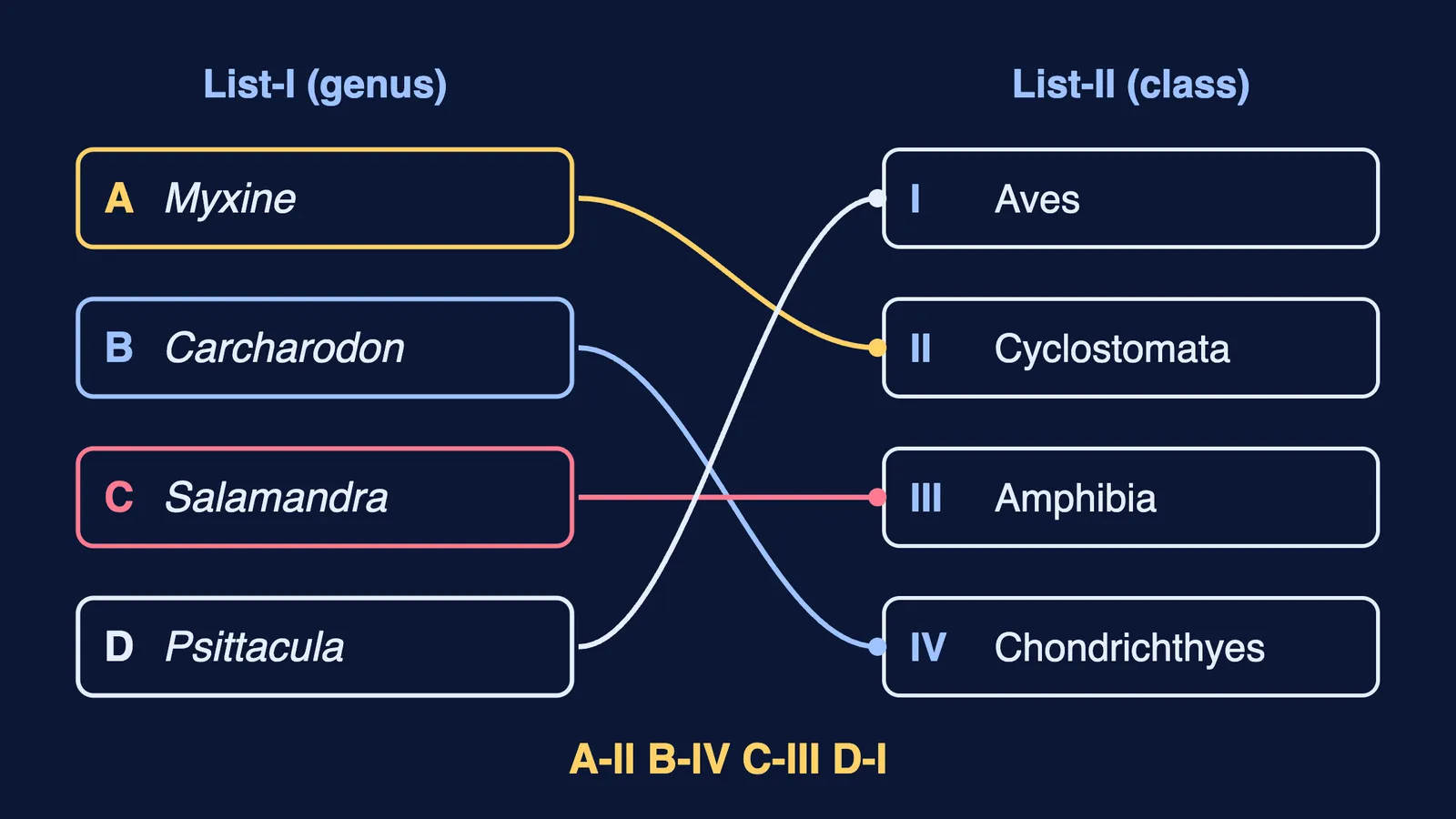
Q10 (hard). List-I: A. *Ichthyophis* B. *Pristis* C. *Hemidactylus* D. *Aptenodytes*. List-II: I. Aves II. Reptilia III. Chondrichthyes IV. Amphibia.
(1) A-II, B-III, C-IV, D-I (2) A-IV, B-I, C-II, D-III (3) A-III, B-IV, C-II, D-I (4) A-IV, B-III, C-II, D-I
Answer: (4). *Ichthyophis* is a limbless amphibian, *Pristis* a saw fish, *Hemidactylus* a wall lizard, *Aptenodytes* a penguin.
Which single-answer questions test the same chapter?
Check the stem for "incorrect" first, then hunt for the line that breaks.
Q11 (medium). NCERT describes fertilisation as internal in: (1) *Rana* (2) *Catla* (3) *Antedon* (4) *Calotes*
Answer: (4). Reptiles fertilise internally; amphibians externally, bony fishes and echinoderms usually externally.
Q12 (hard). Which is incorrect about Chondrichthyes? (1) The mouth is ventral. (2) Teeth are backwardly directed, modified placoid scales. (3) They can regulate their body temperature. (4) *Torpedo* has electric organs.
Answer: (3). NCERT calls them poikilothermous: they cannot regulate body temperature.
Try the Animal Kingdom assertion-reason set.
Not sure which group to revise first? Fermi's AI tutor works out what you already know and builds a plan for the session.


