

On this page
Here are six assertion-reason items and four Statement I / Statement II pairs on Animal Kingdom, each block running from easy to hard. Every statement was checked against Chapter 4 of NCERT Class 11 Biology (reprint 2026-27). The NMC NEET (UG)-2026 syllabus lists this chapter in Unit 1 as the salient features of non-chordates up to phyla and chordates up to classes.
How do you answer assertion-reason questions on Animal Kingdom?
Use these keys throughout.
Assertion-reason:
(A) Both A and R are true and R is the correct explanation of A.
(B) Both A and R are true but R is NOT the correct explanation of A.
(C) A is true but R is false.
(D) A is false but R is true.
Statement pairs:
(A) Both statements are correct.
(B) Both statements are incorrect.
(C) Statement I is correct, Statement II is incorrect.
(D) Statement I is incorrect, Statement II is correct.
Judge A alone, then R alone, and only if both are true ask, "Is R the reason NCERT gives for A?" In this chapter most false lines are a correct feature pinned to the wrong group, so name the group first and the feature second.
For the chapter itself, read our walk-through on placing any phylum with six questions, and for the rest of Zoology, the Human Physiology for NEET guide.
Assertion-reason questions on Animal Kingdom
Q1 (easy). Assertion (A): *Taenia* and *Fasciola* are commonly known as flatworms. Reason (R): Platyhelminthes have a body flattened from top to bottom (dorso-ventrally).
Answer: (A). Both are true, and NCERT section 4.2.4 gives the flattened body as the reason for the name. Trap: picking (B) because "flat" feels too obvious to be the answer.
Q2 (easy). Assertion (A): The long bones of birds are hollow, with air cavities. Reason (R): The endoskeleton of birds is only partly ossified.
Answer: (C). A is true: the long bones are pneumatic. R is false: NCERT says the bird endoskeleton is fully ossified (bony). Trap: reading "hollow" as "not fully bone".
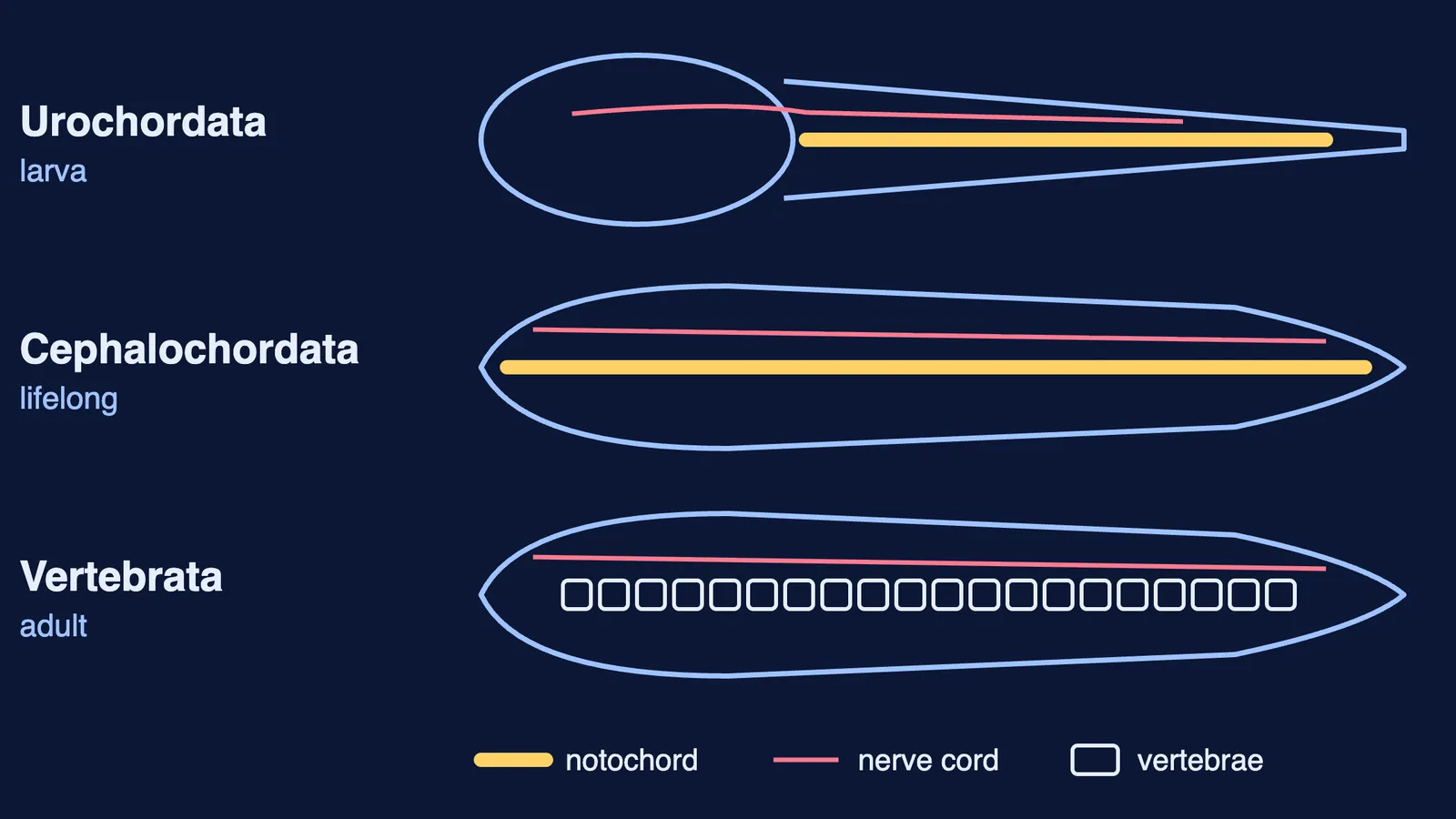
Q3 (medium). Assertion (A): In Urochordata, the notochord extends from head to tail and persists throughout life. Reason (R): Urochordata and Cephalochordata, the protochordates, are exclusively marine.
Answer: (D). A is false: in Urochordata the notochord is present only in the larval tail. Head-to-tail and lifelong describes Cephalochordata, such as *Branchiostoma*. R is true. Trap: swapping the two protochordate subphyla.
Q4 (medium). Assertion (A): Cyclostomes are placed in the division Agnatha. Reason (R): Cyclostomes have a sucking, circular mouth without jaws.
Answer: (A). Both are true, and NCERT's vertebrate scheme splits Agnatha (lacks jaw) from Gnathostomata (bears jaw), so the jawless mouth is exactly why cyclostomes go there. Trap: choosing (B) because R reads like a feeding detail rather than the basis of the division.
Q5 (hard). Assertion (A): Annelids have a closed circulatory system. Reason (R): Annelids are metamerically segmented coelomates.
Answer: (B). Both are true, but segmentation and a coelom do not cause closed circulation. Arthropods are also segmented coelomates, yet NCERT gives them an open circulatory system. Trap: both lines come from the same paragraph, so they feel linked.
Q6 (hard). Assertion (A): Cartilaginous fishes such as *Scoliodon* have gill slits without an operculum. Reason (R): In Chondrichthyes, the notochord is replaced by a vertebral column in the adult.
Answer: (C). A is true: their gill slits are separate and uncovered. R is false: NCERT says the notochord is persistent throughout life in Chondrichthyes. Trap: applying the general vertebrate rule to a class that NCERT treats as the exception.
Statement I and Statement II questions on Animal Kingdom
Q7 (easy). Statement I: *Nereis*, an aquatic annelid, swims with the help of lateral appendages called parapodia. Statement II: Nephridia carry out osmoregulation and excretion in annelids.
Answer: (A). Both match NCERT section 4.2.6. Trap: doubting Statement I because earthworms, the usual annelid example, have no parapodia.
Q8 (medium). Statement I: In arthropods, excretion takes place through flame cells. Statement II: Flatworms rely on flame cells for both excretion and osmoregulation.
Answer: (D). Arthropods excrete through malpighian tubules; flame cells belong to flatworms, so only Statement II is correct. Trap: remembering "flame cells" without the phylum attached.
Q9 (hard). Statement I: In molluscs, the feather-like gills in the mantle cavity have both respiratory and excretory functions. Statement II: The radula, a file-like rasping organ, lies inside the visceral hump.
Answer: (C). Statement I matches NCERT. Statement II is wrong about the place: NCERT places the radula in the mouth, while the visceral hump is covered by the mantle. Trap: the description of the radula is right, so the wrong location slips past.
Q10 (hard). Statement I: Reptiles have external ear openings, with a tympanum serving as the ear. Statement II: In echinoderms, the mouth is on the upper (dorsal) side and the anus on the lower (ventral) side.
Answer: (B). Both are incorrect. Reptiles have no external ear openings, though a tympanum does represent the ear. In echinoderms the mouth is ventral and the anus dorsal. Trap: each statement carries one true clause, which makes the whole line feel true.
How should you use this set?
Do all ten in 12 minutes without notes, writing T or F above each line before choosing a key.
Score yourself, then sort every miss: a wrong fact (fix it in NCERT) or a wrong link (run the counter-example test).
Redo the misses two days later, and write a new false version of each by moving one feature to a neighbouring group.
The key spread here is deliberate: every option appears at least twice, so a run of the same letter tells you nothing.
If a miss comes from a concept gap, such as what separates a pseudocoelom from a true coelom, the Fermi Concept Library has every concept in biology with its own lesson. For more on the format itself, read our assertion-reason strategy.


