On this page
A premature baby can lie in incubator air at 34 °C and still lose heat faster than its body makes it. The reason is radiation. Skin sends out infrared to every surface it can see, and the Stefan–Boltzmann law depends on the temperature of those surfaces, not the temperature of the air. If the incubator's plastic hood is cooled by the room, the baby radiates to a cold wall through warm air.
This post is physics only. It gives no clinical advice, and newborn care decisions, including incubator settings, belong to doctors and nurses. Every number in the worked example below is illustrative of the physics model, not a measurement of any real baby or incubator.
How does a newborn lose heat?
There are four routes, the same as for any warm object:
Radiation to the surfaces around it.
Convection to the air moving past its skin.
Evaporation of water from its skin and breath.
Conduction to the mattress it lies on.
For small babies, radiation is a big one. A 2016 study in Medical Engineering & Physics by Delanaud and co-workers opens by noting that radiant heat loss is high in low-birth-weight newborns. Evaporation also matters, because very premature skin is thin and lets water through, and its size depends on humidity. This post sticks to radiation.
Why does air temperature not appear in the radiation formula?
The net power radiated by skin at absolute temperature T_s to surroundings at T_w is
P = εσA(T_s⁴ − T_w⁴)
where σ = 5.67 × 10⁻⁸ W m⁻² K⁻⁴, A is the area that radiates and ε is the emissivity. Air is almost transparent to this infrared, so the air temperature is simply not in the equation. The law itself, with its T⁴, is set out in black-body radiation: Stefan's law and Wien's law problems.
Skin is close to a perfect emitter in the infrared. Sanchez-Marin and co-workers, in the Journal of Biomedical Optics in 2009, found that human skin behaves almost like a black body at a wavelength of 10.6 µm. So ε is near 1. The example uses ε = 0.97 as an illustrative value.
Convection is the opposite case. It depends on the air temperature, and with skin at 36 °C and air at 34 °C the difference is only 2 °C. Newton's law of cooling handles that kind of small-difference loss.
How much heat does a premature baby radiate to a cold wall?
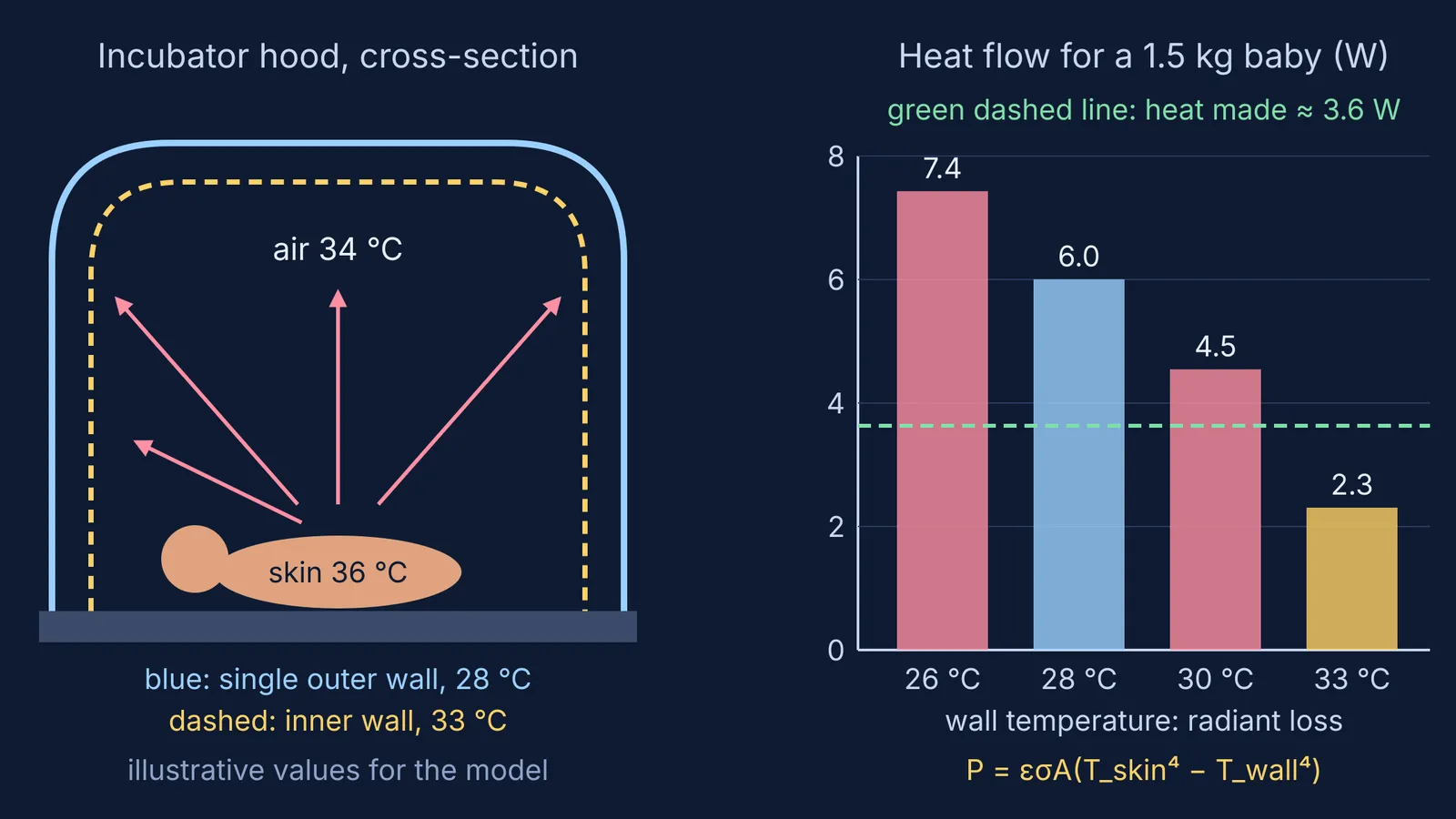
Take an illustrative baby: mass 1.5 kg, radiating area A = 0.12 m², skin at 36 °C, ε = 0.97.
Convert to kelvin. T_s = 36 + 273.15 = 309.15 K. Wall at 28 °C: T_w = 301.15 K.
Fourth powers. T_s⁴ = 9.134 × 10⁹ K⁴. T_w⁴ = 8.225 × 10⁹ K⁴. Difference = 0.909 × 10⁹ K⁴.
Multiply. P = 0.97 × 5.67 × 10⁻⁸ × 0.12 × 0.909 × 10⁹ ≈ 6.0 W.
Units. W m⁻² K⁻⁴ × m² × K⁴ = W.
Repeat for other wall temperatures:
Wall at 26 °C: 7.4 W
Wall at 28 °C: 6.0 W
Wall at 30 °C: 4.5 W
Wall at 33 °C: 2.3 W
Each 1 °C of wall temperature is worth about 0.75 W here. You can see why from the linear form: for small differences, P ≈ 4εσT³A ΔT, and 4 × 0.97 × 5.67 × 10⁻⁸ × 305³ ≈ 6.2 W m⁻² K⁻¹, times 0.12 m², gives 0.75 W per kelvin.
Compare convection to the 34 °C air, using an illustrative coefficient h = 4 W m⁻² K⁻¹: P = hAΔT = 4 × 0.12 × 2 ≈ 1.0 W. In this model, radiation to a 28 °C wall is six times the convective loss.
How does that compare with the heat the baby makes?
A newborn's heat production is its energy expenditure. Bauer and co-workers, in the British Journal of Nutrition in 2003, measured it in babies born under 1,000 g and found it rose from 115 to 310 kJ per kg per day over their first five weeks. Take 50 kcal per kg per day (209 kJ) as an illustrative value inside that range:
209 × 10³ J × 1.5 kg ÷ 86,400 s ≈ 3.6 W
So in the model, a baby making 3.6 W and radiating 6.0 W to a 28 °C wall is short by about 2.4 W before convection and evaporation are even counted. Warm air alone cannot fix that, because the radiation term does not contain the air temperature.
Why is the incubator wall colder than the air inside it?
A single plastic hood sits between warm air inside and a cooler room outside. Heat flows through it, so its temperature settles somewhere between the two. The cooler the room, the cooler the wall. The comparison of radiation with the other routes is worked more generally in when radiation beats conduction and convection.
The physics answer is to give the skin something warmer to look at. A double-walled incubator adds a second, inner wall with the warm incubator air on both sides of it. In the model, raising the wall the baby sees from 28 °C to 33 °C cuts the radiant loss from 6.0 W to 2.3 W.
Do double walls work as well as the model says?
Real measurements show the routes are linked, so the gain is smaller. Bell and Rios, in Pediatric Research in 1983, found that a double-walled incubator lowered radiant loss in premature babies but raised convective loss, so the total heat loss was unchanged. The 2016 Delanaud study found the same pattern with an extra roof panel: less radiation, more convection and evaporation. A Cochrane review by Laroia and co-workers found that double walls reduce heat loss only slightly, and that the studies give no evidence this improves clinical outcomes.
That is a useful lesson in physics too. Fixing one term in a heat balance shifts the others, so the whole balance must be measured. If you want to revise how the radiation, conduction and convection laws fit together, the Concept Library covers each of them.
Quick checklist
Radiation: P = εσA(T_s⁴ − T_w⁴). The air temperature is not in it.
Skin is almost a black body in the infrared, so ε is close to 1.
Use kelvin and subtract fourth powers.
In the illustrative model, a 1.5 kg baby radiates about 6.0 W to a 28 °C wall and makes about 3.6 W.
Each 1 °C of wall temperature changes the radiant loss by about 4εσT³A.
Measured double-wall gains are smaller, because convection and evaporation rise.
All numbers here illustrate the model. Care decisions belong to doctors and nurses.