On this page
Part 1 pairs 12 rules from the morphology chapter of NCERT Class 11 Biology (Reprint 2026-27) with the exception NCERT names. Part 2 has 13 original questions in four NEET formats, each answered with a short NCERT reason. The topics sit in Unit 2 of the Biology section of the NMC syllabus for NEET (UG) 2026.
The current reprint has no section on root, stem or leaf modifications, so nothing below draws on them.
Which rules in morphology of flowering plants have NCERT exceptions?
Roots grow from the radicle (5.1). Exception: grass, Monstera and banyan form adventitious roots elsewhere.
A leaf carries a bud in its axil (5.3.2). Exception: leaflets of a compound leaf carry none.
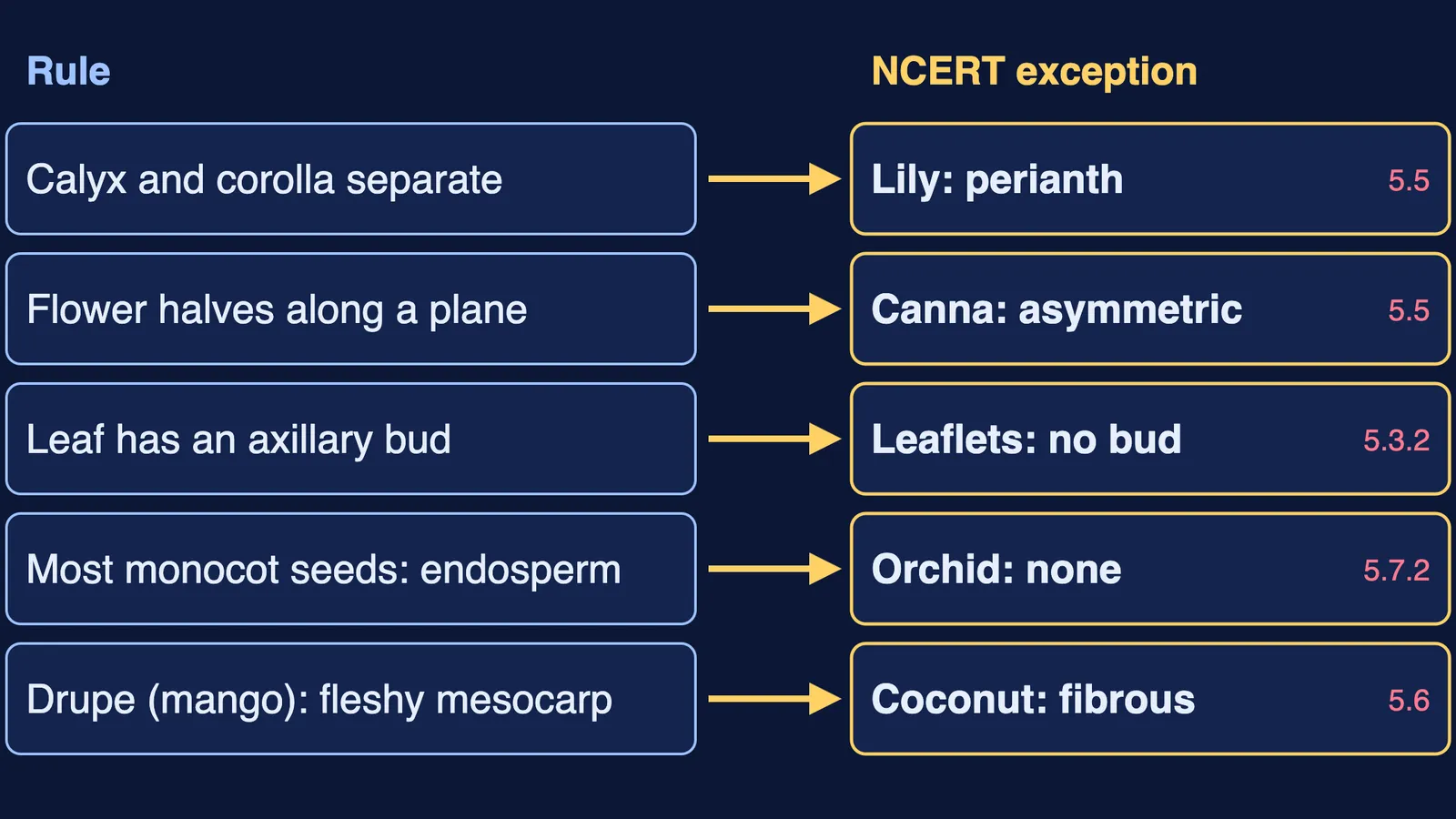
A typical flower has a separate calyx and corolla (5.5). Exception: in lily they are not distinct and form a perianth.
A flower splits into similar halves along at least one vertical plane (5.5). Exception: canna, which NCERT calls asymmetric.
A stamen is the male organ that makes pollen (5.5.1.3). Exception: the staminode, a sterile stamen.
Parietal placentation goes with a one-chambered ovary (5.5.1.4). Exception: a false septum makes it two-chambered in mustard and Argemone.
A fruit is an ovary that ripens after fertilisation (5.6). Exception: parthenocarpic fruit forms without it.
A drupe such as mango has a fleshy, edible mesocarp (5.6). Exception: coconut is a drupe too, but its mesocarp is fibrous.
Monocot seeds are generally endospermic (5.7.2). Exception: orchid seeds have no endosperm.
Dicot cotyledons are often the fleshy food store, and bean, gram and pea keep no endosperm (5.7.1). Exception: in castor the endosperm is the food-storing tissue.
A seed has its own seed coat, attached to the fruit only at the hilum (5.7.1). Exception: in maize the membranous seed coat is generally fused with the fruit wall (5.7.2).
Stems in Solanaceae are aerial (5.9). Exception: potato (Solanum tuberosum) has an underground stem.
How do you handle odd-one-out and exception questions?
Name the shared feature in words before hunting for the misfit.
Test all four options against it, including your favourite.
Check whether another feature splits the four differently; if so, reread the stem for the basis it sets.
For "NOT an exception", find the option that simply obeys the rule.
Can you spot the odd one out?
Q1. By where the roots arise, which is the odd one out?
(1) Grass (2) Mustard (3) Monstera (4) Banyan
Answer: (2). Mustard's tap root comes from the radicle; the rest are adventitious (5.1).
Q2. By floral symmetry, which is the odd one out?
(1) Pea (2) Cassia (3) Canna (4) Bean
Answer: (3). Canna is asymmetric; the others are zygomorphic (5.5).
Q3. By how the outer two whorls are described, which is the odd one out?
(1) China rose (2) Brinjal (3) Mustard (4) Lily
Answer: (4). Only lily has calyx and corolla merged as a perianth (5.5).
Q4. By endosperm in the mature seed, which is the odd one out?
(1) Castor (2) Orchid (3) Maize (4) Brinjal
Answer: (2). Orchid seeds lack endosperm; the other three are endospermic (5.7, 5.9).
Which of these is NOT an NCERT exception?
Q5. Which pairing is NOT an exception?
(1) Coconut: a drupe with a fibrous mesocarp (2) Lily: no separate calyx and corolla (3) Mango: a drupe with a fleshy, edible mesocarp (4) Orchid: a monocot seed without endosperm
Answer: (3). Mango is the typical drupe the rule describes (5.6).
Q6. Which of these is NOT an exception?
(1) Mustard: a superior ovary in a hypogynous flower (2) Argemone: a one-chambered ovary split by a false septum (3) Potato: an underground stem in Solanaceae (4) Neem: leaflets with no axillary bud
Answer: (1). Mustard follows the rule: hypogynous, so its ovary is superior (5.5).
Can you judge these exception statements?
Codes for Q7 to Q10: (1) Both statements are correct (2) Both are incorrect (3) Only I is correct (4) Only II is correct
Q7. Statement I: Silk cotton leaflets join at the tip of the petiole. Statement II: Each silk cotton leaflet carries a bud in its axil.
Answer: (3). A leaflet has no axillary bud (5.3.2).
Q8. Statement I: In a dicot seed, the tegmen is the outer layer of the seed coat and the testa the inner. Statement II: Maize has a membranous seed coat that is generally fused with the fruit wall.
Answer: (4). NCERT puts the testa outside and the tegmen inside (5.7.1).
Q9. Statement I: A staminode is a stamen fused with a petal. Statement II: Lily's stamens, attached to the perianth, are called epipetalous.
Answer: (2). A staminode is a sterile stamen, and stamens on a perianth are epiphyllous (5.5.1.3).
Q10. Statement I: A fruit that forms without fertilisation of the ovary is parthenocarpic. Statement II: Potato is NCERT's underground-stem exception in Solanaceae.
Answer: (1). See 5.6 and 5.9.
Which single-correct MCQs test the exceptions?
Q11. NCERT calls the canna flower asymmetric because it:
(1) can be halved along any radial plane (2) can be halved along only one vertical plane (3) has no thalamus (4) cannot be cut into similar halves by any vertical plane through its centre
Answer: (4). Options (1) and (2) describe actinomorphic and zygomorphic flowers (5.5).
Q12. In mustard and Argemone, parietal placentation still gives a two-chambered ovary because:
(1) a false septum forms (2) the placenta becomes axial (3) septa are absent around a central axis (4) the thalamus fuses with the ovary
Answer: (1). Option (3) describes free central placentation (5.5.1.4).
Q13. Among NCERT's dicot seeds, castor stands apart because:
(1) it has one shield-shaped cotyledon (2) its endosperm remains as a food-storing tissue (3) its seed coat has no tegmen (4) it has no hilum
Answer: (2). Castor is endospermic; bean, gram and pea are not (5.7.1).
What should you do after the set?
Cover the answers, attempt all 13, and tag each miss as a forgotten rule or a forgotten exception.
Rewrite missed rows as one line with the section number; retry in three days.
Then try the statement and match-the-list morphology set and the diagram-based morphology questions. New to the chapter? Start with how to prepare this chapter for NEET.
Which rule-and-exception pair keeps slipping? Fermi's AI tutor works out what you already know and builds a plan for the session.