On this page
Walk through a foundry and you may see heavy iron weights or clamps sitting on top of sand moulds before the metal goes in. It looks like overkill. The casting might be a flat plate holding less than 100 kg of iron, and the top half of the mould is a solid block of rammed sand. Yet without that extra load, the molten iron can lift the top half and run out along the joint. The reason is the hydrostatic paradox: the upward push on the mould depends on the depth of the metal, not on how much metal there is.
Pouring molten metal is work for trained foundry staff with proper protective equipment and procedures. This post explains the physics only and gives no casting instructions.
What are the parts of a sand mould?
A simple sand mould is made in two boxes of rammed sand. The lower half is the drag and the upper half is the cope, as defined in the IIT Guwahati casting notes by R. Ganesh Narayanan. A pattern leaves a cavity the shape of the part. Molten metal is poured into a cup on top of the cope, runs down a vertical channel called the sprue, and fills the cavity. If the part must be hollow, a sand core is placed inside the cavity, held by core prints and small metal supports called chaplets.
When the cavity is full, the metal also stands in the sprue, up to the pouring cup. That column is the key.
Why does a thin casting push so hard on the cope?
Pressure in a liquid at rest depends only on depth: p = ρgh. Every point on the top surface of the cavity lies a depth h below the metal level in the sprue, so the metal presses up on the underside of the cope with ρgh everywhere over the cavity's plan area A. The total upward force is
F = ρ g h A
The thickness of the casting does not appear. This is the same result as in why a liquid's weight does not always equal the force on its base: a thin layer of liquid fed by a tall narrow column can push with far more than its own weight. The extra force comes from the cope pushing back down on the metal. If the cope cannot supply it, it lifts.
The Metal Museum's hydraulic pressure handout uses exactly this method: multiply the area of pattern and sprues that faces the cope by the height up to the top of the pour cup, then by the density of the metal. It lists iron at 0.25 lb per cubic inch, which is about 6,900 kg/m³, and notes that the cope's own weight can be subtracted because it helps keep the mould closed.
Worked example: how much lift does an iron plate produce?
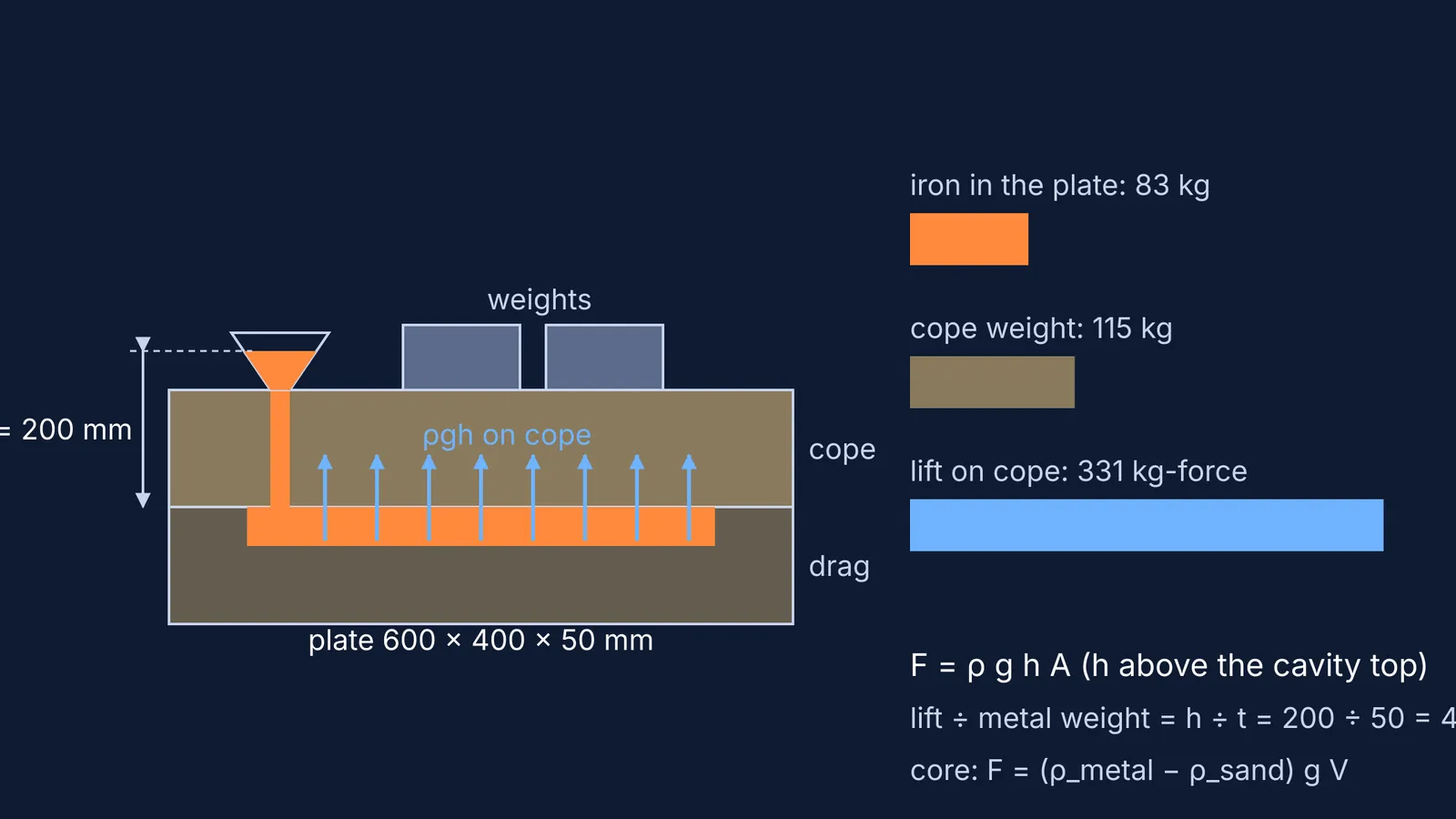
Data (illustrative): a grey-iron plate 600 mm × 400 mm × 50 mm, lying wholly in the drag so its top face is at the joint. The metal level in the sprue is 200 mm above that face. Liquid iron density 6,900 kg/m³ (the handout's value). The cope is 800 mm × 600 mm × 150 mm of sand at about 1,600 kg/m³, a typical value. Take g = 9.81 m/s².
Pressure under the cope. p = ρgh = 6,900 × 9.81 × 0.200 = 13.5 kPa.
Plan area of the cavity. A = 0.600 × 0.400 = 0.240 m².
Upward force. F = pA = 13,538 × 0.240 = 3,250 N. Divided by g, that is a lift of 331 kg-force.
Metal in the plate. m = 6,900 × 0.600 × 0.400 × 0.050 = 82.8 kg.
Compare. 331 ÷ 82.8 = 4.0. The lift is four times the weight of the metal in the casting.
Cope weight. 1,600 × 0.80 × 0.60 × 0.15 = 115 kg. The cope supplies only 115 of the 331 kg-force needed.
Shortfall. 331 − 115 = 216 kg-force must come from weights or clamps, before any safety margin.
Notice why the ratio is exactly 4. The lift is ρghA and the metal's weight is ρgtA, where t is the thickness, so their ratio is h ÷ t = 200 ÷ 50. Raise the sprue to 300 mm and the lift becomes 6,900 × 0.300 × 0.240 = 497 kg-force, while the casting is unchanged.
Why do cores need chaplets?
A sand core surrounded by molten iron is like a cork in water. Archimedes' principle gives an upward force equal to the weight of iron it displaces, minus its own weight:
F = (ρ_metal − ρ_sand) g V
For a 4-litre core (V = 0.004 m³): F = (6,900 − 1,600) × 9.81 × 0.004 = 208 N, about 21 kg-force, while the core itself weighs only 6.4 kg. The net lift is 3.3 times the core's weight here; the IIT Guwahati notes put it at about four times for iron castings. Those notes also say chaplets support the core against its own weight and "the metallostatic force", which is the foundry name for this ρgh pressure. The core's lift is passed through its prints into the cope, so it adds to the force on the cope too. As Does buoyant force change with depth in a liquid? shows, this upthrust does not depend on how deep the core sits.
Is the static force the whole story?
No. While the metal is still flowing and when the stream stops, the pressure rises briefly above ρgh, so the static figure is a minimum and foundries allow a margin. The force also acts only over the cavity, so the load must sit over that area, not just at the corners of the box. After filling, the metal starts to freeze from the mould walls, on a timescale set by its volume-to-area ratio, as Chvorinov's rule explains.
How would JEE ask this?
A JEE-style version: "A vessel has a flat lid of area A held down by its weight W. It is filled with liquid of density ρ through a thin tube whose top is h above the lid. Find the smallest h at which the lid lifts." The answer is h = W ÷ (ρgA), and the volume of liquid never enters. To check your setup on problems like this, the Fermi Problem Library has a step-by-step solver that explains the reasoning. If you are preparing for JEE, Fermi Test Prep offers personalised preparation for JEE Main & Advanced with an AI tutor, live classes, adaptive mocks, mentorship and a study plan that updates based on mastery.
Quick checklist
Lift on the cope: F = ρghA, with h from the cavity's top face up to the metal level in the sprue.
The casting's thickness does not appear; lift ÷ metal weight = h ÷ t for a flat plate.
600 × 400 mm plate, h = 200 mm, iron: 331 kg-force lift against 83 kg of metal.
Subtract the cope's own weight; the rest must be held down, plus a margin.
Core lift: (ρ_metal − ρ_sand)gV, which is why chaplets and core prints are needed.
Molten-metal work is for trained foundry staff only.