On this page
This set pairs 10 general rules from Plant Kingdom, Chapter 3 of NCERT Class 11 Biology (Reprint 2026-27), with the exception the chapter itself names, then tests them with 12 original questions. The NEET (UG) 2026 syllabus places the chapter in Biology Unit 1, Diversity in Living World.
New to the chapter? Start with our Plant Kingdom Class 11 notes.
Which Plant Kingdom rules have NCERT exceptions?
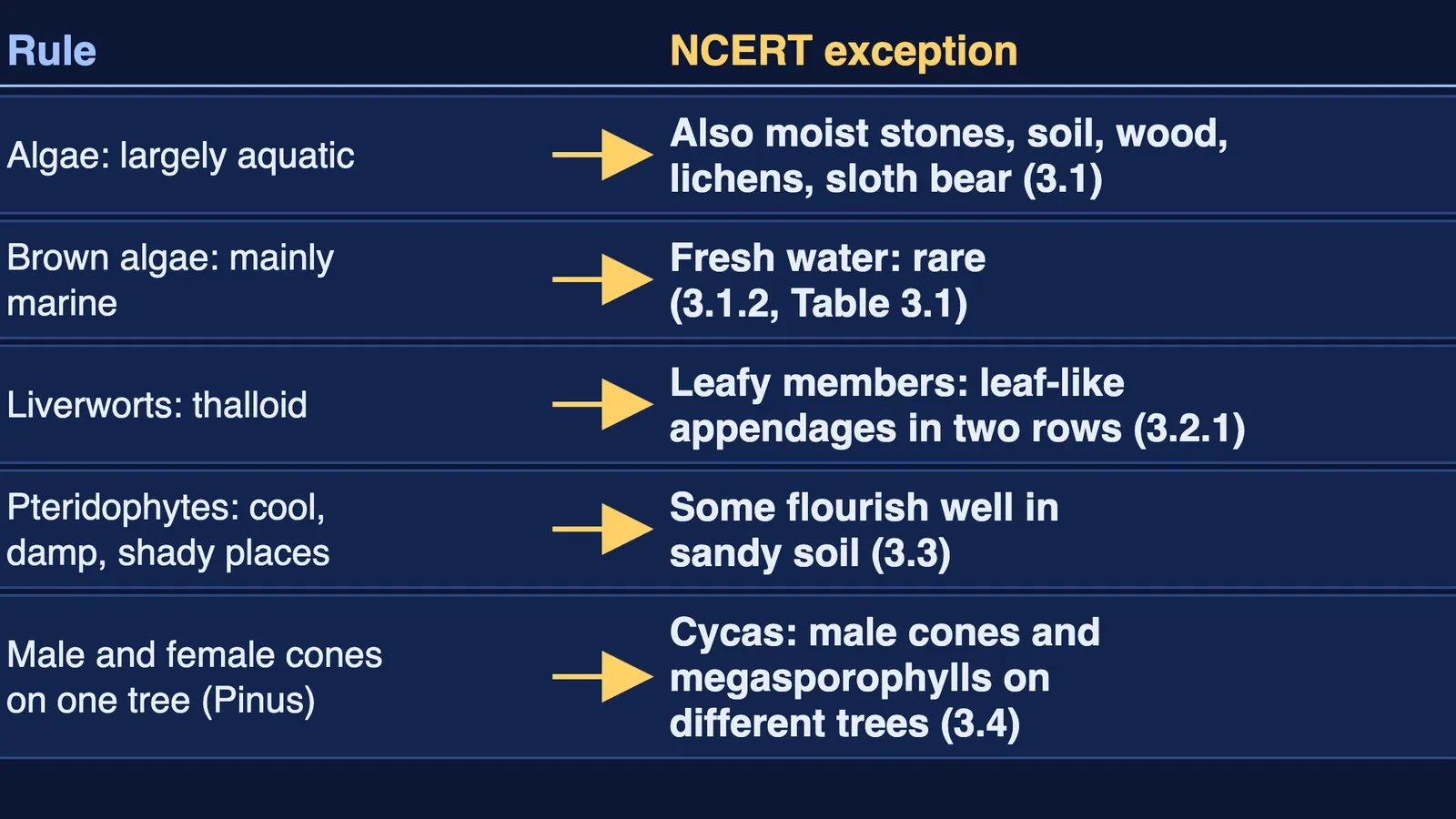
Rule → NCERT's exception (section).
Algae are largely aquatic → also on moist stones, soil and wood, in lichens with fungi, and on the sloth bear (3.1).
A name ending in "algae" marks an alga → cyanobacteria, though still called blue-green algae, are no longer classed as algae (chapter introduction).
Algae range from colonial to filamentous forms such as Volvox and Ulothrix → a few marine forms, the kelps, form massive bodies that may reach 100 metres (3.1, 3.1.2).
Green algae store starch in pyrenoids → some algae store oil droplets (3.1.1).
Brown algae live mainly in the sea → Table 3.1 lists fresh water as a rare habitat (3.1.2).
Red algae are mostly marine → Table 3.1 lists some in fresh water (3.1.3).
Liverworts are thalloid, as in Marchantia → leafy members bear leaf-like appendages in two rows (3.2.1).
Bryophytes have little economic value → Sphagnum peat (fuel, packing) and mosses as animal food (3.2).
Pteridophytes grow in cool, damp, shady places → some thrive in sandy soil (3.3).
Male and female cones may share one tree, as in Pinus → in Cycas, male cones and megasporophylls grow on different trees (3.4).
How do you handle odd-one-out and exception questions?
Name the shared feature first. If the stem gives a basis, such as "with respect to stored food", judge only on that.
Write yes or no beside each option for that one feature. The answer is the single "no".
For "which is NOT an exception", check whether each option truly breaks the rule. The answer follows the rule or is not in NCERT.
Odd-one-out questions on Plant Kingdom
Q1. With respect to producing at least one kind of flagellated gamete, which is the odd one out? (1) Ulothrix (2) Spirogyra (3) Volvox (4) Fucus
Answer: (2). Spirogyra's gametes are non-flagellated; Ulothrix gametes are flagellated, and Volvox and Fucus have a motile male gamete (3.1).
Q2. With respect to which generation forms the main plant body, which is the odd one out? (1) Funaria (2) Equisetum (3) Marchantia (4) Sphagnum
Answer: (2). Equisetum is a pteridophyte; the three bryophytes have a gametophyte as the main body (3.2, 3.3).
Q3. With respect to being counted as algae in NCERT's current scheme, which is the odd one out? (1) Porphyra (2) Polysiphonia (3) Gracilaria (4) Blue-green algae
Answer: (4). The chapter introduction says cyanobacteria are no longer algae; the other three are red algae.
Q4. With respect to having chlorophyll c among the major pigments, which is the odd one out? (1) Laminaria (2) Sargassum (3) Dictyota (4) Chara
Answer: (4). Chara is a green alga with chlorophyll a and b; the other three are brown algae with chlorophyll a and c (3.1.1, 3.1.2, Table 3.1).
Which is NOT an exception?
Q5. NCERT calls algae largely aquatic. Which is NOT one of the other places it names for them? (1) Moist wood (2) The sloth bear (3) Coralloid roots of Cycas (4) Lichens, with fungi
Answer: (3). Coralloid roots hold N2-fixing cyanobacteria, which NCERT no longer counts as algae (3.4).
Q6. NCERT places pteridophytes in cool, damp, shady places. Which exception does it add? (1) Some flourish well in sandy soil (2) Some grow in salt water (3) Some grow on the bark of trees (4) Some live with fungi as lichens
Answer: (1). Section 3.3 adds only sandy-soil conditions.
Q7. Bryophytes are generally of little economic importance. Which is NOT an exception NCERT gives? (1) Sphagnum peat used as fuel (2) Mosses eaten by some plant-eating mammals and birds (3) Agar from mosses, used to grow microbes (4) Sphagnum used to pack living material for transport
Answer: (3). Agar comes from the red algae Gelidium and Gracilaria (3.1).
Q8. Which pairing is NOT a genuine NCERT rule and exception? (1) Bryophyte sporophytes depend on the gametophyte, yet the moss sporophyte is free-living (2) Brown algae are mainly marine, yet a few occur in fresh water (3) Liverworts are usually thalloid, yet leafy members bear leaf-like appendages in two rows (4) Pteridophytes favour cool, damp, shady places, yet some thrive in sandy soil
Answer: (1). NCERT says the bryophyte sporophyte is not free-living (3.2, 3.2.2).
Two-statement and single-correct questions
Key for Q9 to Q11: (1) Both statements are correct (2) Both are incorrect (3) Statement I is correct, Statement II is incorrect (4) Statement I is incorrect, Statement II is correct.
Q9. Statement I: NCERT's example of algae growing on an animal is the sloth bear. Statement II: NCERT counts cyanobacteria among the green algae because they carry chlorophyll.
Answer: (3). Section 3.1 names the sloth bear; cyanobacteria are no longer algae.
Q10. Statement I: Some algae may store food as oil droplets. Statement II: NCERT names kelps as marine forms that build massive plant bodies.
Answer: (1). See sections 3.1.1 and 3.1.
Q11. Statement I: Red algae are found only in salt water. Statement II: Green algae occur in fresh, brackish and salt water.
Answer: (4). Table 3.1 lists some red algae in fresh water.
Q12. A student writes, "All algae store their food as starch." Which NCERT fact disproves this? (1) Green algae usually have a cellulose and pectose wall (2) Brown algae store mannitol or laminarin (3) Green algae have chlorophyll a and b (4) Red algae contain r-phycoerythrin
Answer: (2). Brown algae store mannitol or laminarin (3.1.2, Table 3.1).
What should you do after the set?
Do all 12 in 12 minutes, then mark.
For each miss, find the hedge word in NCERT that hid the exception.
Build your own odd-one-out set from the 10 rules, and test every option against every feature.
Then try our Plant Kingdom statement and match-the-list set and Plant Kingdom assertion-reason questions.
Unsure which exceptions you keep missing? Fermi's AI tutor works out what you already know and builds a plan for the session.