

On this page
These 14 original questions cover Plant Kingdom in NCERT Class 11 Biology (Reprint 2026-27), each with a one-line NCERT reason. The NEET (UG) 2026 syllabus puts it in Unit 1, Diversity in Living World, and lists three to five features and at least two examples per plant group. Basics first? Read our Plant kingdom for NEET guide.
How do you attack two-statement questions on Plant Kingdom?
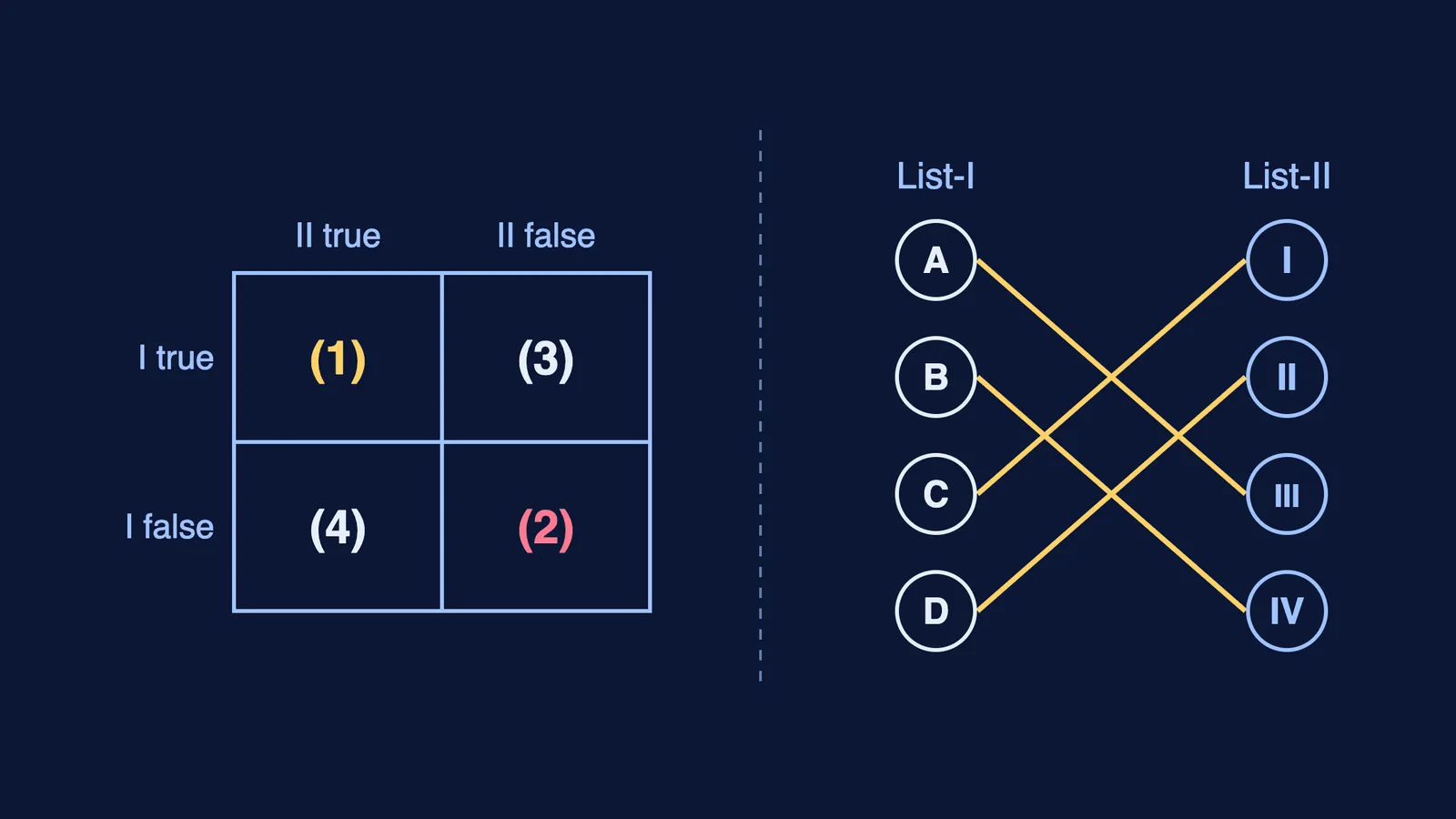
Mark each statement T or F before reading the options. A false line usually swaps one detail, such as the group or habitat. Key for Q1 to Q6:
(1) Both statements are correct
(2) Both statements are incorrect
(3) Statement I is correct but Statement II is incorrect
(4) Statement I is incorrect but Statement II is correct
Q1. Statement I: Numerical taxonomy weighs every character equally and can handle hundreds at once. Statement II: Chemotaxonomy settles confusions using chromosome number, structure and behaviour.
Answer: (3). Chromosome data is cytotaxonomy; chemotaxonomy uses chemical constituents.
Q2. Statement I: In green algae, pyrenoids hold protein as well as starch. Statement II: Some algae store food as oil droplets.
Answer: (1). Both are in NCERT section 3.1.1.
Q3. Statement I: Red algae live only in well-lit water close to the surface. Statement II: Sexual reproduction in red algae is oogamous and followed by complex post-fertilisation developments.
Answer: (4). Red algae also grow at great depths with little light.
Q4. Statement I: A bryophyte archegonium is flask-shaped, with one egg inside. Statement II: The bryophyte zygote undergoes meiosis at once to form haploid spores.
Answer: (3). The zygote first forms a multicellular sporophyte; some of its cells later undergo meiosis.
Q5. Statement I: Selaginella has small leaves (microphylls), whereas ferns have large leaves (macrophylls). Statement II: In Equisetum, sporophylls may form compact strobili.
Answer: (1). Both are in NCERT section 3.3.
Q6. Statement I: Artificial systems gave sexual characters more weight than vegetative ones. Statement II: Phylogenetic systems assume that members of a taxon arose from different ancestors.
Answer: (2). Artificial systems weighted both equally; phylogenetic systems assume a common ancestor.
How do you solve match-the-list questions quickly?
Fix your surest pair and strike out options that disagree; a second sure pair usually settles it. Our match-the-list method covers the format in depth.
Q7. Match the alga with its type of sexual reproduction.
List-I: (A) Ulothrix (B) Spirogyra (C) Eudorina (D) Fucus
List-II: (I) Anisogamy (II) Oogamy (III) Isogamy with flagellated gametes (IV) Isogamy with non-flagellated gametes
(1) A-III, B-IV, C-I, D-II
(2) A-IV, B-III, C-I, D-II
(3) A-III, B-IV, C-II, D-I
(4) A-I, B-IV, C-III, D-II
Answer: (1). NCERT section 3.1 uses each as its example.
Q8. Match each brown-alga term with its meaning.
List-I: (A) Holdfast (B) Stipe (C) Frond (D) Algin
List-II: (I) Leaf-like photosynthetic organ (II) Attaches the body to the substratum (III) Gelatinous coating over the cell wall (IV) Stalk
(1) A-IV, B-II, C-I, D-III
(2) A-II, B-IV, C-I, D-III
(3) A-II, B-IV, C-III, D-I
(4) A-II, B-I, C-IV, D-III
Answer: (2). As described in NCERT section 3.1.2.
Q9. Match the pteridophyte class with its NCERT genus.
List-I: (A) Psilopsida (B) Lycopsida (C) Sphenopsida (D) Pteropsida
List-II: (I) Adiantum (II) Equisetum (III) Lycopodium (IV) Psilotum
(1) A-IV, B-II, C-III, D-I
(2) A-III, B-IV, C-II, D-I
(3) A-IV, B-III, C-II, D-I
(4) A-IV, B-III, C-I, D-II
Answer: (3). NCERT section 3.3 lists these classes and genera.
Q10. Match the gymnosperm structure with its description.
List-I: (A) Pollen grain (B) Ovule (C) Megaspore mother cell (D) Female gametophyte
List-II: (I) Bears two or more archegonia (II) Highly reduced male gametophyte (III) Nucellus with its protective envelopes (IV) Arises from a nucellus cell and divides by meiosis
(1) A-II, B-III, C-IV, D-I
(2) A-II, B-IV, C-III, D-I
(3) A-I, B-III, C-IV, D-II
(4) A-II, B-III, C-I, D-IV
Answer: (1). All four follow NCERT section 3.4.
How should you handle single-correct MCQs in this chapter?
Circle NOT or correct in the stem, then name the plant group each option describes.
Q11. Which role does NCERT NOT give to mosses?
(1) Colonising rocks along with lichens
(2) Breaking down rocks so higher plants can grow
(3) Softening the impact of falling rain
(4) Use as medicinal plants and garden ornamentals
Answer: (4). NCERT gives these uses for pteridophytes.
Q12. In Marchantia, gemmae are:
(1) Unicellular spores formed by meiosis in the capsule
(2) Multicellular green buds formed in cup-like receptacles on the thallus, used in asexual reproduction
(3) Biflagellate male gametes released from antheridia
(4) Diploid buds formed on the seta
Answer: (2). This matches NCERT section 3.2.1.
Q13. Which is NOT an NCERT water-saving feature of conifer leaves?
(1) Needle-like shape
(2) Thick cuticle
(3) Sunken stomata
(4) Pinnate leaves that persist for a few years
Answer: (4). Persistent pinnate leaves describe Cycas.
Q14. Which statement is correct?
(1) Kelps are red algae that can reach 100 metres
(2) Sequoia, a gymnosperm, is one of the tallest tree species
(3) Cycas has a branched stem
(4) Wolffia is the tallest angiosperm
Answer: (2). Kelps are brown algae, Cycas is unbranched, Wolffia is the smallest angiosperm.
What should you do after the set?
Do all 14 in 15 minutes, then mark.
For each miss, find the NCERT line and rewrite it in one sentence.
Two days later, redo only the misses.
Then try our Plant kingdom assertion-reason set, which tests different facts.
Not sure which plant group to revise first? Fermi's AI tutor works out what you already know and builds a plan for the session.


