On this page
Here are six assertion-reason items and four Statement I / Statement II pairs on Plant Kingdom, each block running from easy to hard. Every statement was checked against Chapter 3 of NCERT Class 11 Biology (reprint 2026-27). The NMC NEET (UG)-2026 syllabus lists the salient features and classification of plants into algae, bryophytes, pteridophytes and gymnosperms in Unit 1.
How do you answer assertion-reason questions on Plant Kingdom?
Use these keys throughout.
Assertion-reason:
(A) Both A and R are true and R is the correct explanation of A.
(B) Both A and R are true but R is NOT the correct explanation of A.
(C) A is true but R is false.
(D) A is false but R is true.
Statement pairs:
(A) Both statements are correct.
(B) Both statements are incorrect.
(C) Statement I is correct, Statement II is incorrect.
(D) Statement I is incorrect, Statement II is correct.
Judge A alone, then R alone, and only if both are true ask, "Is R the reason NCERT gives for A?" Most false lines here move a pigment, food or spore type to the wrong group, so name the group first.
For the chapter itself, read our Plant kingdom for NEET guide or the five plant groups compared.
Assertion-reason questions on Plant Kingdom
Q1 (easy). Assertion (A): Mosses and liverworts are described as the amphibians of the plant kingdom. Reason (R): Although they grow on land, their antherozoids must be released into water to reach the archegonium.
Answer: (A). Both are true, and NCERT section 3.2 gives this dependence on water for sexual reproduction as the reason for the name. Trap: picking (B) because "amphibian" sounds like it is about habitat.
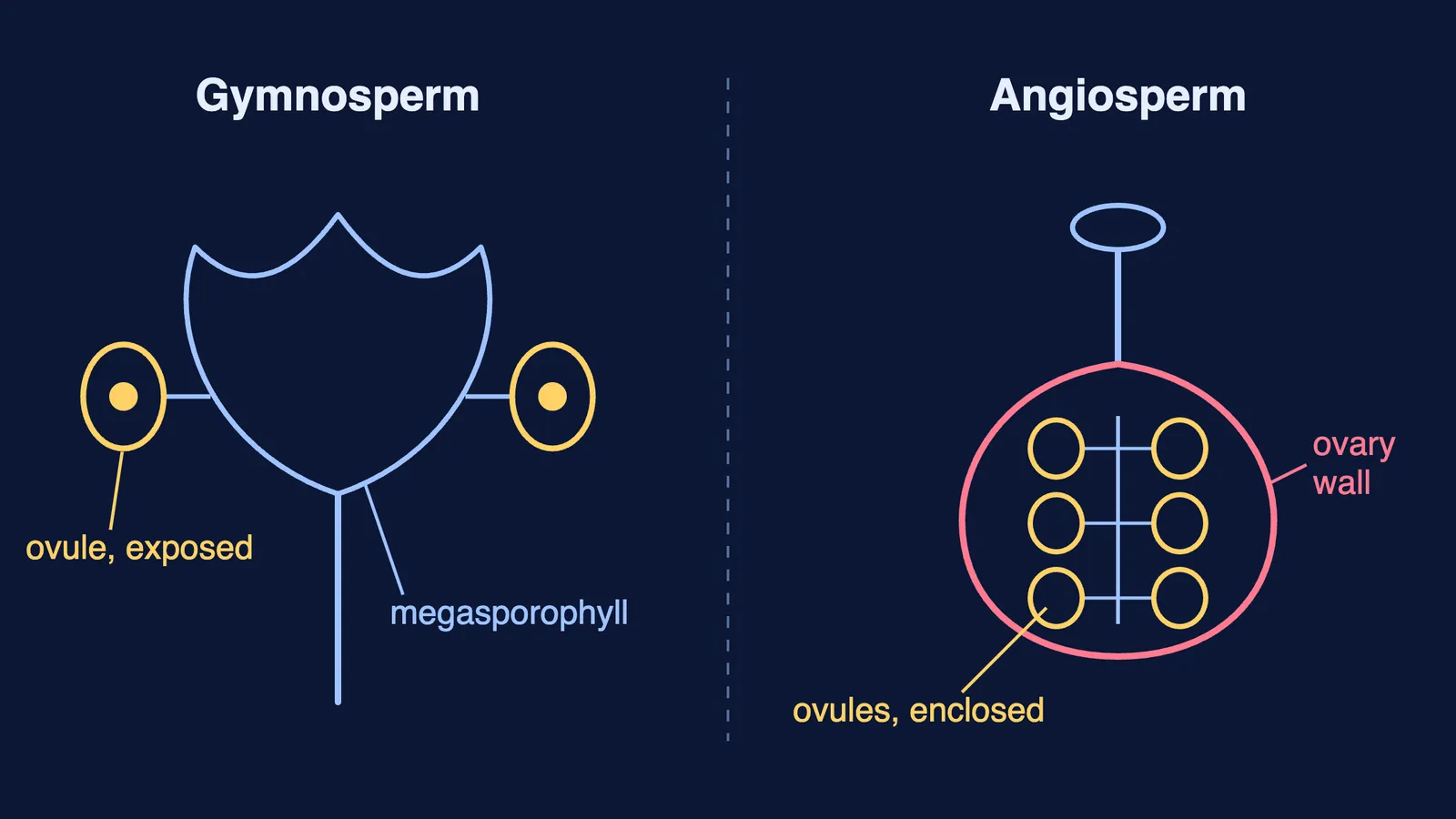
Q2 (easy). Assertion (A): Gymnosperms are called naked-seeded plants. Reason (R): Their ovules are enclosed in an ovary wall that does not ripen into a fruit.
Answer: (C). A is true. R is false: NCERT says gymnosperm ovules are not enclosed by any ovary wall and stay exposed before and after fertilisation. Trap: "does not ripen into a fruit" sounds sensible, so the false first half slips past.
Q3 (medium). Assertion (A): In mosses, the protonema develops from the leafy stage as a lateral bud. Reason (R): The gametophyte is the predominant stage in the life cycle of a moss.
Answer: (D). A is false and reversed: the protonema develops directly from a spore, and the leafy stage develops from the secondary protonema as a lateral bud. R is true. Trap: remembering "lateral bud" without remembering which stage grows from which.
Q4 (medium). Assertion (A): The spread of living pteridophytes is limited to narrow geographical regions. Reason (R): Pteridophytes were the first terrestrial plants to possess vascular tissues, xylem and phloem.
Answer: (B). Both are true, but NCERT section 3.3 blames the limited spread on the gametophyte's need for cool, damp, shady places and on water being needed for fertilisation. Vascular tissue is not that reason. Trap: R is the best-known pteridophyte fact, so it feels like the reason.
Q5 (hard). Assertion (A): One brown alga can look olive green while another looks dark brown. Reason (R): Brown algae differ in how much of the xanthophyll fucoxanthin they contain.
Answer: (A). Both are true, and NCERT ties the olive-green-to-brown colour range directly to how much fucoxanthin is present. Trap: choosing (B) because chlorophyll a and c are also present.
Q6 (hard). Assertion (A): In Pinus, male and female cones are borne on the same tree. Reason (R): Gymnosperms are heterosporous, producing microspores and megaspores.
Answer: (B). Both are true, but making two kinds of spores says nothing about where the cones sit. Cycas is also heterosporous, yet NCERT section 3.4 says its male cones and megasporophylls are borne on different trees. Trap: "two kinds of spores" and "two kinds of cones" sound like cause and effect.
Statement I and Statement II questions on Plant Kingdom
Q7 (easy). Statement I: Agar, obtained from Gelidium and Gracilaria, is used to grow microbes and in preparing ice-creams and jellies. Statement II: Chlorella, a unicellular alga rich in proteins, is used as a food supplement.
Answer: (A). Both match NCERT section 3.1. Trap: doubting Statement I because agar sounds like a lab-only product.
Q8 (medium). Statement I: Red algae store food as floridean starch, which is very similar to amylopectin and glycogen in structure. Statement II: Red algae reproduce asexually by biflagellate zoospores.
Answer: (C). Statement I is correct. Statement II is wrong: red algae reproduce asexually by non-motile spores, and NCERT's table lists their flagella as absent. Biflagellate zoospores belong to brown algae. Trap: carrying the brown-algae spore over to the red algae.
Q9 (hard). Statement I: As in pteridophytes, the male and female gametophytes of gymnosperms are free-living. Statement II: In Selaginella and Salvinia, megaspores give rise to female gametophytes that are retained on the parent sporophyte for variable periods.
Answer: (D). NCERT says gymnosperm gametophytes have no independent free-living existence and stay within the sporangia on the sporophyte, so Statement I is wrong. Statement II is correct. Trap: the free-living fern prothallus makes Statement I feel safe.
Q10 (hard). Statement I: Green algae have a rigid cell wall with an inner layer of pectose and an outer layer of cellulose. Statement II: In Cycas, coralloid roots are associated with mycorrhizal fungi.
Answer: (B). Both are incorrect. The layers are swapped: cellulose is inner and pectose outer. Coralloid roots of Cycas hold N2-fixing cyanobacteria; mycorrhiza is the Pinus example. Trap: each line uses the right words with one detail moved.
How should you use this set?
Do all ten in 12 minutes without notes, writing T or F above each line before choosing a key.
Score yourself, then sort every miss: a wrong fact (fix it in NCERT) or a wrong link (run the counter-example test).
Redo the misses two days later, and write a new false version of each by moving one feature to a neighbouring group.
Every key appears at least twice, so a run of one letter tells you nothing.
If a miss comes from a concept gap, such as what heterospory is and why it matters, the Fermi Concept Library has every concept in biology with its own lesson. For more on the format itself, read our assertion-reason strategy.