On this page
The car behind you has its high beams on. You flick the tab under the rear-view mirror, and the glare shrinks to two soft dots. Nothing electrical happened: the trick is a piece of glass slightly thicker at one edge than the other, plus the fact that bare glass makes a poor mirror.
What is inside a day-night rear-view mirror?
A manual day-night mirror, also called a prismatic mirror, is a piece of glass that is wedge-shaped in cross-section, so its front and back surfaces are not parallel (Wikipedia: Rearview mirror). Like most household mirrors, it carries a thin reflective layer on the back of the glass (Wikipedia: Mirror).
That gives the mirror two reflecting surfaces, one strong and one weak:
The metal-coated back. Silver can reflect up to 98 or 99% of light, and aluminium reflects 85 to 90% of visible light (Wikipedia: Mirror).
The bare front glass. For glass with refractive index 1.5, about 4% of light arriving straight on is reflected at the air-glass surface (LibreTexts: Reflection and transmission at an interface/01:_Basic_Electromagnetic_and_Wave_Optics/1.10:_Reflection_and_Transmission_at_an_Interface)).
Because the surfaces are tilted against each other, the two reflections of a headlight leave in different directions. Only one can reach your eye at a time, and the tab chooses which.
How does the day-night mirror in a car work?
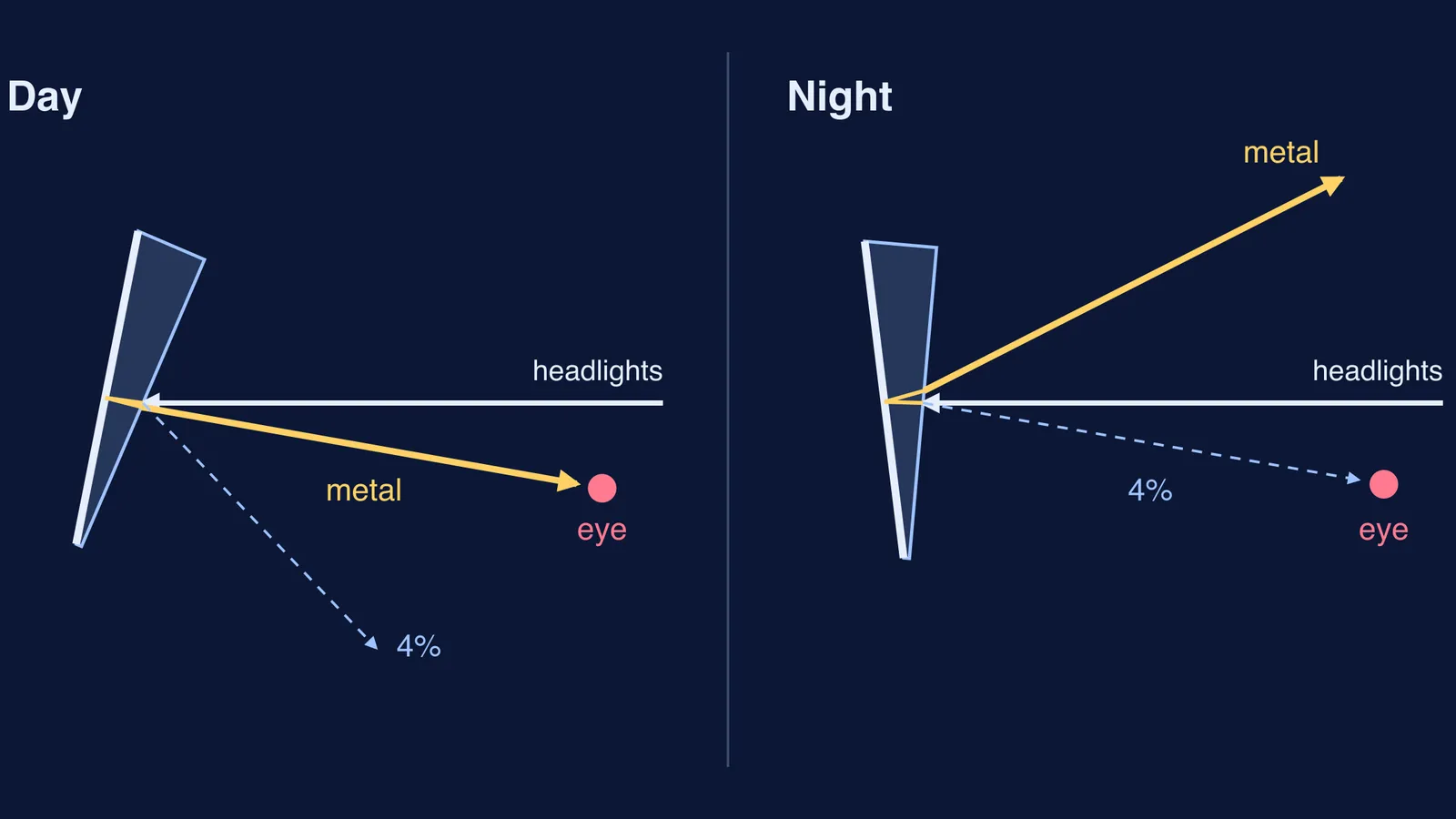
In the diagram at the top, light from the headlights behind you comes in from the right.
Day position: the ray that enters the glass, bounces off the metal back and comes out again (yellow) heads for your eye. The weak front-surface reflection (dashed) goes down towards your lap, so you never notice it.
Night position: the tab tilts the whole wedge a little. Now the faint front-surface reflection lands on your eye, and the bright metal reflection is thrown up towards the roof.
In night mode the main mirror points up at the dark ceiling while the glass wedge points out of the rear window (A Moment of Science). These mirrors first appeared in the 1930s and were standard on most passenger cars and trucks by the early 1970s; many newer cars instead dim automatically with light sensors and electrochromism (Wikipedia: Rearview mirror).
How much dimmer is the night setting?
A worked estimate from the figures above (a rough model, not a measurement of any particular car):
Day path: the light crosses the front glass twice, in and out. Each crossing reflects away about 4%, so about 96% gets through each way (LibreTexts/01:_Basic_Electromagnetic_and_Wave_Optics/1.10:_Reflection_and_Transmission_at_an_Interface)).
With a silver backing at 99% (Wikipedia: Mirror): 0.96 × 0.99 × 0.96 ≈ 0.91, so about 91% comes back to you.
With an aluminium backing at 85%: 0.96 × 0.85 × 0.96 ≈ 0.78, so about 78%.
Night path: only the front-surface reflection reaches you, about 4%.
Ratio: 0.78 ÷ 0.04 ≈ 20 and 0.91 ÷ 0.04 ≈ 23. The headlights arrive roughly 20 times weaker.
The model ignores light that bounces more than once inside the glass, and the 4% figure is for light arriving straight on, which rear-view mirror light roughly does.
Why do the two reflections go in different directions?
Tilt a plain mirror by an angle α and its reflected ray turns by 2α, from the law of reflection. In the wedge, the back surface is tilted by α relative to the front, but the ray reaches it through glass. Leaving the glass, refraction bends the ray away from the normal, which multiplies the small inside angle by about n. You can revise that step in our post on when light bends towards the normal.
The result, for a thin wedge and small angles: the metal reflection leaves at about 2nα from the front-surface reflection. With n = 1.5 that is about 3α. So if a wedge had an angle of 3 degrees, the two images would be about 9 degrees apart, enough to aim one at your eye and the other at the roof.
If you find it hard to picture rays bending inside a block, the Fermi Simulation Lab has interactive simulations for ideas that are easier to see than to read.
How can you check this in your own car?
You need a parked car and two minutes; set the mirror back afterwards.
In daylight, flip to night. You may see a dim view out of the back window with a second image of the roof lining over it: the metal reflection, now aimed at you.
At night, with a streetlight behind the car, flip between positions. The light stays in roughly the same place but dims sharply.
Your own reflection in a window after dark is the same weak glass reflection; see why windows show reflections at night.
On paper, draw the wedge, mark the normals at both surfaces and trace one ray each way. The laws of regular reflection are all you need for the bounces.
To practise more refraction and reflection numericals step by step, the Fermi Problem Library has worked problems with a solver that explains the reasoning rather than printing an answer.