

On this page
A polished steel plate shows you your face; a sheet of paper does not. The physics of each ray is the same. What changes is the surface, and once you see that, a classic exam question ("does diffuse reflection break the laws of reflection?") answers itself.
What is the difference between regular and diffuse reflection?
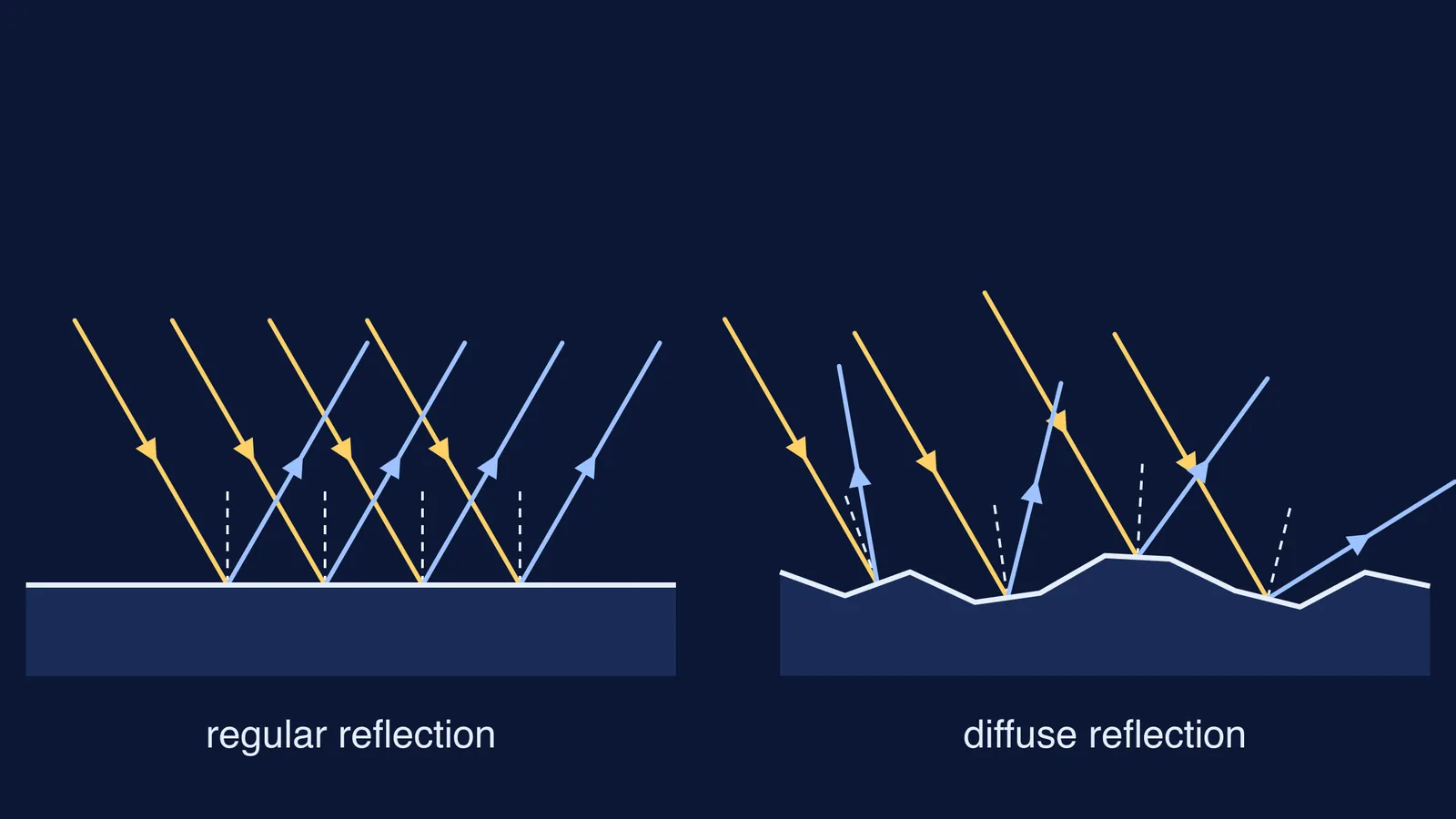
Regular reflection (also called specular reflection) happens at a smooth surface: a parallel beam comes in and leaves as a parallel beam, so you see a clear image. Diffuse reflection happens at a rough surface: the same parallel beam leaves in many directions, so you see the surface itself but no image.
According to OpenStax University Physics, Volume 3, light hitting a rough surface "is reflected in many different directions, or diffused", because it strikes different parts of the surface at different angles. The same section notes that diffused light lets you see a sheet of paper from any angle, and people, clothing, leaves and walls from all sides.
Regular: a mirror or polished steel. You see an image, from one direction only.
Diffuse: paper, a painted wall, cloth. You see the object from anywhere, but no image.
How smooth does a surface have to be?
"Smooth" is measured against the wavelength of light, not against your fingertips. OpenStax describes a mirror as having a smooth surface "compared with the wavelength of light" (OpenStax University Physics, section 1.2).
The human eye typically detects wavelengths from 380 to 700 nanometres, according to NASA's guide to visible light.
So a surface acts like a mirror only if its bumps are much smaller than a few hundred nanometres. Paper can feel smooth to your hand and still be far too rough for light.
Do the laws of reflection hold for diffuse reflection?
Yes, at every single point. The laws, as stated in Richard Fitzpatrick's University of Texas lecture notes on geometric optics, are:
The incident ray, the reflected ray and the normal to the surface all lie in the same plane.
The angle of reflection equals the angle of incidence.
The same notes say that for rough surfaces "the law of reflection remains valid"; the normal simply varies in direction from point to point.
The detail that matters is where the angles are measured from. OpenStax College Physics 2e measures them from the perpendicular to the surface at the point where the ray strikes. On a mirror, that perpendicular (the normal) points the same way everywhere. On a rough surface, it changes from point to point. Each tiny patch acts as a small plane mirror tilted its own way, so every ray obeys the law, yet the reflected rays spread out.
Worked example: one beam, three patches
A parallel beam arrives at 30 degrees to the vertical, coming from the left. Take vertical as the average normal of a rough surface, and look at three patches.
Flat patch. Normal vertical. i = 30 degrees, so r = 30 degrees: the ray leaves 30 degrees right of vertical.
Patch tilted 10 degrees towards the light. Its normal leans 10 degrees left. i = 20 degrees, r = 20 degrees on the other side of that normal: the ray leaves 10 degrees right of vertical.
Patch tilted 10 degrees away from the light. Its normal leans 10 degrees right. i = 40 degrees, r = 40 degrees: the ray leaves 50 degrees right of vertical.
Three parallel rays went in; they came out at 10, 30 and 50 degrees. Every one of them obeyed i = r. The pattern is worth remembering: tilt a patch by some angle and the reflected ray turns by twice that angle. A real rough surface has countless patches at random tilts, so the light goes everywhere.
If normals swinging from patch to patch are hard to picture, the Fermi Simulation Lab has interactive simulations for ideas that are easier to see than to read.
How do you answer this in an exam?
A checklist for a short-answer question:
Define both in one line each: smooth surface, parallel rays stay parallel; rough surface, they scatter.
Draw parallel rays on a straight line and on a jagged line, side by side.
On the jagged line, draw a dashed normal at each point where a ray lands, perpendicular to that small patch.
Mark equal i and r at one of those points.
State that the irregular surface causes the scattering, not a failure of the laws, and give an example of each.
To revise the laws of reflection alongside related ideas such as images in plane mirrors, each topic has its own lesson in the Fermi Concept Library.
Next time you read under a lamp, tilt the page: the words stay readable from almost any angle, because the rough paper sends light in every direction.


