On this page
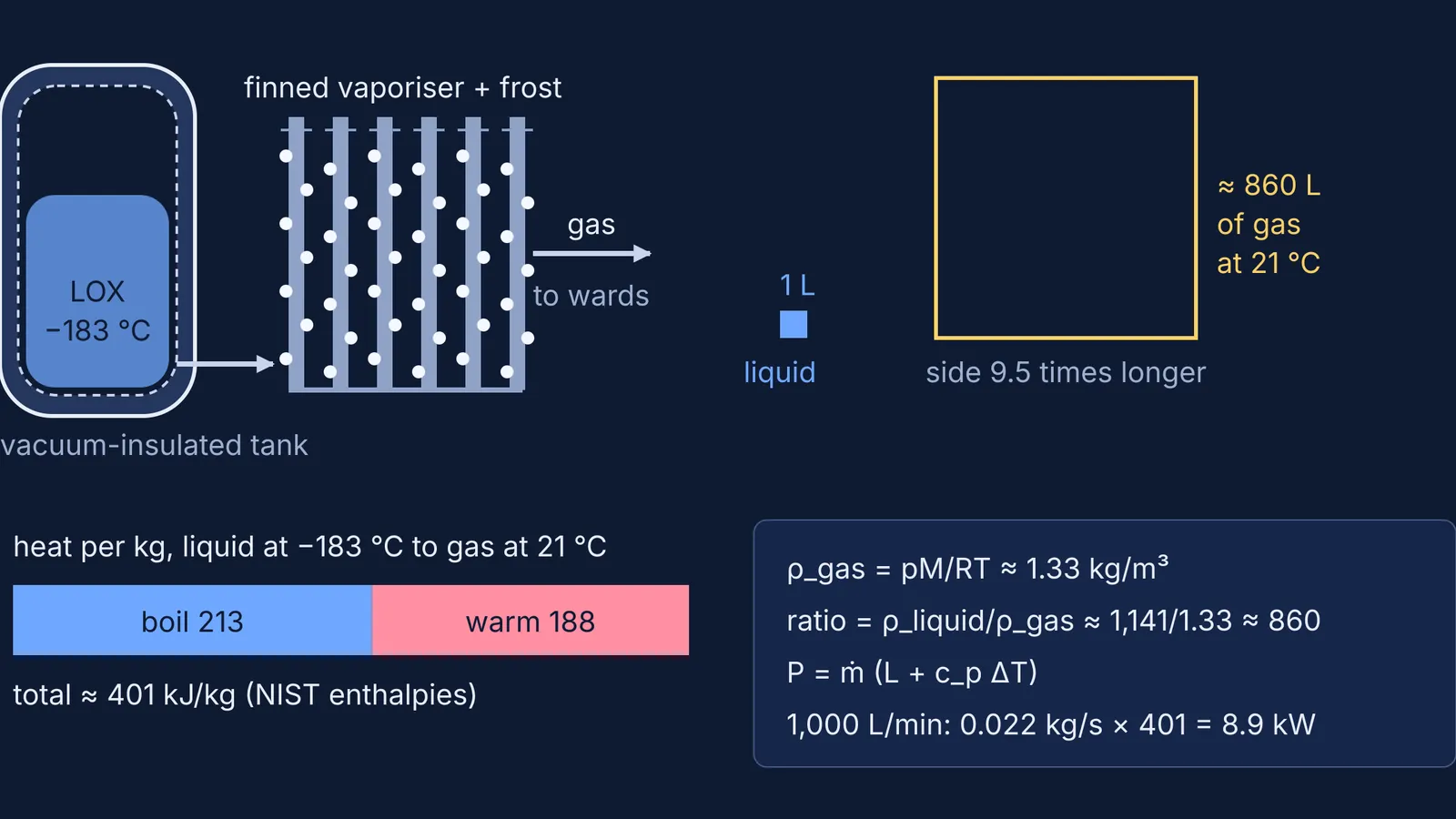
Many large hospitals do not store their oxygen in rows of steel cylinders. They keep it in a tall white tank outside the building, as a pale blue liquid at about −183 °C. A pipe runs from the tank to a set of finned metal tubes, and from there the gas goes to the wards. On a humid day those fins are often thick with frost, even in an Indian summer. Two pieces of Class 11 physics explain the whole set-up: the ideal gas equation tells you why the liquid is worth the trouble, and latent heat tells you why the fins freeze.
How much gas does one litre of liquid oxygen make?
Liquid oxygen at its normal boiling point (90.19 K, or −183 °C, at 1 atm) has a density of about 1,141 kg/m³, according to the NIST Chemistry WebBook data for oxygen. The same source gives the density of oxygen gas at 1 atm as 1.327 kg/m³ at 21 °C and 1.354 kg/m³ at 15 °C.
You can check the gas density yourself with the ideal gas equation in the form ρ = pM/RT:
ρ = (101,325 Pa × 0.032 kg/mol) / (8.314 J/(mol K) × 294.15 K) = 1.326 kg/m³
That matches NIST to within 0.1%, because oxygen at room temperature and 1 atm behaves almost ideally.
Since mass does not change when the liquid boils, the expansion ratio is just the ratio of the two densities:
At 21 °C: 1,141 / 1.327 = 860. One litre of liquid gives about 860 litres of gas.
At 15 °C: 1,141 / 1.354 = 843.
The answer depends on the temperature you choose for the gas, which is why sources quote slightly different numbers. Linde's safety advice on cryogenic liquefied gases says one litre of liquid oxygen produces approximately 850 litres of gas.
That ratio is the whole reason for the tank. A high-pressure cylinder also packs gas in tightly, as the oxygen cylinder problem on gas withdrawn shows with pV = nRT, but it needs thick steel walls. The liquid gets its density from being cold, not from high pressure. The tank holds it at only a few bar inside a vacuum-insulated double wall, and a little of it always boils off.
How long would a hospital tank last?
Take an illustrative tank holding 10 kL (10 m³) of liquid.
Mass of liquid. m = ρV = 1,141 × 10 = 11,410 kg, about 11.4 tonnes.
Volume as gas at 21 °C. V = m/ρ_gas = 11,410 / 1.327 ≈ 8,600 m³.
One patient's use. At an illustrative 10 litres a minute, one patient uses 10 × 60 × 24 = 14,400 L, or 14.4 m³, a day.
Patient-days. 8,600 / 14.4 ≈ 600 patient-days of supply from one tank.
These are physics numbers to show scale, not medical guidance. Real flow rates are set by doctors for each patient.
Why do the vaporiser fins frost over?
To turn the liquid back into gas at room temperature, you have to supply two amounts of heat to every kilogram:
Latent heat of vaporisation, to boil the liquid at −183 °C. From NIST's enthalpy values at 1 atm, L ≈ 213 kJ/kg.
Sensible heat, to warm the cold gas from −183 °C to about 21 °C. NIST's enthalpies give 188 kJ/kg for this step, which means an average specific heat of 188 / 204 ≈ 0.92 kJ/(kg K).
Together that is Q = L + c_pΔT ≈ 213 + 188 = 401 kJ for every kilogram. Notice the warming step is almost as large as the boiling step. Many textbook problems stop at mL and miss nearly half the heat.
A hospital vaporiser usually has no heater at all. It is a bank of finned metal tubes that takes this heat from the surrounding air. The tubes run far below 0 °C, so water vapour in the air condenses on them and freezes. This is the same auto-refrigeration that makes an LPG cylinder grow frost, but here the liquid starts 140 degrees colder and the gas must be warmed all the way back up.
Worked example: how much heat does the vaporiser need?
A hospital draws gas at 1,000 litres a minute, measured at 21 °C and 1 atm. How much heat must the vaporiser take from the air?
Volume flow. 1,000 L/min = 1.0 m³/min = 1.0/60 m³/s.
Mass flow. ṁ = ρ_gas × volume flow = 1.327 × (1.0/60) = 0.0221 kg/s.
Heat per kilogram. q = L + c_pΔT = 213 + 188 = 401 kJ/kg.
Power. P = ṁq = 0.0221 × 401 = 8.86 kJ/s, or about 8.9 kW.
Check the units. (kg/s) × (kJ/kg) = kJ/s = kW. Good.
Per hour. ṁ × 3,600 = 80 kg of liquid, about 70 litres, every hour.
So a steady 8.9 kW must flow from the air into the tubes, about as much heat as four or five 2 kW room heaters give out. On a still, humid night the air near the fins cools and the frost layer, which insulates the tubes, grows. So a vaporiser has to be sized for its worst weather, not its average day.
What safety rules apply to liquid oxygen?
The physics above comes with real hazards. Air with extra oxygen makes things burn far more fiercely: clothing, oil and grease can catch fire easily and burn hot and fast. Liquid oxygen and the cold gas near it cause severe cold burns to skin and eyes on contact, like burns from a hot source. Linde's safety advice says cryogenic liquids must only be decanted by trained operators, and that smoking and open flames must not be allowed where oxygen is stored, handled or used.
So only trained staff should ever handle liquid oxygen or its equipment. Never smoke or bring a flame near oxygen, whether it is a hospital tank, a cylinder or a home concentrator. This post explains the physics only and is not medical or handling guidance.
The oxygen in these tanks is made by boiling it out of liquid air, as covered in fractional distillation of liquid air.
To revise latent heat and specific heat, try the Concept Library, or work similar mixed-heat problems step by step in the Fermi Problem Library.
Quick checklist
Expansion ratio = ρ_liquid / ρ_gas ≈ 1,141 / 1.327 ≈ 860 at 21 °C (843 at 15 °C).
Gas density from ρ = pM/RT; oxygen at 1 atm is nearly ideal.
Heat to vaporise and warm: q = L + c_pΔT ≈ 213 + 188 ≈ 401 kJ/kg.
Vaporiser power: P = ṁq; 1,000 L/min needs about 8.9 kW from the air.
Frost forms because the tubes run far below 0 °C.
Oxygen-rich air makes fires fierce; liquid oxygen causes cold burns. Trained staff only, no smoking or flames.