

On this page
Air is a mixture of gases, mostly nitrogen and oxygen, with a small amount of argon. Because these gases have different boiling points, they can be separated on an industrial scale using a process called fractional distillation.
Before distillation begins, the air must be purified and turned into a liquid. Once liquefied, it is slowly warmed so that each gas boils off and can be collected one by one. This method is the most common way to produce pure gases for industrial and medical use.
How is air turned into a liquid?
The first step in separating air is to remove impurities. Air is filtered to clear out dust, and then cooled to remove water vapour and carbon dioxide. If these were left in the mixture, they would freeze into solid ice and dry ice, blocking the pipes 1.
Once purified, the air undergoes a continuous cycle of compression and expansion. First, it is compressed to high pressures, which naturally causes it to heat up. The hot, compressed air is then passed through a series of cooling coils to bring its temperature down. After cooling, it is allowed to expand rapidly through a valve. This rapid expansion—known as the Joule-Thomson effect—causes the temperature to drop drastically. By repeating this compression and expansion cycle, the temperature is steadily lowered to below −195 °C 2, at which point the air condenses into a pale blue liquid.
If you have concept gaps in thermodynamics and want to see how pressure, volume and temperature are related during expansion, the Fermi Concept Library covers every concept in physics and chemistry, each with its own lesson and its place in the map.
What are the boiling points of gases in air?
Fractional distillation works because each component of liquid air turns back into a gas at a different temperature. The key boiling points at standard atmospheric pressure are:
Because nitrogen has the lowest boiling point, it is the first to boil. Oxygen, with the highest boiling point of the three, remains a liquid the longest.
How does the fractionating column work?
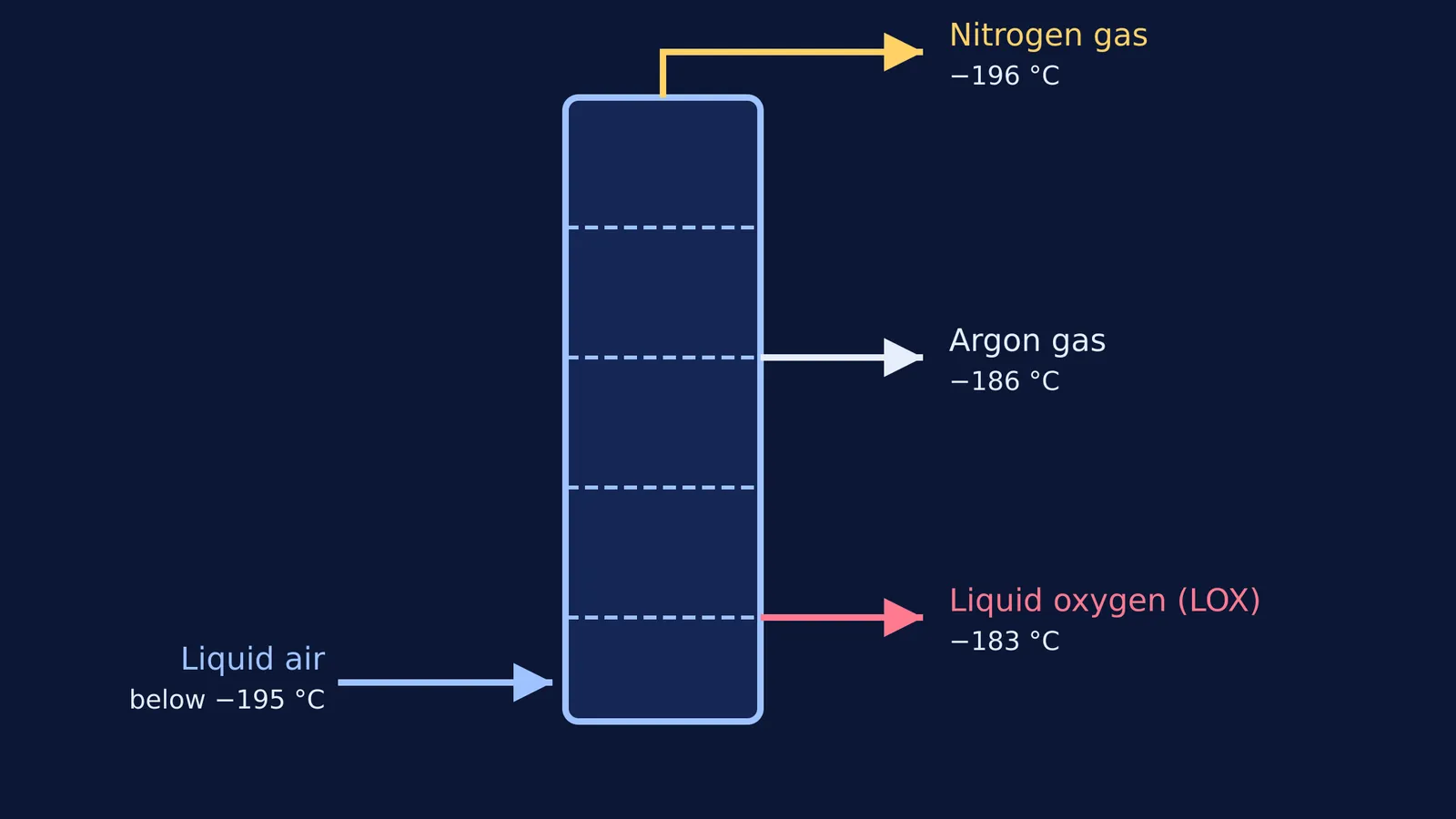
The liquid air, now sitting below −195 °C, is pumped into the bottom of a tall fractionating column. The column is designed with a careful temperature gradient: it is slightly warmer at the bottom and colder at the top 3.
As the liquid air slowly warms up, the nitrogen boils first. When the temperature reaches −196 °C, nitrogen turns into a gas and rises to the top of the column, where it is piped off and collected 1.
Argon boils next at −186 °C. It is drawn off from the middle section of the column. Finally, oxygen, which boils at −183 °C, is collected at the bottom. Often, it is kept as liquid oxygen (LOX) because it is easier to transport and store in its liquid state 1.
Why do we separate gases from air?
The gases extracted from air have crucial roles in medicine, industry and research.
Nitrogen makes up about 78% of the Earth's atmosphere by volume 4. Because it is highly unreactive, nitrogen is widely used to create an inert atmosphere for food packaging and for manufacturing electronics. In its liquid form, it is a standard cryogen used to freeze biological samples and in cryosurgery.
Oxygen is highly reactive and essential for combustion and respiration. It is used heavily in steelmaking, where massive amounts are required for basic oxygen steelmaking furnaces 1. Medical-grade oxygen is vital for hospitals, ambulances, and respiratory therapy. In rocketry, liquid oxygen acts as an oxidizer for rocket engines 1.
Argon, the third-most abundant gas in the atmosphere, is extremely chemically inert 5. It is used as a shielding gas in arc welding to protect the hot metal from reacting with oxygen, and inside incandescent light bulbs to stop the filament from burning up.
A step-by-step summary for exam prep
When answering questions about the fractional distillation of liquid air, you can use this checklist to make sure you cover all the key marks:
Purify: Filter out dust, then freeze out water and carbon dioxide.
Compress and cool: Compress the air, cool it, and let it expand to reach below −195 °C and liquefy.
Warm slowly: Pump the liquid air into a fractionating column.
Collect by boiling point: Nitrogen boils off at −196 °C, argon at −186 °C, and oxygen at −183 °C.
If you make wrong-method mistakes when setting up the equations for gas mixtures, you can practice with the Fermi Problem Library. It offers worked problems with a step-by-step solver that explains the reasoning rather than printing an answer.
For more on how gases behave, you might read about the Free expansion of an ideal gas: why work and ΔU are both zero or look at Converting PV, PT and VT graphs of ideal gas processes. If you need to calculate properties of mixtures, try our guide on the Average molar mass of a gas mixture: worked air and vapour examples.


