On this page
Before satellite navigation, a navigator could find a transmitter's direction with a coil of wire turning on a vertical shaft. Aircraft still carry a version of it, the automatic direction finder (ADF). The physics is Faraday's law applied to a radio wave's magnetic field. The surprise is that the operator does not hunt for the loudest signal. They hunt for silence.
How does a loop aerial pick up a radio wave?
Far from a transmitter, a radio wave is a plane EM wave. Its electric and magnetic fields are at right angles to each other and to the direction the wave travels, and their sizes are linked by B = E/c, as in the E₀/B₀ = c relation for EM waves. A medium-wave station uses a vertical mast, so near the ground E is vertical and B is horizontal, at right angles to the line to the station.
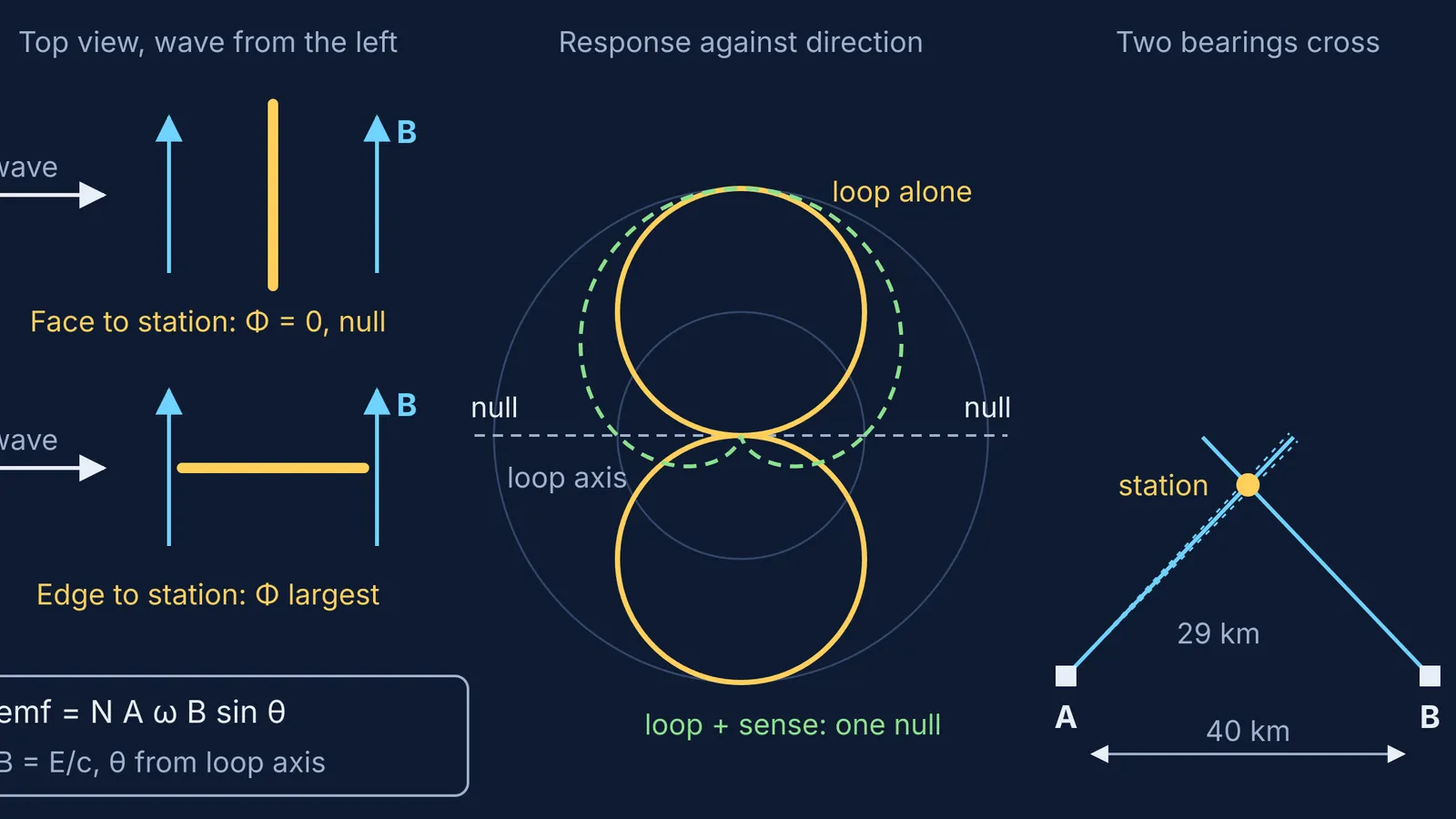
Now hang a vertical loop of N turns and area A in that wave. The flux through it is Φ = N A B sin θ, where θ is the angle between the loop's axis (the line through its centre, at right angles to its face) and the direction of the station. B oscillates at the wave's angular frequency ω, so by Faraday's law the emf is
emf = N A ω B sin θ
This is the same law that drives a hearing aid's telecoil in a hearing loop, except that here the direction of the field is what you want to know.
Why does the signal vanish when the loop faces the station?
Turn the loop so its face looks straight at the station (θ = 0). The horizontal B is at right angles to the line to the station, so it lies flat in the plane of the loop. No field lines pass through the loop, the flux is zero, and so is the emf. Turn the loop 90° so its edge points at the station, and B passes straight through the loop. The flux, and the signal, are now as large as they get.
Plotted against direction, sin θ gives a figure-eight with two sharp nulls along the loop's axis. The FAA Instrument Flying Handbook (chapter 9) describes the ADF loop the same way: it "receives signals better from two directions (bidirectional)".
Why do operators turn to the null, not the peak?
Because sin θ changes fastest near zero and slowest near 90°.
2° from the null: sin 2° = 0.035, so 3.5% of the full signal, or 29 dB down.
5° from the null: sin 5° = 0.087, or 8.7%, 21 dB down.
10° from the peak: cos 10° = 0.985, so 98.5% of the full signal, only 0.13 dB down.
Your ear cannot tell 98.5% from 100%, but it easily hears a signal fall tenfold. So you swing the loop until the station fades out and read the bearing. The same trick of finding a field's direction from where a coil's emf vanishes is used in the earth inductor for measuring dip.
Worked example: how big is the signal from a medium-wave station?
Take a station at 1 MHz whose field at your receiver is E = 1 mV/m (an illustrative round value, typical of a station some distance away), and a square loop 0.3 m × 0.3 m with 10 turns.
Wavelength. λ = c/f = 3.00 × 10⁸ / 1.0 × 10⁶ = 300 m. The loop's perimeter is 1.2 m, 0.4% of λ, so the small-loop picture holds.
Magnetic field. B = E/c = 1.0 × 10⁻³ / 3.00 × 10⁸ = 3.3 × 10⁻¹² T, or 3.3 pT.
Angular frequency. ω = 2πf = 6.28 × 10⁶ rad/s.
Peak emf, edge to the station. emf = N A ω B = 10 × 0.09 × 6.28 × 10⁶ × 3.3 × 10⁻¹² = 1.9 × 10⁻⁵ V, about 19 µV.
Units check. T m² s⁻¹ = Wb/s = V.
Cross-check. Putting B = E/c and ω = 2πc/λ together gives emf = (2πNA/λ) E. Here 2πNA/λ = 0.0189 m, so emf = 0.0189 × 1.0 × 10⁻³ = 19 µV again.
Near the null. At 2° off, the emf is 19 × 0.035 = 0.66 µV.
How does a sense antenna settle the 180° ambiguity?
A figure-eight has two nulls, 180° apart. A null at 40° could mean the station is at 40° or at 220°. The loop alone cannot tell which.
The fix is a short vertical wire, the sense antenna, which responds equally in every direction. The loop's output flips sign across the null, so its two lobes are opposite in phase. The receiver shifts the sense signal by 90° (the loop responds to dB/dt, the wire to E), scales it to match, and adds the two. The total goes as 1 + sin θ: large on one side, zero on the other. This is a heart-shaped pattern, a cardioid, with a single null. The FAA handbook puts it plainly: with loop and sense inputs processed together, the receiver hears the signal "well in all directions but one, thus resolving all directional ambiguity."
You take the bearing from the sharp loop null and use the sense antenna only to pick which direction is real.
How do two bearings fix the station's position?
One bearing gives a line; two lines from two places cross at the station. Aircraft once fixed their position this way, and amateur radio "fox hunts" still track hidden transmitters like this.
Say receivers A and B are 40 km apart, east-west. A finds the station at a bearing of 43.6° and B at 316.4°. The lines cross 20 km east of A and 21 km north, √(20² + 21²) = 29 km from each. If A's bearing is 1° out, its line moves sideways at the station by 29 × tan 1° = 0.51 km. The two lines cross at 87°, nearly at right angles, so the fix moves by about the same amount. A 1° bearing error at 29 km is about half a kilometre on the map.
At night, waves reflected from the ionosphere (sky waves) arrive from above with a tilted field, which fills in the null and makes it wander. The FAA handbook warns that AM broadcast stations are "much more susceptible to sky wave propagation especially from dusk to dawn", and that aircraft beacons use 190 to 535 kHz.
You can practise these angle conventions with the step-by-step solver in the Fermi Problem Library, which explains the reasoning at each step. If you are preparing for JEE Main and Advanced, Fermi Test Prep offers personalised preparation with an AI tutor, live classes, adaptive mocks, mentorship and a study plan that updates based on mastery.
Quick checklist
A radio wave's B is horizontal and at right angles to the line to the station; B = E/c.
Loop flux Φ = NAB sin θ, θ from the loop's axis to the station; emf = NAωB sin θ.
Face to the station: zero flux, a null. Edge to the station: the largest signal.
The null is sharp (2° off is 29 dB down); the peak is flat (10° off is 0.13 dB down).
A sense antenna adds a uniform signal, giving a cardioid with one null and ending the 180° doubt.