On this page
A sign showing an ear and a letter T means the room has a hearing loop: a wire laid round the floor that carries the sound as an electric current. A hearing aid switched to its "T" setting picks the sound straight out of the magnetic field, without the echo and crowd noise between the speaker and the listener, and with nothing to pair. The whole system is Faraday's law with numbers you can work out.
How does a hearing loop send sound without radio?
An amplifier drives the microphone signal as a current through wire laid round the room. The current follows the sound waveform: a 1 kHz tone makes a current that reverses direction 1,000 times a second. That current makes a magnetic field that changes at the same rate.
There is no carrier wave: the field is the audio itself, as described in the European standards body's technical report on hearing loop systems, ETSI TR 103 614, which also says these systems work between about 10 Hz and 9 kHz.
Inside the hearing aid, a telecoil (a few hundred turns of fine wire on a tiny ferrite rod) picks up the changing flux as an emf, ε = −N dΦ/dt. This is the coupling worked in mutual inductance of a small loop at the centre of a large loop, except that here the small loop is a millimetre-sized coil sitting 1.2 m above the floor.
What field strength does the IEC 60118-4 standard ask for?
Loop fields are quoted as magnetic field strength H, in mA/m. The international standard is IEC 60118-4, and the same ETSI report summarises what it requires:
The reference level, called 0 dB, is 400 mA/m.
With a steady 1 kHz test tone, the loop should be able to give about 100 mA/m on average and up to 400 mA/m where listeners' heads are. The extra room up to 400 mA/m is for the loudest peaks in speech or music.
Over the listening area of a large loop, the level should stay within ±3 dB.
The frequency response should stay within ±3 dB of the 1 kHz value from 100 Hz to 5 kHz.
In air, B = μ₀H. So 400 mA/m gives B = 4π × 10⁻⁷ × 0.400 = 5.03 × 10⁻⁷ T, or 0.50 µT. The 100 mA/m average gives 0.126 µT. Earth's field, roughly 50 µT, is a hundred times stronger but steady, so it induces no emf. Only changing flux counts.
How much current does a loop round a room need?
Problem. A room 8 m × 8 m has a single-turn square loop at floor level. A listener's ear is 1.2 m above the centre of the floor. What peak current gives 400 mA/m there?
Field on the axis of a square loop. For side a and height z above the centre, adding the four straight sides gives B = μ₀Ia² / [2π(z² + a²/4)√(z² + a²/2)]. At z = 0 this becomes the familiar 2√2μ₀I/πa.
Put in the numbers. With a = 8 m and z = 1.2 m: z² + a²/4 = 1.44 + 16 = 17.44 m², and √(z² + a²/2) = √33.44 = 5.783 m.
Field strength per ampere. H = B/μ₀ = Ia² / [2π × 17.44 × 5.783] = I × 64/633.7 = 0.1010 I per metre.
Solve. I = 0.400/0.1010 = 3.96 A. About 4 A on the speech peaks.
Check the units. A × m² / (m² × m) = A/m, which is right for H.
Compare with the floor. In the plane of the loop, H = 2√2I/πa = 2√2 × 3.96/(π × 8) = 0.446 A/m. Lifting the ear 1.2 m costs about 10%, the same fall-off with height you see on the axis of a circular loop.
Is the field the same everywhere in the room?
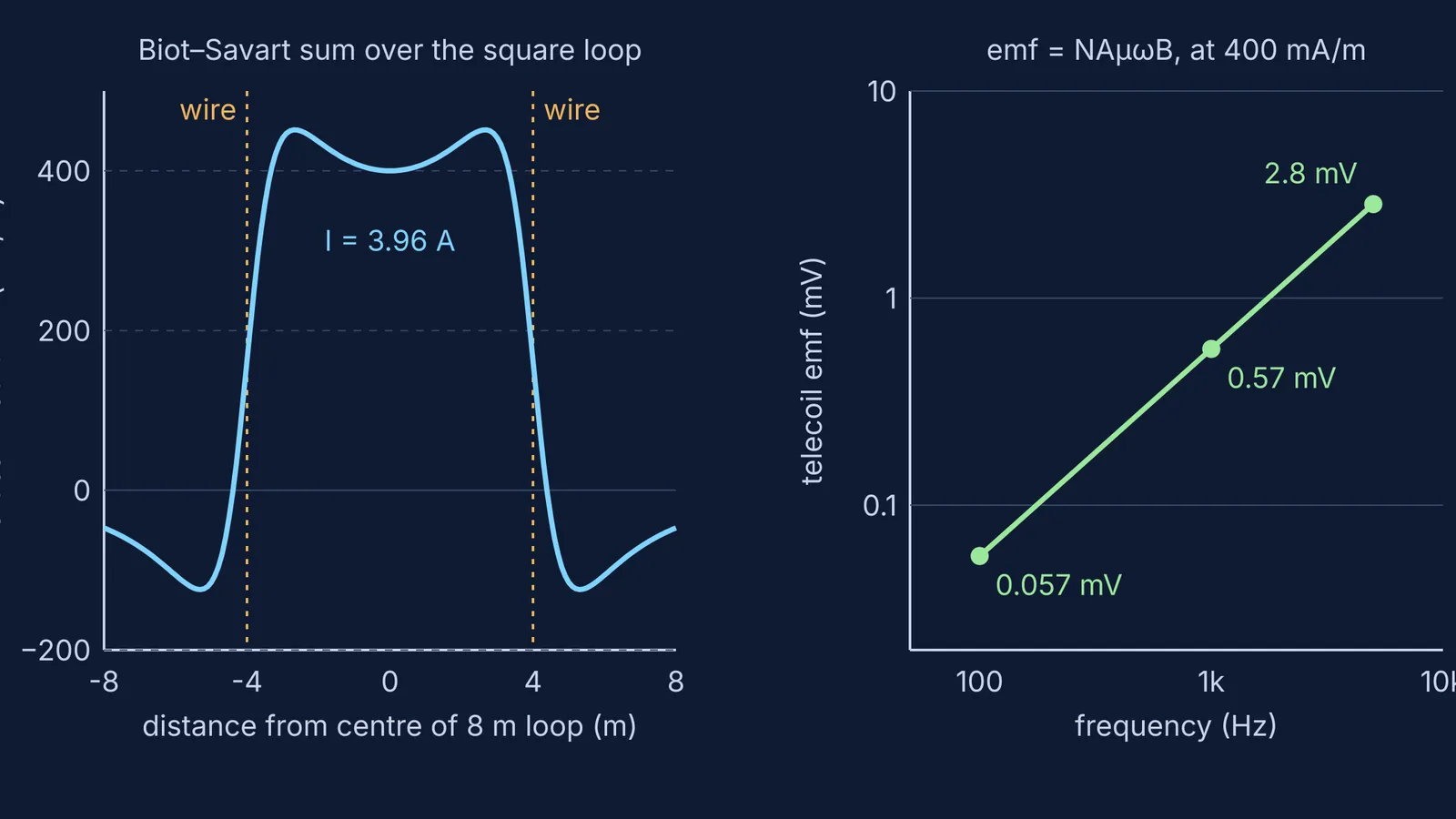
Not quite. A numerical Biot–Savart sum over all four sides for the same 3.96 A, at 1.2 m height, from the centre towards the middle of one side, gives:
Centre: 400 mA/m.
2.5 m out: 450 mA/m, or +1.0 dB.
3.5 m out, half a metre inside the wire: 359 mA/m, or −0.9 dB.
4.0 m, right above the wire: 162 mA/m, or −7.8 dB.
5.0 m, a metre outside the wire: 115 mA/m, pointing the other way.
Near the wire the field lines circle round it, so just above the wire the field is mostly horizontal. An upright telecoil picks up only the vertical part, so seats right over the wire get a weak signal. Everywhere more than about half a metre inside the wire stays within ±1 dB.
The field also leaks out of the room. The same sum gives about −30 dB at one loop width (8 m) beyond the wire and −44 dB at twice that, which matches the overspill figures in the ETSI report.
How big an emf does a hearing aid's telecoil get?
Take illustrative values, not from any datasheet: 400 turns, a cross-section of 3 mm × 3 mm (A = 9.0 × 10⁻⁶ m²), and a ferrite core that multiplies the flux 50 times (effective μ of 50). For a field B₀ sin ωt along the coil's axis, ε = NAμωB₀ cos ωt. Using the 0.50 µT field at 1 kHz:
ω = 2π × 1000 = 6283 rad/s.
NAμ = 400 × 9.0 × 10⁻⁶ × 50 = 0.180 m².
ε = 0.180 × 6283 × 5.03 × 10⁻⁷ = 5.7 × 10⁻⁴ V, about 0.57 mV.
At the 100 mA/m average level, the emf is a quarter of that, 0.14 mV. The coil must point along the field: only the component along its axis counts. Tilt your head 30° and the signal falls to cos 30° = 0.87 of its value (−1.2 dB). Lean back 60° and it halves (−6 dB).
Why does a telecoil's signal rise with frequency?
The emf depends on dB/dt, so it is proportional to ω. With the same 400 mA/m field, the coil above gives 0.057 mV at 100 Hz and 2.8 mV at 5 kHz, a ratio of 50, or 34 dB. The same happens in how an electric guitar pickup turns a steel string into a signal.
The loop itself is meant to deliver a flat field, so the loop amplifier drives a constant current even though the loop's inductive impedance changes with frequency (the ETSI report notes this). The rising emf is then corrected inside the hearing aid, which has to cut the treble relative to the bass by 20 dB per decade.
If you want to see how changing flux drives an induced current, the Fermi Simulation Lab has interactive simulations for ideas that are easier to see than read.
Quick checklist
A hearing loop is a current-carrying wire round a room; its changing magnetic field carries the sound.
B = μ₀H: the 400 mA/m reference level is 0.50 µT.
An 8 m square loop needs about 3.96 A for 400 mA/m at 1.2 m above the centre.
The vertical field is flat across most of the room and weak right above the wire.
Telecoil emf = NAμωB, so it rises 10 times for every 10-fold rise in frequency.
Only the field component along the coil's axis counts.