

On this page
If you are studying electromagnetic induction for JEE or NEET, the mutual inductance of two concentric loops is a classic derivation. It looks like a complex two-body problem that demands advanced integral calculus, but the physics relies on one powerful simplifying assumption: when the inner loop is much smaller than the outer loop (r ≪ R), the magnetic field across it is practically uniform.
Just as finding the potential of concentric spherical shells relies on treating the inner and outer shapes step-by-step, finding mutual inductance is about isolating one loop's effect on the other. Mutual inductance is the measure of how effectively a change in current in one coil induces an electromotive force (EMF) in a second coil. Here is the standard method to derive the mutual inductance M for concentric loops, along with a practical framework for tackling similar exam problems.
What is the mutual inductance of two concentric loops?
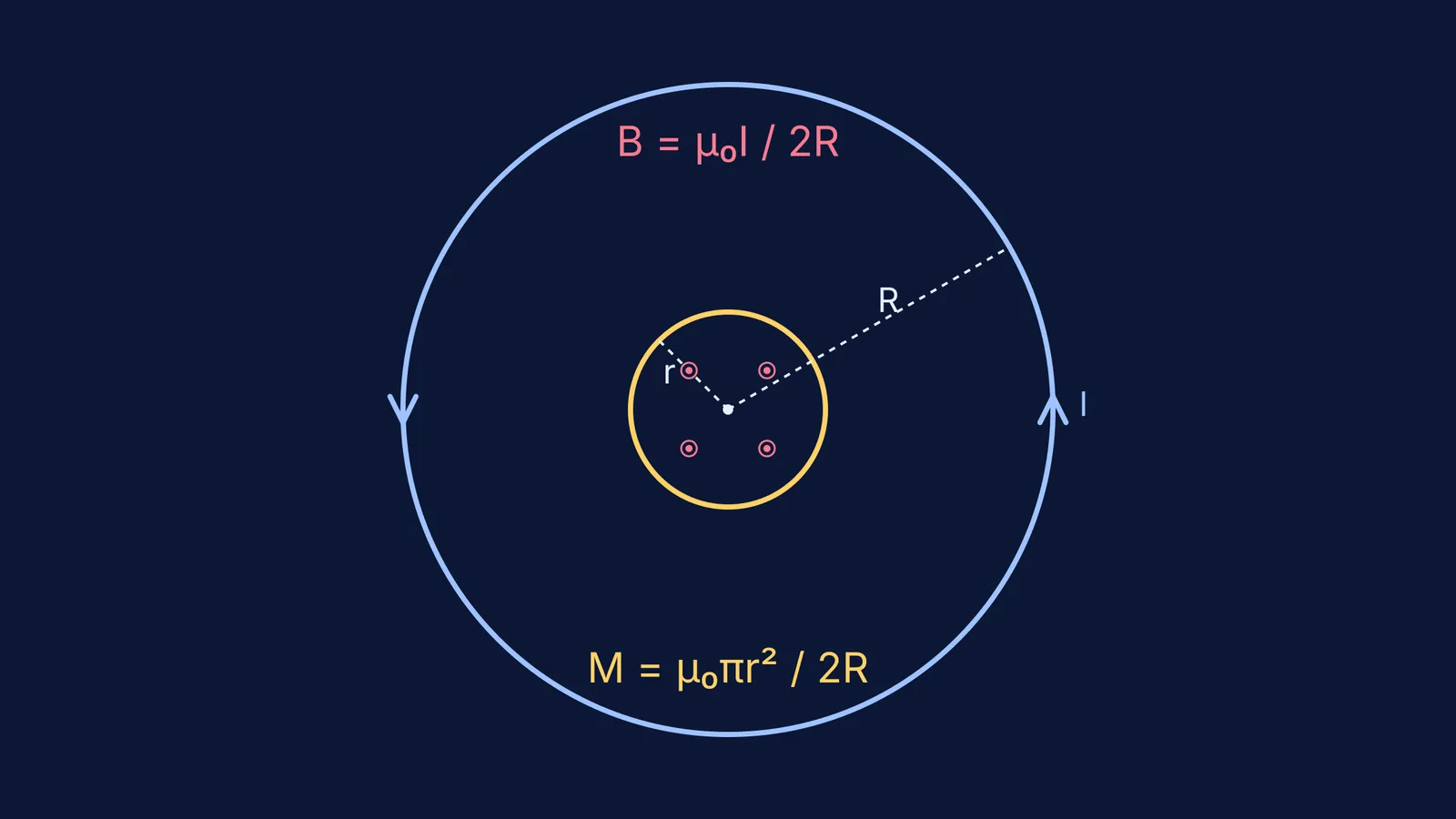
When an electric current I flows through a large outer loop of radius R, it creates a magnetic field at its centre. If a small loop of radius r is placed exactly at this centre, some of those magnetic field lines pass directly through it.
According to the official NCERT Physics Class 12 textbook, the mutual inductance of this arrangement is M = μ₀πr² / 2R. The unit of mutual inductance is the Henry (H).
This formula comes from assembling two separate pieces of geometry: the magnetic field produced by the large loop, and the total area of the small loop catching that field.
What is the magnetic field of the large loop?
The first step is to pretend the small loop is not there at all. As explained on Testbook, the magnetic field B exactly at the centre of a single circular current-carrying loop of radius R is given by the Biot-Savart law:
B = μ₀I / 2R
Here, μ₀ is the permeability of free space (4π × 10⁻⁷ T·m/A), and I is the current flowing in the large loop.
Because the inner loop is extremely small relative to the outer one (r ≪ R), we can safely assume this central magnetic field is uniform over the entire area of the small loop. In reality, the magnetic field of a loop weakens slightly as you move away from the dead centre, but for a tiny inner loop, this variation is negligible.
How do you find the flux through the small loop?
The magnetic flux Φ is the product of the uniform magnetic field and the area it crosses. Since the small loop has radius r, its geometric area is A = πr².
Because the two loops are concentric and lie flat in the same plane, the field lines pass through the small loop at exactly 90 degrees to its surface. This means the angle between the area vector (which points straight out of the surface) and the magnetic field is 0 degrees, so cos θ = 1. The total magnetic flux linked with the small loop is simply:
Φ = B × A Φ = (μ₀I / 2R) × (πr²)
Mutual inductance M is fundamentally defined as the flux passing through one loop per unit of current in the other (Φ / I). If you divide the total flux by the driving current I, the I terms cancel out, leaving you with the final result:
M = μ₀πr² / 2R
Why does the reciprocity theorem matter?
A common exam trick asks you to find the flux through the large loop if a current is instead sent through the small loop. This sounds mathematically impossible. The small loop acts like a tiny magnetic dipole, and its field spreads out and varies wildly across the large loop's massive area, making a direct surface integral a nightmare.
This is where the reciprocity theorem saves you. Mutual inductance is perfectly symmetric: M₁₂ = M₂₁. The flux the small loop induces in the large one per unit current is exactly the same as the flux the large loop induces in the small one. If you have concept gaps around this geometric symmetry, the Fermi Concept Library has every concept in physics with its own lesson. Understanding this means you can completely skip the complex calculus integral and simply reuse the known result M = μ₀πr² / 2R.
This "outer field times inner area" trick works flawlessly for other geometries too. If the outer loop is spinning to create a magnetic field rather than carrying a direct wired current—similar to finding the magnetic moment of a spinning charged ring—you can still apply the exact same logic by substituting the steady current I with the effective current (charge multiplied by frequency) of the spinning system.
What if the small loop is rotated?
In more difficult physics problems, the small loop is tilted by an angle θ relative to the large loop. When this happens, the area vector is no longer parallel to the magnetic field. The general flux formula becomes Φ = B A cos θ, meaning the mutual inductance drops to:
M = (μ₀πr² / 2R) cos θ
If the small loop is flipped completely sideways (θ = 90°), the magnetic field lines graze its surface perfectly parallel to the loop without actually passing through it, making the mutual inductance exactly zero. If you make wrong-method mistakes with these changing flux scenarios, the Fermi Problem Library has worked problems with a step-by-step solver that explains the reasoning. This will help you see how the angle affects the final result and prevents induced currents.
Once you recognise that mutual inductance for nested loops always boils down to "large loop's field × small loop's area", exam questions that once looked like advanced calculus become straightforward arithmetic.


