On this page
The field on the axis of a circular current loop is one of the few Biot-Savart results you can get in closed form, which is why it turns up in Class 12 boards, JEE Main and JEE Advanced. It also teaches a move you will reuse for rings of charge, solenoids and Helmholtz coils: let symmetry cancel half the vector before you integrate anything.
The result, as derived in OpenStax University Physics Volume 2, section 12.4, is B = μ0IR²/2(R² + x²)^(3/2), where R is the loop's radius, I the current and x the distance from the centre along the axis.
How do you derive the field on the axis with Biot-Savart?
Put the loop in a plane with its centre at the origin and the axis along x. Take a point P on the axis at distance x. Follow the steps in the OpenStax derivation:
Pick a small element dl of the loop. Its distance to P is r = √(R² + x²), the same for every element.
The line from dl to P lies in the plane that contains the axis and that element, and dl runs along the loop, at right angles to that plane. So the two are perpendicular, and the Biot-Savart law gives a magnitude dB = μ0I dl / 4π(R² + x²).
dB is perpendicular to the line from dl to P, so it tilts away from the axis. Split it into a part along the axis and a part sideways.
The element on the opposite side of the loop gives the same sideways part in the opposite direction. Around the whole loop, all sideways parts cancel.
The axial part is dB times R/r. So dBx = μ0I R dl / 4πr³.
Nothing except dl changes around the loop, and the dl add up to the circumference 2πR. So B = μ0IR² / 2r³ = μ0IR²/2(R² + x²)^(3/2).
The direction follows the right-hand rule: curl your fingers with the current and your thumb points along B on the axis.
What is the field at the centre of the loop?
Set x = 0. Then r = R and B = μ0I/2R, which is equation 12.17 in OpenStax. This is the strongest the field gets anywhere on the axis.
For a coil of N turns, HyperPhysics at Georgia State University notes that you use NI as the current. So the centre field of a flat coil is μ0NI/2R.
What happens to the field far from the loop?
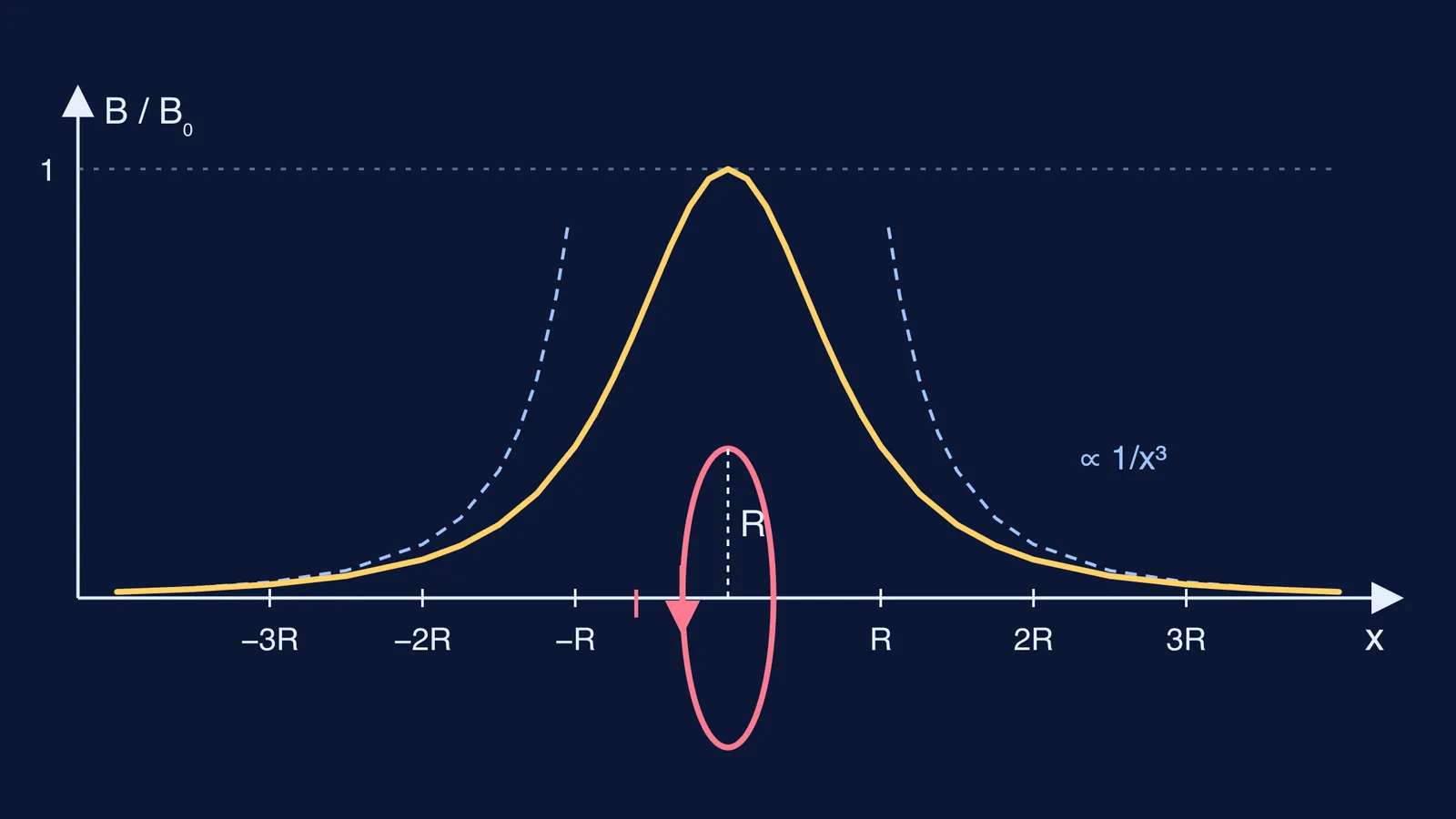
When x is much larger than R, R² in the bracket is negligible, and B ≈ μ0IR²/2x³. Written with the loop's magnetic moment μ = IπR², this becomes B = μ0μ/2πx³, the field of a magnetic dipole (OpenStax, equation 12.19). A 1/x³ fall-off is much faster than the 1/x of a long straight wire.
The hero diagram above plots the exact curve against the 1/x³ approximation. Near the loop the approximation overshoots badly; at three radii it is still about 17% too high.
Worked example: how strong is the field of a 50-turn coil?
A coil has N = 50 turns, radius R = 5.0 cm, and carries I = 2.0 A. Take μ0 = 1.2566 × 10⁻⁶ N A⁻², the CODATA 2022 value listed by NIST.
At the centre: B = μ0NI/2R = (1.2566 × 10⁻⁶ × 100) / 0.10 ≈ 1.26 × 10⁻³ T, or 1.26 mT.
At x = R = 5 cm: the factor R³/(R² + x²)^(3/2) is (1/2)^(3/2) ≈ 0.354, so B ≈ 0.444 mT. One radius out, the field has already dropped to about a third.
At x = 12 cm: r = √(25 + 144) = 13 cm, so the factor is (5/13)³ ≈ 0.0569 and B ≈ 71.5 μT.
The far-field shortcut at x = 12 cm gives 1.26 mT × (5/12)³ ≈ 90.9 μT, about 27% too high.
At x = 50 cm (ten radii) the exact value is about 1.238 μT and the shortcut gives about 1.257 μT, only 1.5% off.
Use the 1/x³ form only when the question says x is much larger than R; otherwise use the full formula.
For more like this, the Fermi Problem Library has worked problems with a step-by-step solver that explains the reasoning rather than printing an answer.
Where do students lose marks on this formula?
Writing (R² + x²) without the 3/2 power, or squaring instead.
Using R instead of R² in the numerator. Units catch this: μ0I times length² over length³ is μ0I per length, the right shape.
Forgetting N for a coil, or forgetting to convert centimetres to metres.
Adding the sideways components instead of cancelling them.
Using the far-field form close to the loop.
If the tilting dB vectors are hard to picture, Fermi's Simulation Lab has interactive simulations for ideas that are easier to see than to read.