

On this page
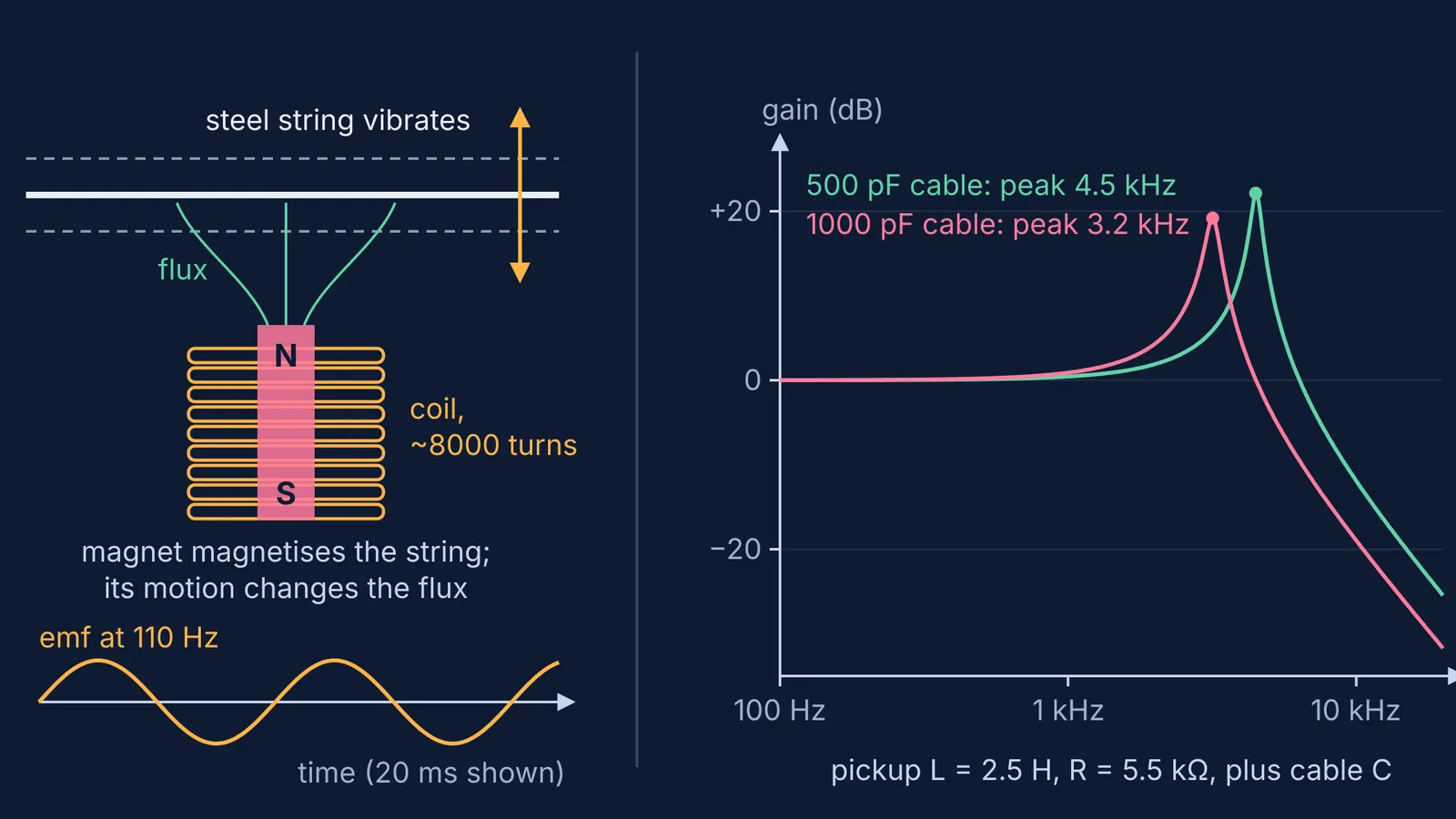
Pluck a steel string on an electric guitar and a voltage appears at the jack, even though nothing touches the string. The pickup under it is a magnet wrapped in a coil of very fine wire. The magnet magnetises the string, the vibrating string changes the magnetic flux through the coil, and Faraday's law turns that change into an emf at the string's frequency. This post puts numbers on the coil, the tiny flux change involved, and the resonance that makes a long cable sound darker.
How does a guitar pickup make a voltage?
A single-coil pickup has one magnetic pole piece under each string, with a coil of several thousand turns of enamelled copper wire wound around the poles. The pole piece magnetises the steel string just above it, so the string becomes part of the magnetic circuit.
When the string moves towards the pole, more flux passes through the coil. When it moves away, less does. Each turn of the coil links a flux Φ that wobbles at the string's frequency, and the total emf is
ε = −N dΦ/dt
If the flux per turn varies as Φ₀ + ΔΦ sin ωt, the emf has amplitude ε₀ = NωΔΦ.
This is a different arrangement from a moving-coil microphone. There, the coil moves through a fixed magnetic field and ε = BLv, as shown in how a microphone turns sound waves into electric current. In a pickup the coil is fixed and the flux through it changes because a magnetised string moves.
Why does a pickup not work with nylon strings?
The pickup does not hear sound in the air. It responds only to a magnetised object moving near it. Nylon is not ferromagnetic, so a nylon string carries no magnetisation and changes the flux by essentially nothing. That is why classical guitars need piezo or microphone pickups instead.
Two more consequences of ε₀ = NωΔΦ:
Frequency matters. At the same displacement amplitude, a string vibrating twice as fast gives twice the emf, because ε ∝ ω.
Distance matters. The flux change falls off quickly with the gap between string and pole, so raising the pickup closer to the strings gives more output. The magnet also pulls on the string, so setting a pickup too close can affect how the string vibrates.
The pitch of each string comes from its tension and mass per unit length, covered in why thicker strings make lower notes. The pickup only reports that motion.
Worked example: how big are the resistance and the flux change?
The turn count and turn length below are illustrative round numbers for a vintage-style single coil; the checks against real pickups are linked.
Wire length. N = 8000 turns with a mean turn length of 13 cm: 8000 × 0.13 = 1040 m of wire.
Cross-section. StewMac describes 42 AWG as the standard wire for Strat pickups. Its bare diameter is about 0.0633 mm, so A = π(0.0633 × 10⁻³ / 2)² = 3.15 × 10⁻⁹ m².
Resistance. With copper's resistivity ρ = 1.68 × 10⁻⁸ Ω m, R = ρL/A = (1.68 × 10⁻⁸ × 1040) / (3.15 × 10⁻⁹) = 5.5 kΩ. That matches the 5.5 to 6.5 kΩ quoted for typical Strat-style single coils by Planet Z (Vintage Vibe Guitars).
Output. Take the A string at 110 Hz giving a 100 mV peak. That is an illustrative round value: single-note peaks measured by Elliott Sound Products range from about 50 mV to 300 mV depending on guitar, string and pickup.
Flux change per turn. ΔΦ = ε₀/(Nω) = 0.100 / (8000 × 2π × 110) = 1.8 × 10⁻⁸ Wb. Units check: V/(rad/s) = V s = Wb.
Compare with the steady flux. A 5 mm diameter pole face at 0.1 T (again illustrative) carries 0.1 × π × (2.5 × 10⁻³)² = 2.0 × 10⁻⁶ Wb. The string changes this by under 1%.
So the signal comes from a tiny wobble in a much larger steady flux. The large number of turns is what makes it usable.
Why does a long guitar cable make the sound darker?
8000 turns around a magnetic core also give the coil a large inductance. Planet Z quotes about 1.8 to 2.5 H for typical Strat-style single coils. Take L = 2.5 H. At 110 Hz its reactance is ωL = 1.7 kΩ, but at 3 kHz it is 47 kΩ, so the inductance matters most for the treble.
The guitar cable adds capacitance between its core and screen. The pickup inductance, the coil resistance and the cable capacitance form a series LCR circuit, with the output taken across C. It resonates at
f₀ = 1/(2π√(LC))
Short, low-capacitance cable, C = 500 pF: f₀ = 1/(2π√(2.5 × 500 × 10⁻¹²)) = 4.5 kHz.
A 2 m lead of about 700 pF, the value Elliott Sound Products used: f₀ = 3.8 kHz.
Long cable, C = 1000 pF: f₀ = 3.2 kHz.
Above the resonance, the response falls steeply. So more cable capacitance moves the treble peak down and cuts more of the upper harmonics: a darker sound. These values sit in the 2.5 to 4.5 kHz range that Sound On Sound gives for a typical pickup's resonance. The coil's own winding capacitance adds to the cable's and lowers f₀ a little further. How sharp a resonance is, and what sets its bandwidth, is covered in LCR resonance: quality factor, bandwidth and power factor.
How does a humbucker cancel mains hum?
A single coil also picks up stray changing fields from wiring and transformers, at 50 Hz in India. A humbucker uses two coils side by side with two changes:
The coils are wound in opposite directions. A hum field passes through both coils in the same sense, so with opposite windings the two hum emfs are equal and opposite, and they cancel when the coils are connected in series.
The magnets have opposite polarity. The string's flux change through the second coil is therefore reversed. Combined with the reversed winding, the two reversals cancel, and the string signals from the two coils add.
Get only one reversal and you either keep the hum or cancel the string. Both are needed.
Pickup inductance, resistance and output vary widely between designs, so treat all of the values here as examples. To see Faraday's law and LCR resonance worked through more slowly, the Concept Library covers each idea from first principles.
Quick checklist
The pickup senses a moving magnetised string, not sound in the air; nylon strings give no signal.
ε = −N dΦ/dt, amplitude NωΔΦ; double the frequency at the same ΔΦ, double the emf.
8000 turns of 42 AWG copper at 13 cm per turn give about 5.5 kΩ.
A 100 mV peak at 110 Hz needs a flux change of only 1.8 × 10⁻⁸ Wb per turn.
With L = 2.5 H, the cable sets the treble peak: 4.5 kHz at 500 pF, 3.2 kHz at 1000 pF.
A humbucker needs both reversed winding and reversed magnet polarity.


