On this page
Every NCERT student learns that mass is conserved in a chemical reaction. Fewer know that it was tested again, at the limit of what a balance could do, long after Lavoisier. Between 1890 and 1908 the Berlin chemist Hans Landolt sealed reacting solutions inside glass and weighed them to a few hundredths of a milligram. For a while he believed he had found mass disappearing. Then he found the real cause, and it was not chemistry. Below: what he did, what went wrong, and why E = mc² never showed up on his balance.
Who was Hans Landolt?
The Neue Deutsche Biographie entry gives his life. He was born in Zürich on 5 December 1831 and died in Berlin on 15 March 1910. He studied chemistry under Karl Löwig, then taught at Bonn (from 1858) and the new Aachen polytechnic (from 1870), and moved to Berlin in 1880. From 1891 he also ran the second chemical institute of Berlin University, where Walther Nernst later succeeded him.
Chemists know his name from the Landolt–Börnstein data tables, first published with Richard Börnstein in 1883. He gave up his professorship in 1905 but kept working in a laboratory at the Physikalisch-Technische Reichsanstalt, the German standards institute.
Why would anyone doubt conservation of mass in 1890?
The doubt came from atomic weights. Landolt opened his first paper, in Zeitschrift für physikalische Chemie 12, 1–34 (1893), by listing values such as chlorine 35.364 and silver 107.668. These were on the scale of the time, not modern values, and they were nowhere near whole numbers. That was a problem for Prout's hypothesis that every atom is built from hydrogen.
Landolt quoted Lothar Meyer's way out: perhaps atoms also hold some of the "light ether" thought to fill space, and that ether is not quite weightless. If a reaction let weighable ether pass through the glass, a sealed reaction would change weight. The only test was to weigh one.
How did Landolt weigh a reaction without opening it?
He used inverted U-shaped glass vessels, each arm 18 cm long and 5 cm wide in 1893. One reactant solution went in each arm and the glass was melted shut. Tipping the vessel poured one solution into the other, so the reaction ran with nothing able to get in or out.
The clever part was the twin. He always made two vessels, A and B, filled the same way. By weighing them under water he matched their outside volumes to within 0.05 cm³, later 0.03 cm³, adding small glass or platinum pieces to the lighter one. Equal volumes meant equal air upthrust, so changes in air density cancelled. He weighed the difference A − B, reacted A, weighed again, then reacted B and weighed a third time. Each run was therefore a double experiment.
His four reactions in 1893 were:
Ag₂SO₄ + 2FeSO₄ → 2Ag + Fe₂(SO₄)₃
HIO₃ + 5HI → 3I₂ + 3H₂O
I₂ + Na₂SO₃ + H₂O → Na₂SO₄ + 2HI
CCl₃CH(OH)₂ + KOH → CHCl₃ + HCOOK + H₂O (chloral hydrate and potash)
His 1893 verdict was that no reaction showed a weight change "mit Bestimmtheit" (with certainty). He wrote, in my translation, that this "closes the last way out that was still open to Prout's hypothesis". But the silver and iodine reactions had always come out slightly lighter, and that bothered him.
Why did his vessels seem to lose weight?
From 1901 he had a new precision balance built by A. Rueprecht of Vienna, and he started again. His final paper, the "third communication" in Zeitschrift für physikalische Chemie 64, 581–614 (1908), sums up what happened next. In his 1906 report 42 of 54 runs had lost weight, mostly by 0.003 to 0.050 mg with 60 to 120 g of reacting material. He had called the loss "the normal phenomenon" and suggested that the jolt of reaction might split tiny particles off atoms, which escaped through the glass.
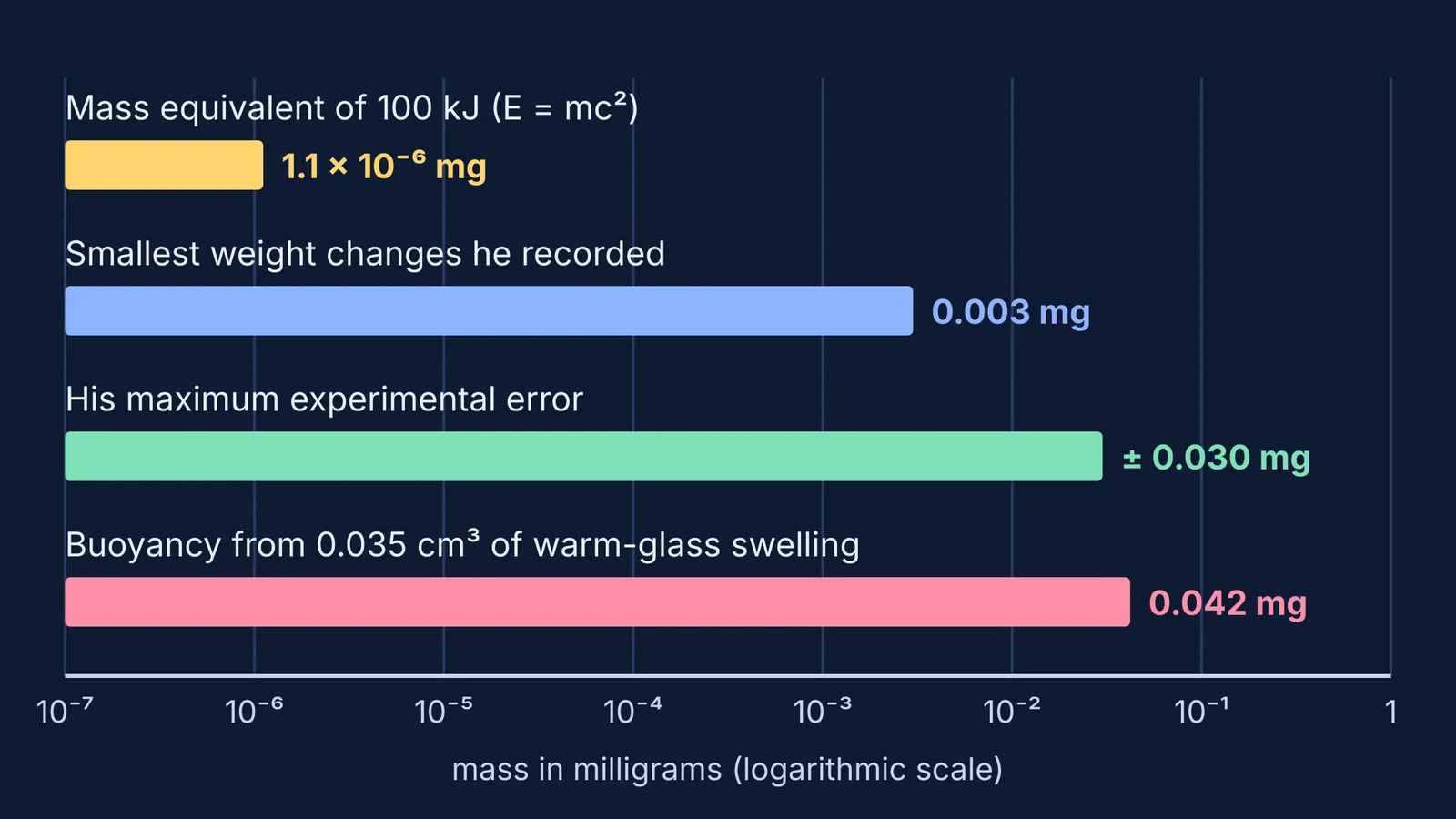
In 1908 he tested the dull explanation properly. Most of his reactions give out heat. Warm glass expands, so a hot vessel pushes aside more air and gets more upthrust, which makes it look lighter. He heated one vessel of about 406 cm³ from 19 °C to 39 °C and then measured its volume for weeks. Soon after heating it was 0.035 cm³ larger than before, and at about 1.2 mg per cm³ of moist air that would make it weigh 0.042 mg too light. Between the third and sixth day it would still read 0.022 to 0.030 mg too light, and it took about 13 days to return to its original volume. In earlier runs he had usually stopped weighing after a few days.
Corrected for this, his 48 results changed character. Before correction 36 were negative. After correction 25 were negative and 23 positive, and almost all lay inside his maximum error of ±0.030 mg, exactly what you see when nothing is happening. His conclusion on page 613 reads: "bei allen vorgenommenen 15 chemischen Umsetzungen [ist] eine Änderung des Gesamtgewichtes der Körper … nicht feststellen lassen". In my translation: in all 15 chemical reactions carried out, no change in the total weight could be detected. He declared the testing of the law of conservation of matter "experimentell für erledigt", experimentally settled.
Could Landolt's balance have seen E = mc²?
No, and Landolt said so himself. Any change, he wrote, was below hundredths or thousandths of a milligram; at the scale of a millionth of a milligram it would belong to Max Planck's 1907 paper on the dynamics of moving systems, and would "escape experimental testing".
Problem: a reaction in a sealed vessel releases 100 kJ of heat. How much mass does the system lose, and could a balance with an error of ±0.030 mg detect it?
Use Δm = E/c². E = 100 kJ = 1.00 × 10⁵ J and c = 3.00 × 10⁸ m/s.
Calculate. Δm = 1.00 × 10⁵ / (3.00 × 10⁸)² = 1.11 × 10⁻¹² kg.
Convert to milligrams. 1 kg = 10⁶ mg, so Δm = 1.11 × 10⁻⁶ mg, about a millionth of a milligram.
Compare with the error. 0.030 / (1.11 × 10⁻⁶) ≈ 27,000. The balance error is about 27,000 times larger than the effect.
Compare with buoyancy. A volume mismatch of only 0.05 cm³ of air is 0.05 × 1.2 = 0.06 mg, which is twice his error limit. That is why the twin vessels had to be matched so closely.
So Landolt set an upper limit; he did not prove mass is exactly constant. To see how the same weighing problems shaped atomic weights, read about Theodore Richards and the impure silver behind Stas's chlorine. If unit conversions like step 3 trip you up, the Fermi Problem Library has a step-by-step solver that explains the reasoning rather than printing an answer.
Quick checklist
Landolt weighed sealed reactions from 1890 to 1908, prompted by Prout's hypothesis.
Twin vessels of matched volume cancelled air buoyancy.
His apparent losses came from warm glass staying expanded for days, not from chemistry.
After correction, 15 reactions showed no change beyond about ±0.030 mg.
For the law's first statement, see Lavoisier and the end of phlogiston.
Preparing for the exam itself? Fermi Test Prep is test prep for JEE Main and Advanced, with an AI tutor.