On this page
In 1815 the English chemist William Prout noticed a pattern in the atomic weights chemists had measured: many looked like whole-number multiples of hydrogen's. A year later he went further and suggested that hydrogen might be the one building block of every element. For decades chlorine stood in the way, with a weight stuck near 35.5. The answer, when it came, was isotopes, and it is the same calculation you do in Class 11 chemistry.
What was Prout's hypothesis about atomic weights?
Prout's paper, "On the Relation between the Specific Gravities of Bodies in their Gaseous State and the Weights of their Atoms", appeared anonymously in Annals of Philosophy in 1815, followed by a correction in 1816 (notes from the Le Moyne College classic chemistry archive). He compared the densities of gases and found that many came out as whole multiples of hydrogen's. In the 1816 correction (text of both papers) he wrote that "we may almost consider the πρωτη υλη of the ancients to be realised in hydrogen": hydrogen as the "first matter" of everything.
Prout's hypothesis is the idea that every element's atomic weight is a whole-number multiple of hydrogen's, because every atom is built from hydrogen (overview on Wikipedia).
Prout's own chlorine number fitted. Taking chlorine's gas density as 2.5 (air = 1), he wrote that chlorine comes out "exactly 36 times that of hydrogen" (Prout's 1815 text). The trouble came with better measurements.
Why did chlorine's 35.5 seem to disprove Prout?
In the 1840s Jean Charles Galissard de Marignac measured chlorine's atomic weight at 35.45 times hydrogen's, not 35 or 36 (Prout's hypothesis, Wikipedia). Marignac tried to rescue the idea by making the basic unit half a hydrogen atom, but other chemists did not take to it. In 1860 Jean Stas summed up 20 years of careful measurements and concluded that the hypothesis was contradicted by experiment (same source).
How did isotopes rescue Prout's hypothesis?
In 1913 Frederick Soddy gave the missing idea a name. Writing in Nature, he called atoms with the same nuclear charge but different total make-up "isotopes", "because they occupy the same place in the periodic table" (Soddy, "Intra-atomic Charge", text; DOI record).
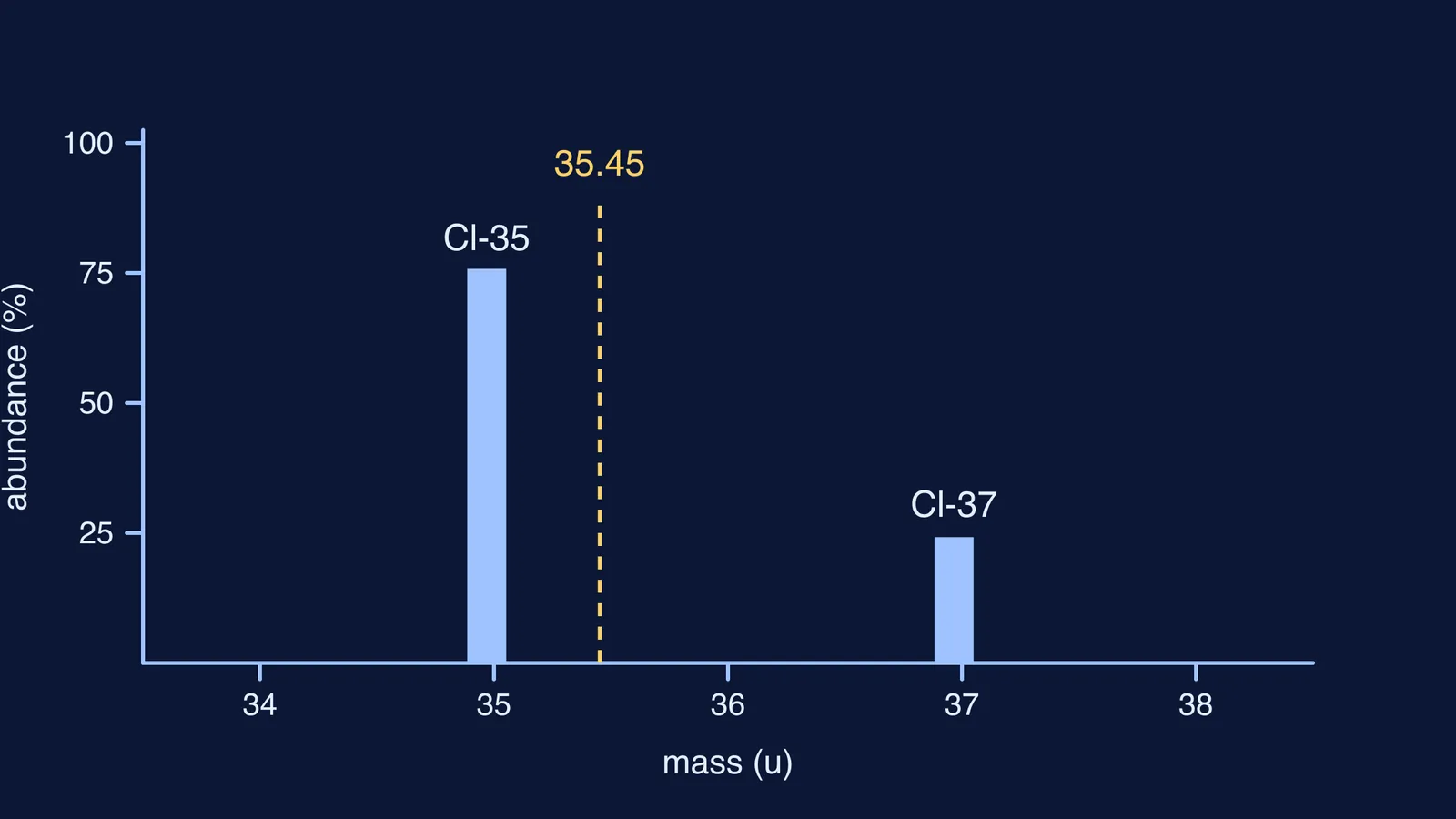
In December 1919 Francis Aston reported that his mass spectrograph showed chlorine "consists of at least two isotopes of atomic weights 35 and 37" (Aston, "The Constitution of the Elements", Nature; text). The line for the lighter mass was three or four times as strong as the heavier one. In the same letter he noted that of more than forty atomic and molecular masses measured so far, "all, without a single exception, fall on whole numbers", with carbon and oxygen taken as 12 and 16. Aston received the 1922 Nobel Prize in Chemistry, in part "for his enunciation of the whole-number rule" (Royal Swedish Academy of Sciences).
To see how a magnetic field pulls the two chlorines apart, read our explainer on how a mass spectrometer separates isotopes by mass.
How do you calculate chlorine's 35.45 yourself?
Here is the worked example, using data from IUPAC's Commission on Isotopic Abundances and Atomic Weights (CIAAW). Chlorine-35 has a mass of 34.968853 u and makes up between 75.5% and 76.1% of natural chlorine. Chlorine-37 has a mass of 36.965903 u and makes up between 23.9% and 24.5%.
Pick abundances inside those ranges that add to 100%: 75.8% and 24.2%.
Multiply each mass by its fraction: 0.758 × 34.968853 = 26.5064, and 0.242 × 36.965903 = 8.9457.
Add them: 26.5064 + 8.9457 = 35.452 u.
That lands inside the standard atomic weight range of 35.446 to 35.457 set by CIAAW. The fraction belongs to no single atom. It is an average over roughly three light atoms for every heavy one.
For a hands-on version, this simulation post on why chlorine is 35.5 lets you change the mix and watch the average move. If the idea of an isotope itself feels shaky, the Fermi Concept Library has a lesson for every concept in chemistry, each with its place in the map.
Was Prout right in the end?
Partly. In 1920 Ernest Rutherford proposed the name "proton" for the hydrogen nucleus, built on the stem of Prout's word "protyle" (Wikipedia). But a nucleus is not simply a pile of hydrogen atoms; it also holds neutrons. And isotope masses are close to whole numbers, not exactly on them: chlorine-35 is 34.969 u, not 35 (CIAAW). Each isotope comes within 1% of a whole-number multiple of hydrogen's mass, and the small mismatch is mostly the mass carried off as binding energy when the nucleus formed (Wikipedia).
For an earlier chapter in Soddy's work, read about Rutherford and Soddy's 1902 discovery that atoms change into new elements. And if you learn better by seeing, the Fermi Simulation Lab has interactive simulations for ideas that are easier to see than to read.