On this page
In 1900 an element was supposed to be permanent: you could combine it, dissolve it or heat it, but iron stayed iron. Two young scientists in Montreal broke that idea with thorium nitrate, ammonia and patient measuring. Their 1902 paper used the same exponential law you meet in your textbook, and gave it a new meaning: atoms turning into other kinds of matter.
Who were Rutherford and Soddy, and how did they meet?
Ernest Rutherford was a physicist from New Zealand working at McGill University; Frederick Soddy was a young English chemist there. According to a CERN Courier article by John Campbell, the two argued on opposite sides at a 1901 McGill Physical Society meeting on whether bodies smaller than an atom exist, after which Rutherford invited Soddy to join him.
Both later won the Nobel Prize in Chemistry. Rutherford's 1908 prize was "for his investigations into the disintegration of the elements, and the chemistry of radioactive substances". Soddy's 1921 prize was for his work on radioactive substances and "the origin and nature of isotopes", a story we tell in Frederick Soddy, isotopes and the displacement law.
What did Rutherford and Soddy discover in 1902?
The key paper is "The cause and nature of radioactivity, Part I", Philosophical Magazine, September 1902. Le Moyne College hosts a full-text transcription.
What they did:
They added ammonia to a solution of thorium nitrate. Thorium came out as solid thorium hydroxide.
They evaporated the leftover liquid, which was chemically free from thorium, and heated off the ammonium salts. The tiny residue, about one-thousandth of the original weight, was many hundred, in some cases over a thousand, times more active than the same weight of thorium oxide.
They called this active stuff ThX (thorium X). The paper notes that "ammonia is the only reagent of those tried capable of separating ThX from thorium", so it behaved like a different chemical substance.
Then they watched both samples for weeks.
Even after ThX and its side effects were removed by 23 precipitations over 9 days, the thorium kept about 25 per cent of its original activity. The authors thought this was most probably a second substance they had not yet separated.
What did the two curves show?
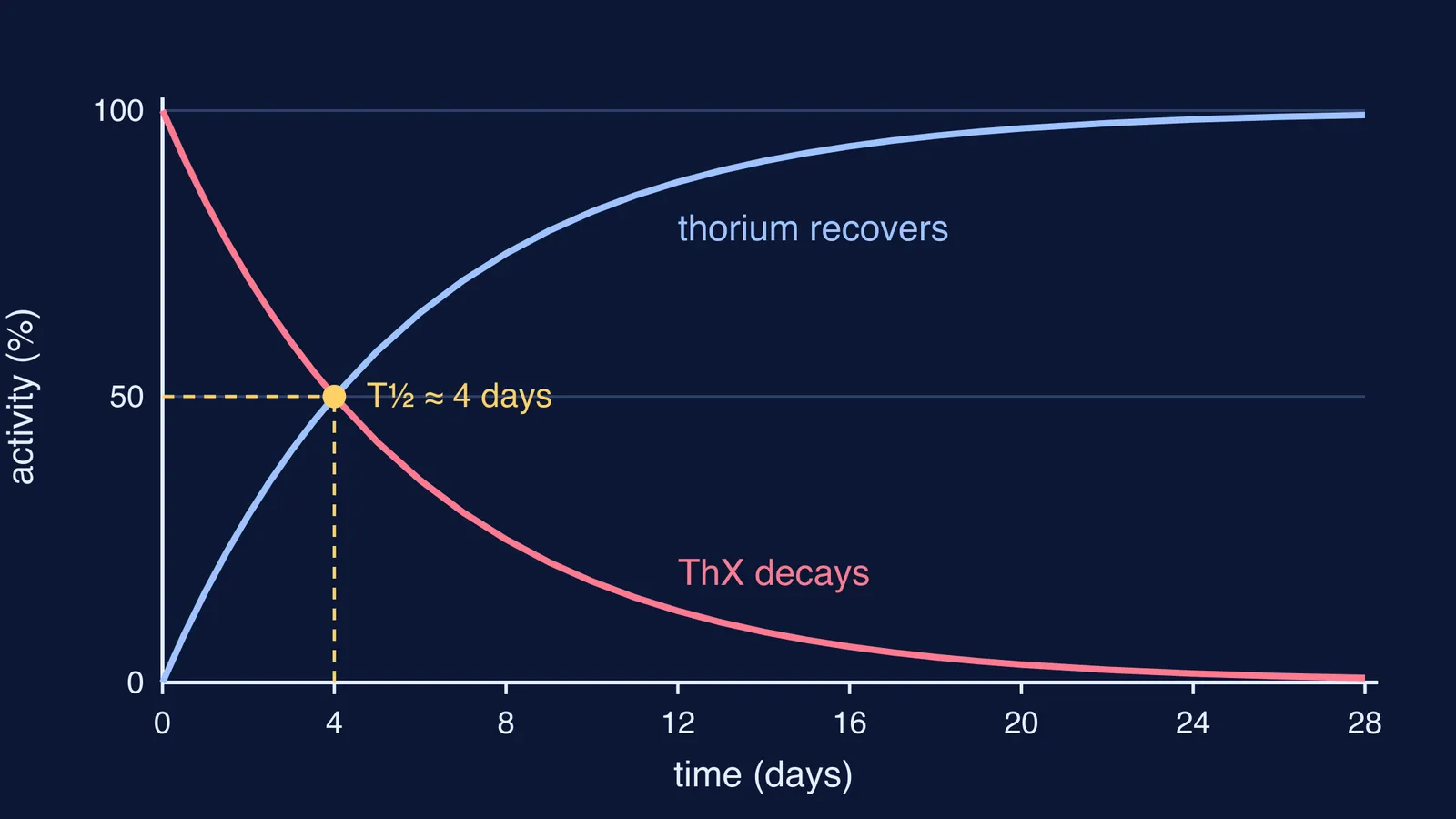
The ThX slowly lost its activity while the thorium gained activity back. In the authors' words, the time for the thorium "to recover one half of its lost activity is about equal to the time taken by the ThX to lose half its activity, viz., in each case about 4 days" (full text).
They wrote the decay as It/I0 = e^(-λt) and the recovery as It/I0 = 1 - e^(-λt), with the same constant λ. Thorium was steadily making fresh ThX, which steadily died away. The normal activity of thorium, they said, is "an equilibrium value" where production and decay balance.
Heat and chemical treatment did not change how fast ThX decayed, so they concluded: "radioactivity is at once an atomic phenomenon and accompanied by chemical changes in which new types of matter are produced, these changes must be occurring within the atom, and the radioactive elements must be undergoing spontaneous transformation."
Where does the decay law appear in Class 12?
The NCERT Class 12 Chemistry textbook, in the Chemical Kinetics chapter, derives [R] = [R]0 e^(-kt) for first-order reactions and states that "all natural and artificial radioactive decay of unstable nuclei take place by first order kinetics." That is the Rutherford-Soddy equation with k in place of λ.
In physics, check your syllabus year carefully. The CBSE 2025-26 Physics syllabus lists no separate radioactivity topic in the Class 12 Nuclei chapter, and entrance exam syllabi differ, so check the current official one for yours. For the full maths, see our guide to radioactive decay and half-life.
How do you redo Rutherford and Soddy's numbers?
Take the paper's half-value time of about 4 days for ThX, and its 25 per cent minimum for thorium.
Decay constant: λ = 0.693 / T½ = 0.693 / 4 ≈ 0.173 per day.
After 12 days (three half-lives), ThX keeps (1/2)^3 = 1/8, or 12.5 per cent, of its activity.
In the same 12 days the thorium regains 1 - 1/8 = 87.5 per cent of the activity it lost.
Measure the recovery from the 25 per cent minimum, as the authors did: the thorium has 75 points to regain, so it is now near 25 + 0.875 × 75 ≈ 91 per cent of its original value.
Check: in this ideal model, the ThX fraction left plus the thorium fraction regained always adds to 1, because production and decay balance.
If it is hard to picture why one curve falls as the other rises, the Fermi Simulation Lab has interactive simulations for ideas that are easier to see than to read, and the Fermi Problem Library has worked problems with a step-by-step solver that explains the reasoning.
Next time you write N = N0 e^(-λt), picture two curves on a Montreal lab bench crossing at about four days.