

On this page
Your periodic table probably gives chlorine an atomic mass of 35.5, yet no chlorine atom weighs 35.5. Every chlorine atom is either chlorine-35 or chlorine-37, and the table shows the average of the natural mixture. Picture that mixture and you can predict the number, and what a mass spectrometer will draw.
Why is chlorine's atomic mass 35.5 and not a whole number?
Isotopes are atoms of the same element with the same number of protons but different numbers of neutrons. Every chlorine atom has 17 protons, so chlorine-35 has 18 neutrons and chlorine-37 has 20.
According to NIST's atomic weights and isotopic compositions table, chlorine-35 makes up 0.7576 of natural chlorine and chlorine-37 makes up 0.2424. Roughly three atoms in every four are the lighter kind, so the average is pulled towards 35.
The IUPAC Commission on Isotopic Abundances and Atomic Weights (CIAAW) gives chlorine's abridged standard atomic weight as 35.45 ± 0.01. The 35.5 in your textbook table is that value rounded to one decimal place.
Chlorine from different sources has slightly different mixtures, so CIAAW gives chlorine's standard atomic weight as an interval, from 35.446 to 35.457. It adopted this interval notation in 2009, after mass spectrometry measurements since 1985 showed the natural variation.
How do you calculate average atomic mass from isotope abundances?
Multiply each isotope's mass by its fractional abundance, then add the results. Here it is with the masses and abundances from the NIST chlorine table:
Chlorine-35: 34.96885 × 0.7576 = 26.4924
Chlorine-37: 36.96590 × 0.2424 = 8.9605
Add them: 26.4924 + 8.9605 = 35.4529, which rounds to 35.45.
The quick exam version uses mass numbers and a 3:1 ratio: (3 × 35 + 1 × 37) ÷ 4 = 35.5. That is close but slightly high. The real mix has a little more than 75% chlorine-35, and each isotope weighs slightly less than its mass number.
Three checks catch most mistakes:
The abundances add up to 1 (0.7576 + 0.2424 = 1.0000).
The answer lies between the lightest and heaviest isotope.
The answer sits closer to the more common isotope.
What does the mass spectrum of chlorine look like?
A mass spectrometer sorts ions by mass-to-charge ratio (m/z) and draws a peak for each, taller for ions that arrive more often. For the physics, see how a magnetic field separates isotopes.
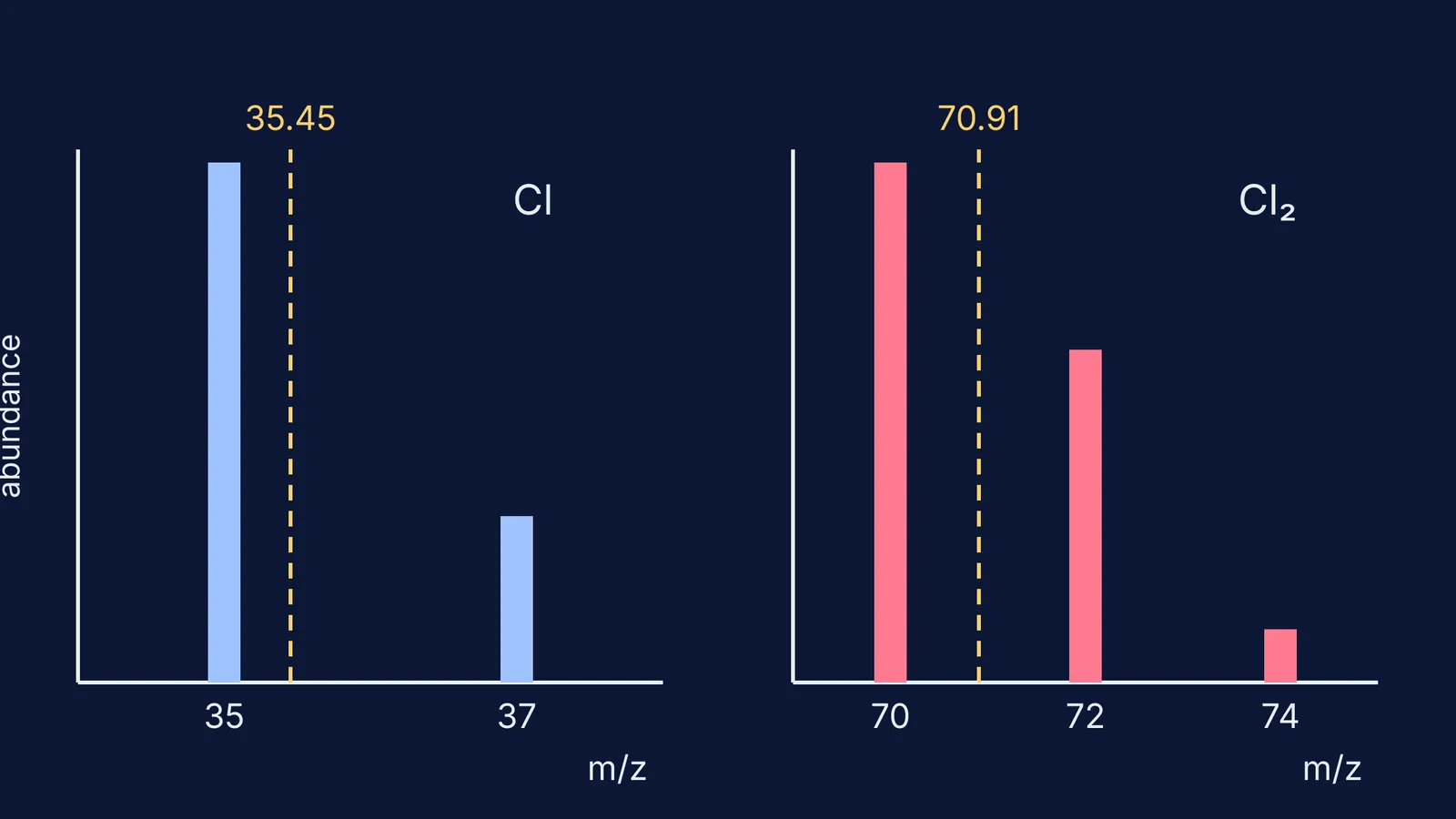
For chlorine atoms, you get two peaks: one at 35 and one at 37. Using the NIST abundances, the peak at 37 is 32% as tall as the peak at 35 (0.2424 ÷ 0.7576), close to a 3:1 ratio. There is no peak at 35.5, because no atom has that mass. The average belongs to the mixture, not to any one atom.
Chlorine gas is made of Cl₂ molecules, and each molecule picks up two atoms from the mixture. That gives three possible masses:
35 + 35 = 70, with probability 0.7576 × 0.7576 = 0.574
35 + 37 = 72, with probability 2 × 0.7576 × 0.2424 = 0.367
37 + 37 = 74, with probability 0.2424 × 0.2424 = 0.059
The middle term is doubled because there are two ways to make it (35 then 37, or 37 then 35). The heights come out at roughly 9:6:1. Chemguide's guide to M+2 peaks uses the same pattern in reverse. Two peaks 2 units apart in a 3:1 ratio mean a molecule has one chlorine atom, and three peaks in a 9:6:1 ratio mean it has two.
Five predictions to test in an isotope simulation
In an isotope-mixing simulation you drop atoms into a sample and watch the average and the spectrum update. The skill is predicting before you click, so write each prediction down first. The Fermi Simulation Lab has interactive simulations for ideas that are easier to see than to read; a pencil and the numbers above work too.
Put three chlorine-35 atoms and one chlorine-37 atom in the sample. Predict the average using mass numbers. (35.5)
Flip it to one chlorine-35 and three chlorine-37. Predict the new average and which peak is taller. (36.5; the peak at 37)
Make an equal mix. Predict the average and the peak heights. (36; two equal peaks)
Draw ten atoms at random from natural chlorine, several times. Predict whether the average stays at 35.45. (It jumps about; only large samples settle near 35.45.)
Pair atoms from a 3:1 mix into Cl₂. Predict the number of peaks and their heights. (Three peaks at 70, 72 and 74, close to 9:6:1)
Prediction 4 holds the real lesson: an atomic mass describes a huge population of atoms, which is why it can be a decimal.
To build atoms from protons, neutrons and electrons before mixing them, try our build an atom simulation with element, charge and isotope predictions. For the numericals that come next, see the mistakes to check in mole concept numericals. If you keep picking the wrong method, the Fermi Problem Library has worked problems with a step-by-step solver that explains the reasoning rather than printing an answer.


