On this page
The 35.45 for chlorine in your periodic table was not always 35.45. Around 1900 the accepted values for chlorine, silver and sodium all carried small errors, and that mattered because, as Richards put it, "many atomic weights are determined by reference to silver". The person who settled many of them was Theodore William Richards of Harvard University. His Nobel lecture, "Atomic Weights", delivered in Stockholm on 6 December 1919 and free to read on NobelPrize.org, explains how the respected Belgian chemist Jean Stas had been misled by a tiny impurity in his silver. It reads like a list of lessons for every gravimetric problem in Class 11.
Who was Theodore W. Richards?
The Nobel Prize biography records that Richards was born in Germantown, Pennsylvania, on 31 January 1868, took his PhD at Harvard in 1888 and spent almost his whole career there. By 1912, it says, he had redetermined the atomic weights of more than thirty important elements. He received the 1914 Nobel Prize in Chemistry "in recognition of his accurate determinations of the atomic weight of a large number of chemical elements" (prize facts). Note the two dates: the prize is the 1914 prize, and the lecture was given in December 1919.
How do you find an atomic weight by weighing?
Richards puts the method in one sentence: "We must find by actual experiment the amount of one element which actually combines with the given amount of some other element, producing a pure compound of definite composition."
The classic case is silver and chlorine. You weigh pure silver, turn all of it into silver chloride, and weigh that. The gain in mass is chlorine. If you know the atomic weight of silver, the ratio gives you chlorine's:
Each Ag atom ends up in one AgCl, so Cl = Ag × (mass of AgCl − mass of Ag) ÷ mass of Ag
The hard part is not the arithmetic. Richards warns that "every precipitate carries down with it contaminating impurities", that no container is free from being dissolved, and that "oxygen, nitrogen and water are almost omnipresent". He made it his rule to prove, by separate experiments, "first, that nothing was lost, and, secondly, that no foreign substance had been unintentionally included." Why the modern value is a decimal at all, and why IUPAC now gives chlorine as a range, is explained in average atomic mass and isotopes.
What went wrong with Stas's silver?
Stas was, in Richards's words, "an excellent experimenter", but "he was but human". The clue came by accident. Richards had made very pure sodium bromide for another purpose, and on routine analysis found "more bromine … in it than corresponded to the atomic weights as determined by Stas". When he repeated the sodium chloride work, he found that chlorine was wrong too:
"Stas, because of an unsuspected impurity in his silver had obtained less silver chloride from a specimen of the metal than really should have been produced by it. This led him to an atomic weight of chlorine distinctly too small and to values for sodium and silver distinctly too large."
Richards also names the cause: Stas used "such very large quantities of material that it could not be properly purified." His summary line is worth memorising: "There is no use in weighing a given specimen of silver, for example, to within one part in a million when its undetermined impurities amount to fifty parts in a million." The errors piled up on the lightest metal, so Stas's lithium was "an excessive estimate … by a whole per cent", about 0.07 on a value near 6.94.
Worked example: how far does 50 ppm of impurity move chlorine?
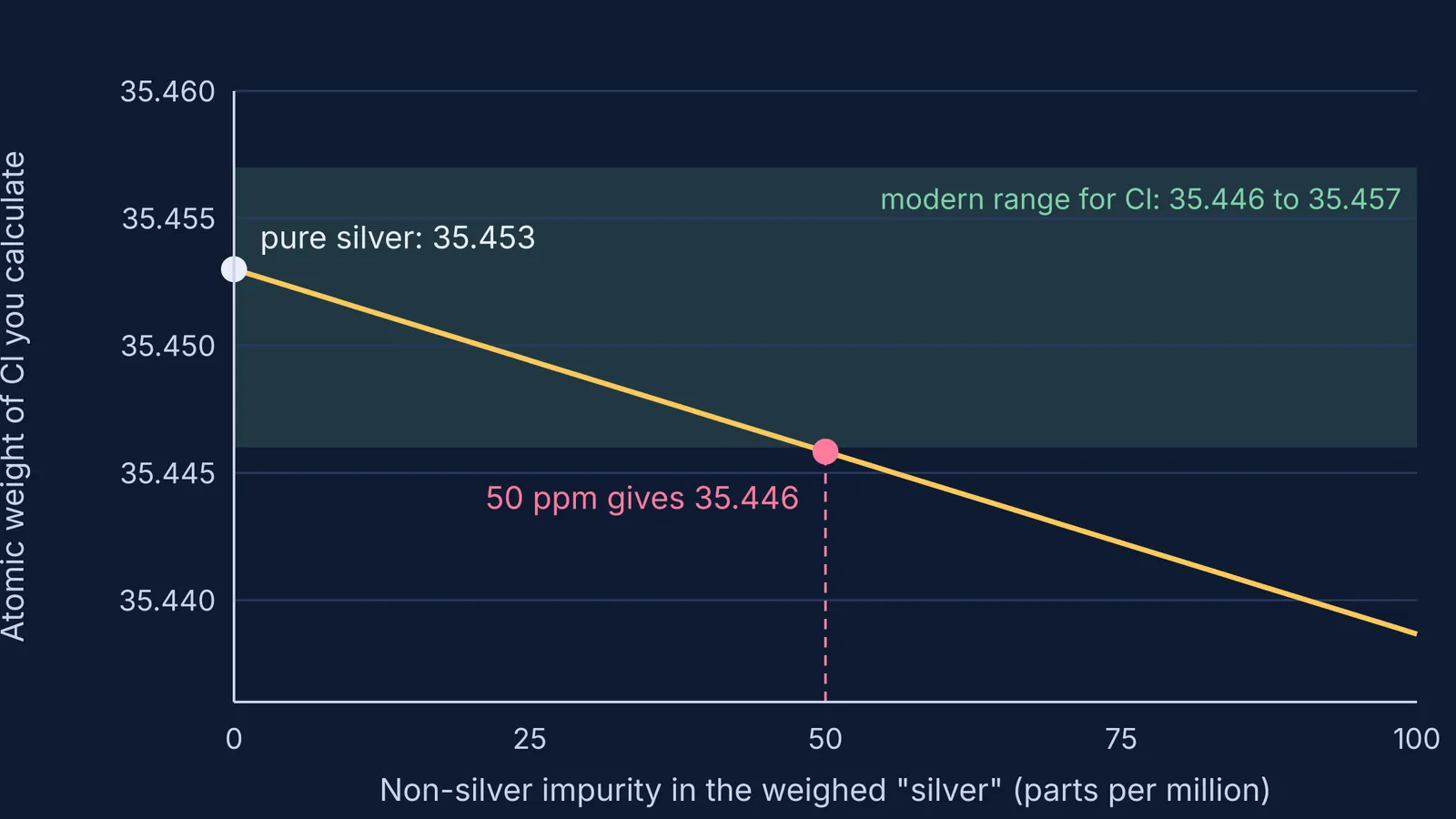
The lecture gives no numbers for Stas's own values, so this example is hypothetical. It takes Richards's "fifty parts in a million" and asks what it would do. Take Ag = 107.868 as known and the true Cl as 35.453.
Pure silver. 10.0000 g of Ag is 10.0000 ÷ 107.868 = 0.092706 mol. It gives 0.092706 × 143.321 = 13.28670 g of AgCl.
Impure "silver". Suppose 50 ppm of the 10.0000 g is not silver and does not react. Real silver = 9.9995 g, so the AgCl formed = 13.28670 × (1 − 0.00005) = 13.28604 g. You collect 0.66 mg less.
What you calculate. You think you used 10.0000 g of silver. Chlorine gained = 13.28604 − 10.00000 = 3.28604 g.
Atomic weight. Cl = 107.868 × 3.28604 ÷ 10.0000 = 35.446.
Size of the error. 35.446 against 35.453 is 0.007 low, about 200 ppm. A 50 ppm impurity became a 200 ppm error.
Why four times? The missing AgCl shows up entirely in the chlorine gain, which is only about a quarter of the AgCl mass (35.453 ÷ 143.321 = 0.247). So the error is multiplied by about 143.3 ÷ 35.45 ≈ 4.0. A small mass found by difference carries the whole error of the big masses around it.
What else did Richards find that is on your syllabus?
The lecture keeps touching NCERT topics:
Hydrogen. With Josiah Parsons Cooke, he found hydrogen "not far from 1.008 if oxygen is taken as 16.000", the 1.008 you still use.
Copper. Copper from America and Germany gave the same value, and "the accepted atomic weight of copper was nearly half a per cent too low", about 0.3 on 63.5.
Cobalt and nickel. Both were analysed as bromides, and the result "proved beyond cavil that cobalt really has a higher atomic weight than nickel", even though "their atomic numbers recently determined by X-ray spectra, suggest the contrary sequence". Today's values are Co 58.93 and Ni 58.69, a gap of 0.24, while Co is element 27 and Ni is 28. That is the Co/Ni pair you meet when the periodic table switches from atomic mass to atomic number.
Faraday's law. The copper coulometer deposits slightly too little copper, because metallic copper reduces some Cu²⁺ to Cu⁺. The silver coulometer deposited too much when the anode was wrapped in filter paper. With both errors removed, Faraday's law became "among the most precise of all the laws of Nature". The same charge deposits Ag and Cu in the ratio 107.868 : 63.546 ÷ 2 = 3.395, so 1.000 g of silver matches 0.2946 g of copper. You can try the copper half yourself in measuring the Faraday constant with a copper coulometer.
Lead. Lead from radioactive minerals came out "as low as 206.08, instead of the 207.2 of ordinary lead". The isotope story behind that is in our profile of Frederick Soddy and isotopes.
To see how atomic mass, the mole and Faraday's laws link up, the Concept Library covers every concept in physics, chemistry, biology, mathematics and computing. For timed practice on mole-concept and electrochemistry questions, Fermi Test Prep is built for JEE Main and Advanced preparation, with an AI tutor.
Quick checklist
Richards: Harvard, 1914 Nobel Prize in Chemistry, lecture on 6 December 1919.
Atomic weight by weighing: mass of one element that combines with a known mass of another.
Cl = Ag × (m of AgCl − m of Ag) ÷ m of Ag.
Impure silver gives too little AgCl, so Cl comes out too light.
An error in a mass found by difference grows; 50 ppm became about 200 ppm.
Co (58.93) is heavier than Ni (58.69) but comes first by atomic number.