On this page
A red-hot steel slab arrives at a rolling mill and two huge rolls squeeze it thinner. Why not squash it from 250 mm to 2 mm in one go? Because the rolls have to pull the slab into the gap by friction alone, and friction can only pull so hard. The limit comes from one line you already know, μ = tan θ, applied at the point where the slab first touches the roll.
How do the rolls grab the slab?
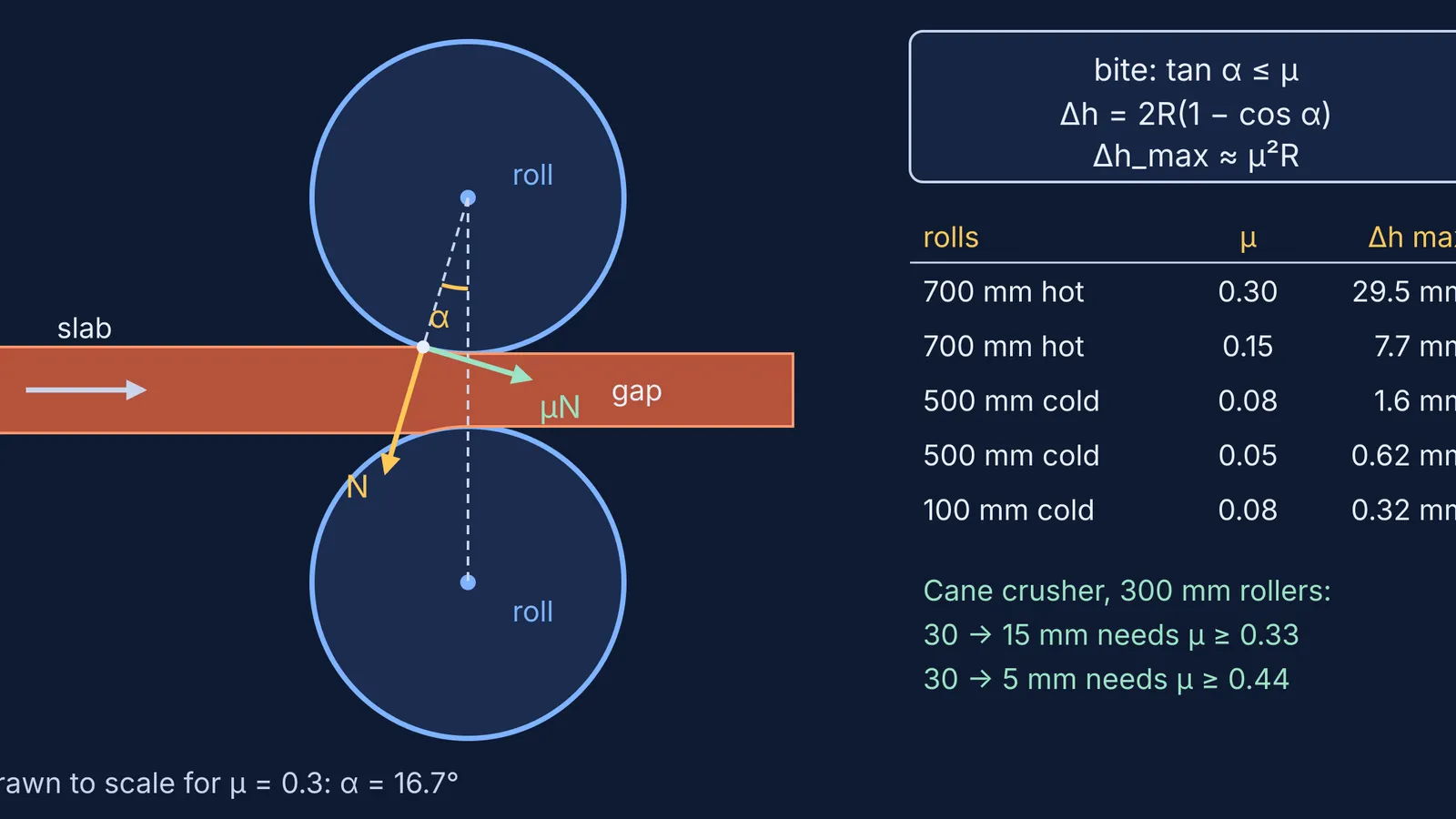
Picture the slab, thicker than the gap, sliding up to two rolls that turn inwards. It first touches each roll at a point a little before the narrowest part of the gap. Draw the radius from the roll's centre to that point. It makes an angle α with the line joining the two roll centres. This is the bite angle.
At that point the roll pushes on the slab with two forces:
Normal force N, along the radius, into the slab. Because the radius is tilted back by α, N has a backward part, N sin α, that tries to push the slab away.
Friction μN, along the tangent, in the direction the roll surface moves. Its forward part is μN cos α, and it tries to drag the slab in.
The slab enters only if the forward pull is at least the backward push:
μN cos α ≥ N sin α, so tan α ≤ μ
This is the same result as a block on a slope at the angle of friction, worked in angle of repose and the tan θ = μ result. The roll surface plays the slope. Splitting a force on a round roller into parts is also the idea behind pulling versus pushing a lawn roller.
How much thinner can one pass make the slab?
The reduction in thickness is called the draft, Δh = h₀ − h₁. From the geometry, the contact point sits a height R(1 − cos α) above the narrowest point of each roll. With two rolls, one above and one below:
Δh = 2R(1 − cos α)
The largest draft comes from the largest bite angle, α = tan⁻¹ μ:
Δh_max = 2R[1 − cos(tan⁻¹ μ)]
For small angles, 1 − cos α ≈ α²/2 and α ≈ μ, so Δh_max ≈ μ²R. Draft grows with the square of friction but only in proportion to roll size. Doubling μ allows four times the squeeze.
The length of the contact arc, from the bite to the gap, is about √(RΔh). It matters for how long each bit of metal is squeezed.
Worked example: hot rolls versus cold, oiled rolls
Question (JEE style). Hot steel is rolled between rolls 700 mm in diameter with μ = 0.3. Find the bite angle, the largest draft and the contact arc length. Repeat for μ = 0.15.
These friction values are round, illustrative numbers. For a sense of scale, a laboratory hot-rolling study by Matsubara, Hiruta and Kimura (ISIJ International, 2015) measured μ = 0.35 for steel rolled at about 700 °C with no lubricant, and found it fell as more oil was left on the surface.
Roll radius. R = 700 ÷ 2 = 350 mm.
Bite angle. α = tan⁻¹ 0.3 = 16.7°.
Largest draft. cos 16.7° = 0.9578, so Δh_max = 2 × 350 × (1 − 0.9578) = 29.5 mm. The shortcut μ²R gives 0.09 × 350 = 31.5 mm, about 7% high, because 16.7° is not a small angle.
Contact arc. Rα = 350 × 0.2915 rad = 102 mm. The √(RΔh) estimate gives the same, 102 mm.
With lubricant, μ = 0.15. α = 8.53°, Δh_max = 7.7 mm. Halving friction cuts the draft to about a quarter.
So a slab 29.5 mm thicker than the gap is the most these rolls can grab. Taking 250 mm down to 25 mm at that rate would need at least 225 ÷ 29.5 = 7.6, so 8 passes. Real mills take fewer millimetres per pass for other reasons too, such as roll force and motor power.
Cold rolling. Cold mills run with oil, so μ is much lower. With illustrative values:
500 mm rolls, μ = 0.08: α = 4.57°, Δh_max = 1.6 mm.
Same rolls, μ = 0.05: Δh_max = 0.62 mm.
100 mm rolls, μ = 0.08: Δh_max = 0.32 mm.
This is why thin sheet and foil need many passes. The last passes of foil are run two sheets at a time, which is why one side of kitchen foil is dull, as why aluminium foil is shiny on one side explains.
Real friction depends on temperature, surface scale, roll roughness and the lubricant, and Szűcs, Krallics and Lenard (Journal of Tribology, 2021) found that published formulas for μ in cold rolling disagree with each other. Treat these drafts as the shape of the answer, not mill data.
Can the rolls go on squeezing once the slab is in?
Yes, a little more. The entry condition is the hard one. Once the slab fills the gap, the roll's push acts nearer the middle of the contact arc rather than at its front edge, so the backward part of N is smaller. A mill can then keep rolling at a bite angle somewhat larger than tan⁻¹ μ. But the slab has to get in first, so the entry condition is the one that limits each pass. For a problem, use tan α ≤ μ at entry.
Why are sugarcane crusher rollers grooved?
A roadside juice crusher works the same way. Take rollers 300 mm across (R = 150 mm) and a cane 30 mm thick, as illustrative values.
Squeeze to 15 mm. Δh = 15 mm, so cos α = 1 − 15 ÷ 300 = 0.95, α = 18.2°, and μ must be at least tan 18.2° = 0.33.
Squeeze to 5 mm. Δh = 25 mm, cos α = 0.917, α = 23.6°, μ ≥ 0.44.
Smooth, wet steel on wet cane cannot be counted on for that much grip, so the rollers carry deep grooves that bite into the cane.
Safety. The same pull that draws in a cane or a slab will draw in a finger, a sleeve or a dupatta. Rollers, crushers and mills must never be approached while running.
Practising friction problems like this
Bite-angle questions are a good test of drawing forces at a curved contact, which JEE problems on rollers and rough curves also ask. To check your method step by step, the Fermi Problem Library has a solver that explains the reasoning. If you are preparing for JEE Main and Advanced, Fermi Test Prep offers personalised preparation with an AI tutor, live classes, adaptive mocks, mentorship and a study plan that updates based on mastery.
Quick checklist
At the first touch, N is along the radius and friction along the tangent.
The rolls bite only if tan α ≤ μ.
Draft for two rolls: Δh = 2R(1 − cos α), close to μ²R for small angles.
Contact arc ≈ √(RΔh).
Less friction or smaller rolls mean a smaller draft per pass.
Never go near running rollers.