

On this page
Have you ever pulled a sheet of aluminium foil from the roll and wondered why one side looks like a mirror while the other has a flat, matte finish? It might seem like a deliberate design choice by the manufacturer to help you cook your meals better, but the difference in shine is actually an accidental byproduct of how the foil is made.
The answer comes down to a clever manufacturing technique used in the very last step of rolling the metal, and the physics of how light bounces off smooth and rough surfaces.
How is aluminium foil rolled thin?
The journey of aluminium foil starts with a large, heavy slab of pure aluminium. Because metals have a property called malleability, they can be squeezed through heavy machinery without breaking. The aluminium is passed through pairs of heavy steel rollers over and over again, getting stretched longer and thinner with each pass.
By industry definition, aluminium foil is any sheet of aluminium that is thinner than 0.2 mm, with standard household foil typically measuring 0.016 mm thick (Wikipedia).
By the time the foil reaches its final rolling pass, it is extremely thin and fragile. If a single sheet were sent through the heavy rollers one last time to reach its final thickness, the immense pressure and tension of the machinery would cause the delicate metal to tear or wrinkle, ruining the batch.
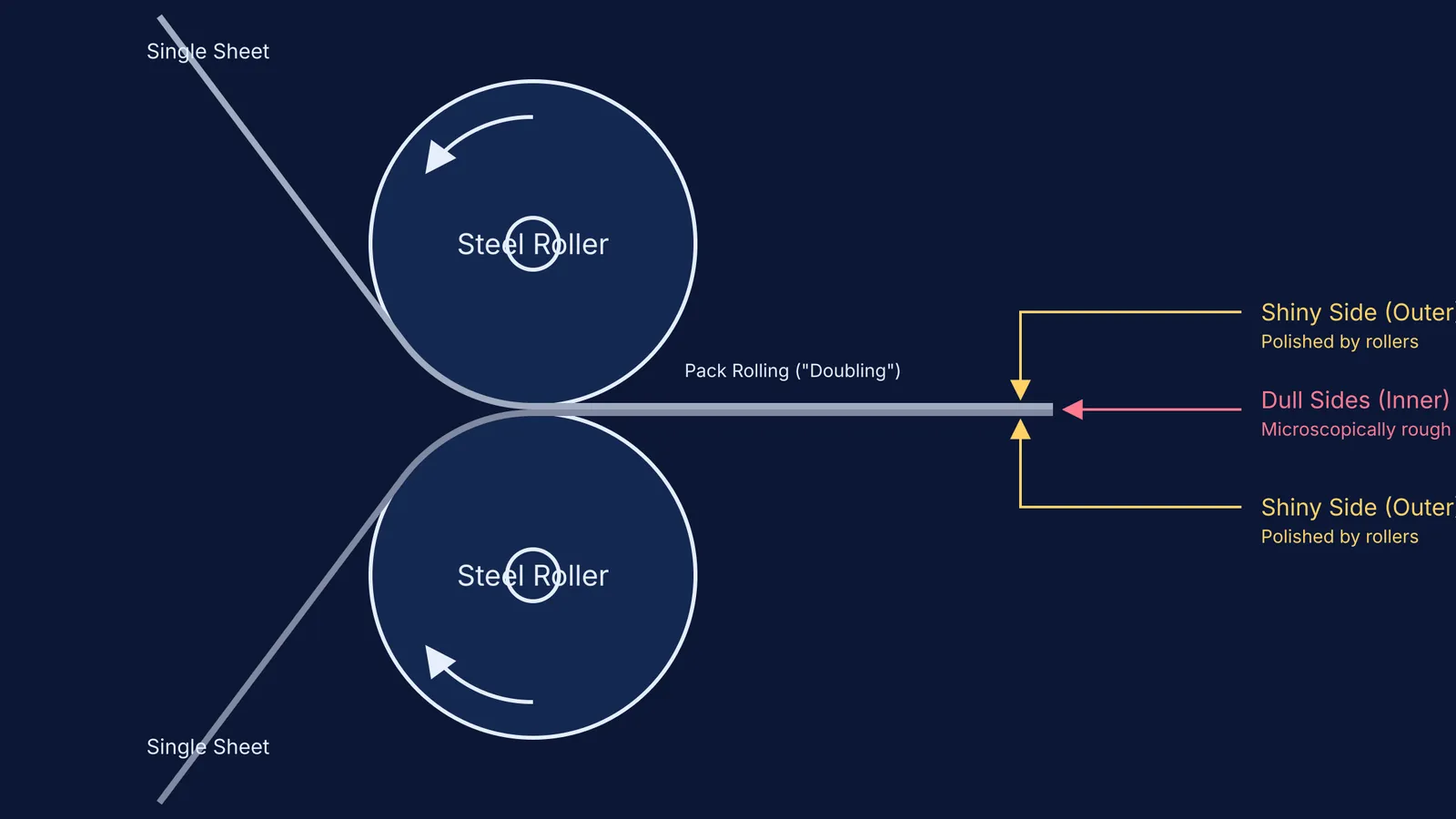
To solve this problem, manufacturers use a trick called "doubling" or "pack rolling". They take two separate sheets of aluminium and feed them through the rolling mill together at exactly the same time.
The shiny side: The outer surfaces of this two-sheet pack press directly against the highly polished steel rollers of the mill. The intense pressure burnishes the metal, leaving a smooth, mirror-like finish on the outside of both sheets.
The dull side: The inner surfaces of the pack face each other. Instead of touching the polished rollers, the two aluminium sheets press tightly against one another. This foil-to-foil contact creates a microscopically rough texture, leaving a matte finish on the inside.
Once the double sheet comes out of the rollers, the two layers are peeled apart and wound onto the rolls you buy in the shop, leaving each single sheet with one shiny face and one dull face.
Why does one side reflect light differently?
The visual difference between the two sides of the foil is a perfect real-world example of optical physics at work.
When visible light hits the smooth, shiny side of the foil, it undergoes specular reflection. Because the surface was polished perfectly flat by the steel rollers, the incoming light rays all hit the foil and bounce off at exactly the same angle. This uniform, parallel reflection allows you to see a clear, bright shine.
On the dull side, the microscopic roughness from the doubling process changes how the light behaves. When light hits this rougher texture, it undergoes diffuse reflection. The rays hit the microscopic bumps and scatter in many different, random directions rather than bouncing back together. Because the reflected light is scattered, your eye does not perceive a clear image, making the surface look flat and dull.
Visualising how light rays scatter off different textures makes the science of optics much easier to grasp. If you want to see exactly how these angles work, the Fermi Simulation Lab lets you interact with specular and diffuse reflection models to watch the rays bounce off smooth and rough boundaries in real time.
Does it matter which side faces the food?
A common kitchen myth suggests that you should wrap food with the shiny side facing in to reflect more heat back into the dish, or with the dull side facing out to absorb heat from the oven. For almost all everyday cooking, baking, and freezing, it makes absolutely no difference which side you use.
While the shiny side is clearly better at reflecting visible light, ovens cook food primarily using infrared radiation, which is a form of heat. Because the wavelengths of infrared radiation are significantly longer than the wavelengths of visible light, the microscopic roughness of the dull side is simply too small to scatter them in the same way. As far as the heat in your oven is concerned, both sides look exactly the same. Both the shiny and dull sides reflect infrared heat with near-identical efficiency.
There is only one exception to this rule: if you buy a roll specifically labelled as non-stick foil. In this case, the manufacturer applies a food-safe, non-stick polymer coating exclusively to the dull side of the foil. The packaging will explicitly instruct you to place your food on the dull side to stop it from sticking. For any standard, uncoated aluminium foil, you can safely use whichever side you prefer.
*(Related reading: Dispersion of white light by a glass prism, explained for Class 10)*
*(Related reading: How is white sugar extracted from sugarcane?)*
*(Related reading: Why does wind make a cold day feel colder?)*


