

On this page
Transforming tough, fibrous sugarcane stalks into pure white sugar crystals relies heavily on physical and chemical principles. The extracted cane juice is acidic, dark, and mostly water.
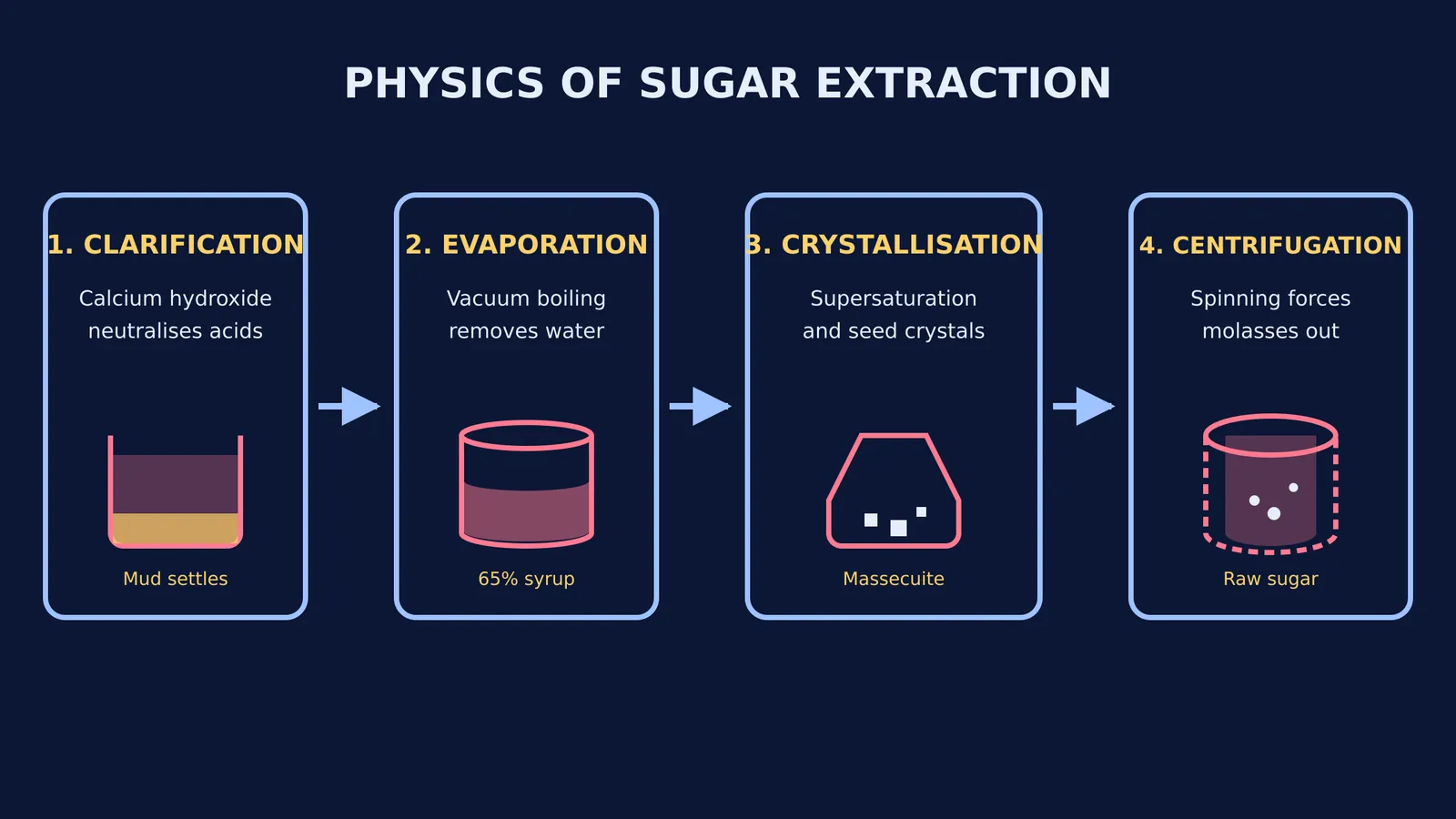
The Government of India fixes a Fair and Remunerative Price (FRP) based on a basic sugar recovery rate of 10.25% (PIB). This means that, on average, a sugar mill extracts 102.5 kg of sugar from every 1,000 kg of crushed sugarcane. Achieving this yield requires four key stages: clarification, evaporation, crystallisation, and centrifugation.
How is the juice clarified?
The raw juice squeezed from the cane is full of soil, organic acids, and plant fibre. If boiled directly, these impurities would ruin the sugar's quality.
Mills use a chemical precipitation step called clarification. The juice is heated and mixed with calcium hydroxide, commonly known as milk of lime. The lime neutralises the natural acids and reacts with the impurities to form heavy, insoluble compounds. These solids settle to the bottom of large clarifier tanks as "mud", leaving a clear, pale yellow liquid at the top. This is similar to the principles behind extracting metals for Class 10: roasting, calcination and reduction, where chemical reactions isolate the desired material from the raw source.
How does evaporation concentrate the juice?
The clarified juice still contains about 85% water. The next step is to remove this water without burning the sugar. The juice flows through a series of multiple-effect evaporators. Lowering the pressure inside these vacuum vessels lowers the boiling point of the liquid, saving energy and preventing the sucrose from caramelising. As the water boils off, the thin liquid transforms into a heavy, thick syrup containing roughly 65% dissolved sugar (EPA).
How do sugar crystals form?
Crystallisation is where the liquid syrup becomes a solid. The thick syrup is transferred to large vacuum pans, where further boiling removes even more water until the solution becomes supersaturated.
In a supersaturated state, the liquid holds more dissolved sugar than it normally could at that temperature. To trigger the process, workers introduce tiny "seed crystals" of sugar. The dissolved sucrose molecules latch onto these seeds, growing them into mature crystals. The resulting thick mixture of solid sugar crystals suspended in a heavy dark liquid (molasses) is known as massecuite.
If you are studying phase changes or want to visualise how concentration and saturation thresholds work, the Fermi Simulation Lab has interactive simulations for the ideas that are easier to see than to read.
How are crystals separated from molasses?
The final challenge is pulling the pure sugar crystals out of the sticky molasses.
The massecuite is fed into a centrifuge, a large, perforated metal basket that spins at high speeds. The intense centrifugal force flings the heavy liquid molasses outwards through the tiny holes in the basket walls, while the solid sugar crystals are trapped inside. The crystals are briefly washed with a mist of hot water as they spin to remove any lingering molasses. The result is raw sugar, which is often further refined to produce the bright white crystals sold in grocery stores. The spinning technique mirrors other laboratory separation methods you might study, much like finding the Rf value in paper chromatography: calculating and using it to separate components of a mixture.


