

On this page
If you have ever ridden a two-wheeler on a winter morning in Delhi or walked to the bus stop on a chilly January day, you know that the thermometer only tells half the story. The air temperature might read 10 °C, but a brisk gust of wind can make it feel freezing.
The human body regulates its temperature through a delicate balance of heat production and heat loss. When you ask why a cold day feels colder in the wind, the answer lies in the physics of fluids and thermodynamics.
Why does wind make a cold day feel colder?
Your body is constantly generating heat and radiating it into the surrounding environment. In perfectly still air, your body heat warms a thin envelope of air immediately next to your skin.
Because air is a poor conductor of heat, this warm envelope acts as a natural biological insulator. It slows down the transfer of thermal energy from your core to the cold world outside.
When the wind blows, it physically strips away this warm boundary layer through a process called forced convection. The wind constantly replaces your hard-won blanket of warm air with new, colder ambient air. Your body must then expend more energy to heat the new air, only for the wind to blow it away again. This accelerated convective heat loss is the primary reason the wind feels so cold.
If you are studying convective heat transfer and want to picture how fluid flow strips away energy, the Fermi Simulation Lab has interactive simulations for ideas that are easier to see than read.
How does the thermal boundary layer work?
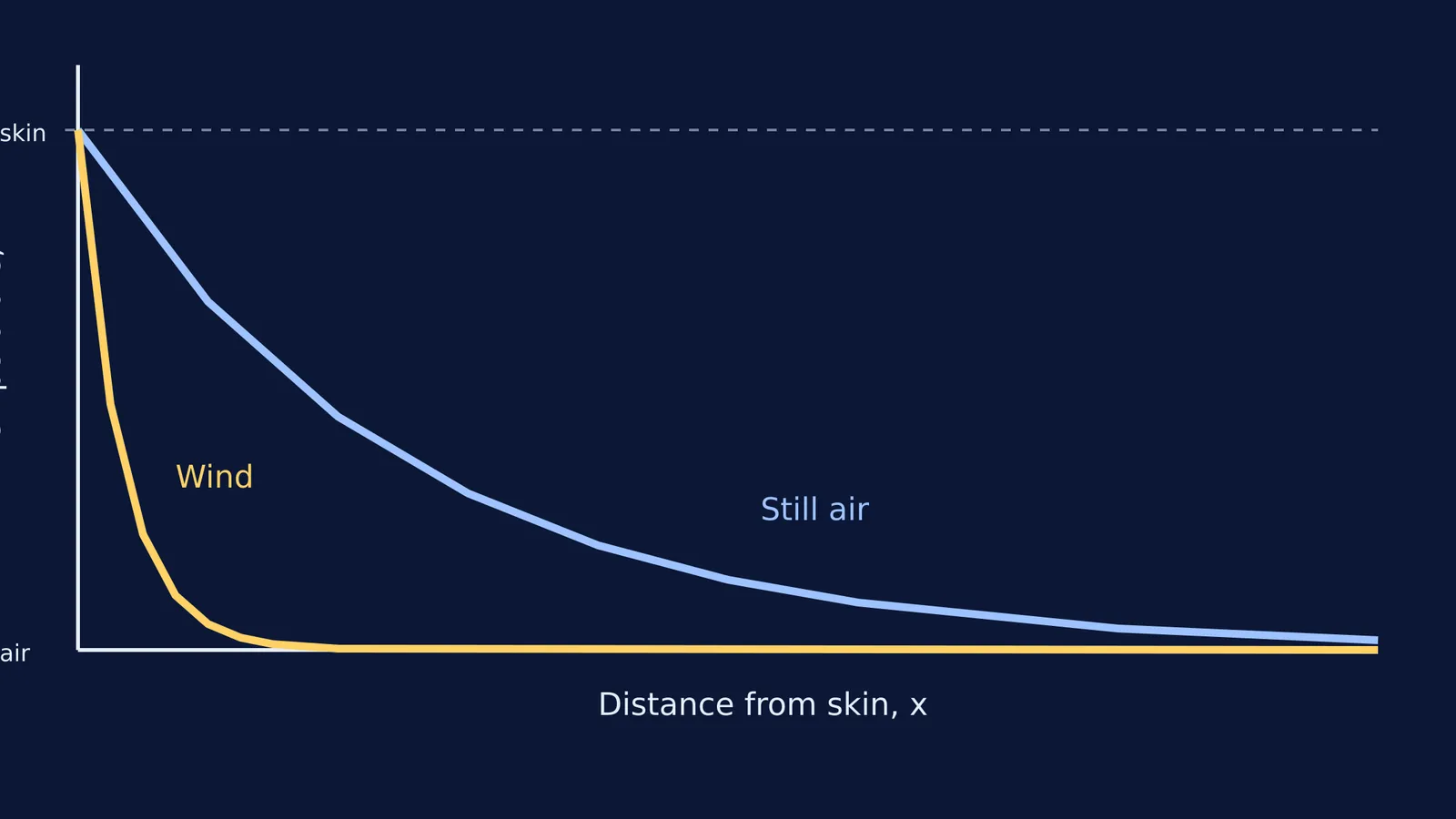
In fluid dynamics, the thermal boundary layer is the microscopic region where the temperature transitions from your skin's surface temperature down to the ambient air temperature.
Without wind, this protective layer of still air is relatively thick. The heat transfer through this static layer is largely conductive. This process is governed by the same principles of thermal physics that dictate the time it takes for ice to form on a pond through conduction.
When wind introduces forced convection, it compresses this protective layer significantly. The temperature gradient becomes incredibly steep. A steeper gradient means a vastly higher rate of heat loss, rapidly draining thermal energy from your skin.
What role does evaporative cooling play?
Beyond convection, wind speeds up evaporation. Even in the cold, your skin constantly releases small amounts of water vapour through insensible perspiration.
In calm conditions, the layer of air near your skin becomes saturated with this moisture, which slows down further evaporation. Moving air carries this moisture-laden air away and replaces it with drier air, driving faster evaporation. Because evaporation is an endothermic process—meaning it requires energy to turn liquid into a gas—it pulls thermal energy directly from your skin.
This dynamic cooling problem is a direct application of thermodynamics, much like tracking heat in isobaric and isochoric processes when a system exchanges energy with its surroundings.
How is the wind chill index calculated?
To quantify this heat loss, meteorologists use the wind chill index. The National Weather Service (NWS) calculates wind chill to estimate how quickly frostbite can occur on exposed skin.
According to the NWS, at an air temperature of 0 °F with a 15 mph wind, the wind chill drops to −19 °F, and exposed skin can freeze in 30 minutes. If the wind speed increases to 30 mph at −10 °F, the wind chill plummets to −39 °F, bringing the frostbite time down to just 10 minutes.
It is important to note that wind chill only affects living things. Wind cannot cool an inanimate object below the actual ambient air temperature; it only forces the object to cool down to that baseline temperature faster.
How can you defend against wind chill?
Because wind strips away the boundary layer, simply wearing a thick, chunky sweater is not enough if the wind can pass straight through the weave.
Base layer: Wear a close-fitting garment right against the skin to trap a microscopic layer of warm air and wick away moisture.
Insulating layer: Add fleece or wool to create a thicker zone of trapped, still air. This replicates the thick boundary layer you would naturally have in calm weather.
Shell layer: Wear a closely woven, windproof jacket on the outside. This vital barrier prevents the wind from flushing out the warm air trapped in the middle layer.


