On this page
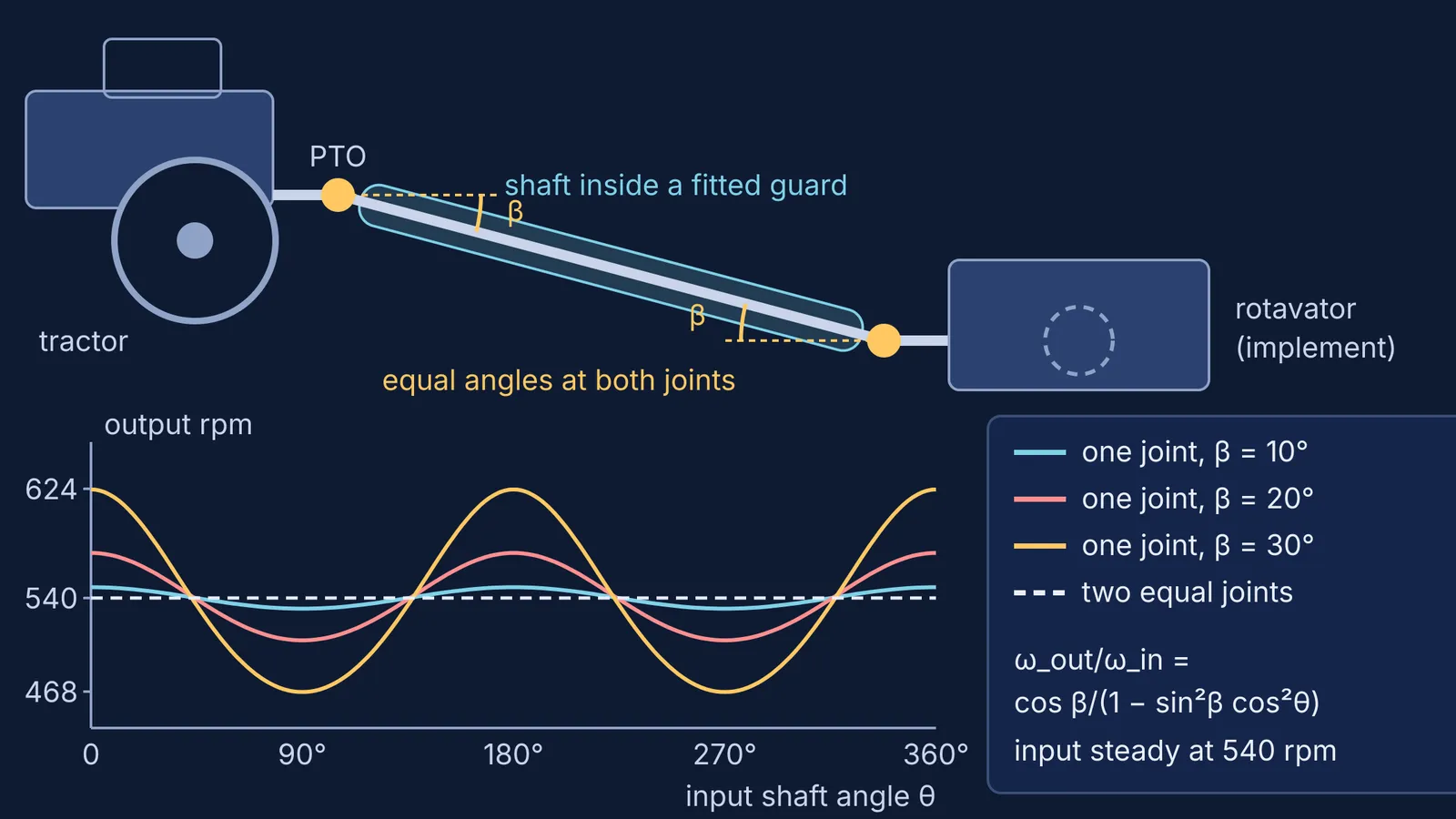
Behind almost every tractor working a field in India is a spinning steel shaft. It carries power from the tractor's power take-off (PTO) to a rotavator, thresher or pump. The implement sits lower and to one side, so the shaft has to turn corners, and it does that with cross-shaped universal joints. There is a catch that surprises most students: a single universal joint at an angle does not pass on a steady speed. Feed in a steady 540 rpm through one joint bent to 30°, and the output swings between about 468 and 624 rpm, twice every turn.
Safety first. A spinning PTO shaft can catch clothing, hair or a loose dupatta in a fraction of a second and wind a person onto it. It can kill. Never go near a PTO shaft while it turns, never step over it, and keep every guard and shield fitted. This post explains the physics only; it is not a guide to setting up or changing any machine.
What is a universal joint and why is it used?
A universal joint, also called a Hooke's or Cardan joint, joins two shafts that meet at an angle. Each shaft ends in a fork, and the two forks are linked by a cross with four arms. As one shaft turns, the cross rocks and drives the other fork round.
It lets a driveshaft reach an implement that is lower or off to one side, even as the angle changes over bumps and turns. The car differential solves a different problem, sharing drive between two wheels that need different speeds. A universal joint passes drive between two shafts that are not in line.
Why does one joint make the output speed swing?
Look along the input shaft. Its fork turns at a steady rate. But the cross is also tied to the output fork, which turns in a plane tilted by the shaft angle β. Seen from the input, that tilted circle is squashed into an ellipse. A point moving steadily round a circle in one plane does not move steadily round its tilted copy; it seems to speed up and slow down.
A standard theory-of-machines result, derived in this university lecture on the universal joint, gives
ω_out/ω_in = cos β/(1 − sin²β cos²θ)
where θ is the angle the input has turned from the position where its fork lies in the plane of the two shafts. The same lecture shows:
Maximum: when cos²θ = 1 (θ = 0°, 180°), ω_out = ω_in/cos β.
Minimum: when cos²θ = 0 (θ = 90°, 270°), ω_out = ω_in cos β.
Small angles: the swing is roughly ω_in β², so doubling the angle roughly quadruples it.
The swing happens twice per turn, because the formula depends on cos²θ, which repeats every 180°. The average speed does not change: each shaft makes exactly one turn for every turn of the other. The output just runs ahead for part of a turn and falls behind for the rest.
Worked example: 540 rpm through one joint
The common PTO speeds are 540 and 1,000 rpm; Bondioli & Pavesi's PTO driveshaft safety catalogue quotes its limits at 540 min⁻¹ and 1,000 min⁻¹. Take a steady input of 540 rpm.
Input angular speed. ω_in = 2π × 540/60 = 56.5 rad/s.
Angle 30°. cos 30° = 0.866. Minimum output = 540 × 0.866 = 468 rpm. Maximum = 540/0.866 = 624 rpm. Swing = 156 rpm, which is 29% of 540.
Other angles. At 10°: 532 to 548 rpm (3.1%). At 20°: 507 to 575 rpm (12%). At 40°: 414 to 705 rpm (54%). The swing grows much faster than the angle.
How far ahead or behind. From tan θ_out = tan θ_in/cos β, the output at 30° gets up to 4.1° ahead of or behind the input during each turn.
Angular acceleration. Differentiating ω_out with respect to time and searching numerically for the peak gives about 942 rad/s² at 30°.
Torque to shake the load. Suppose the implement's rotating parts have a moment of inertia I = 1.0 kg m² (an illustrative value). Then τ = Iα = 1.0 × 942 = 942 N m, reversing 18 times a second (2 swings per turn × 9 turns per second).
Compare with the useful torque. A 30 kW load at 540 rpm needs τ = P/ω = 30,000/56.5 = 531 N m. The shaking torque is larger than the working torque.
Units check: rad/s² × kg m² = N m.
So the shaft, joints and gearboxes take a hammering torque on top of the steady one.
How does a second joint cancel the swing?
A PTO shaft has a joint at each end. If both joints run at the same angle and their inner forks (the two on the middle shaft) lie in the same plane, the second joint's swing is the mirror image of the first. The middle shaft speeds up and slows down, but the second joint undoes it, and the implement turns at a steady 540 rpm.
Get it wrong and the swings add instead. If the angles differ, part of the swing gets through. If the inner forks are a quarter-turn out of line, the two swings add and the output swings even more. That is why the Bondioli & Pavesi catalogue says the two joint angles should be small and as equal as possible, with limits of 35° under power and 45° while rotating, and why constant velocity (CV) joints exist for larger angles. Any fitting or adjustment is a job for the maker's instructions and a trained person, with the engine off.
Why is a turning PTO shaft so dangerous?
At 540 rpm the shaft turns 9 times a second, so cloth that touches it is wound on before anyone can react. The same Bondioli & Pavesi document states that contact with a rotating driveline can cause death or serious injury, that all rotating parts must be guarded, and that you should not step over or go under the driveline.
Simple rules for anyone near a tractor:
Stay away from a PTO shaft whenever the engine is running.
Never step over it or reach across it.
Guards and shields stay fitted, always.
Loose clothing, scarves and long hair are kept well clear.
Tractors can also overturn; see why a tractor flips backwards. Engineers who design these drivelines and guards often come through agricultural engineering.
How does this connect to Class 11 rotational motion?
The idea is angular speed and angular acceleration, ω = dθ/dt and α = dω/dt, then torque τ = Iα. The joint gives you a ω that changes with angle, so the chain rule gives α = (dω/dθ)ω. The Concept Library covers angular acceleration and moment of inertia if you want a refresher.
Checklist
One universal joint at angle β: output swings between ω cos β and ω/cos β, twice per turn.
At 540 rpm and 30°, that is 468 to 624 rpm, a 29% swing.
The average speed is unchanged; only the speed within a turn varies.
The swing grows roughly as β², and the torque to drive it is τ = Iα.
Two joints at equal angles, inner forks in line, cancel the swing.
A turning PTO shaft can kill. Stay away while it turns, never step over it, keep guards fitted.