On this page
You meet Ludwig Gattermann twice in Class 12 chemistry: once in Amines, where copper powder replaces a diazo group, and once in Aldehydes, where carbon monoxide and HCl put a –CHO group on an aromatic ring. Behind the second one is a two-page paper from Heidelberg, received by the German Chemical Society on 1 July 1897. It is short, honest about what failed, and gives real numbers for a yield problem.
Who was Ludwig Gattermann?
Friedrich August Ludwig Gattermann was born in Goslar on 20 April 1860 and died in Freiburg on 20 June 1920, according to his entry in the Neue Deutsche Biographie (NDB, vol. 6, 1964). He took his doctorate in Göttingen in 1885 and became assistant to Victor Meyer, the chemist behind the vapour density method for molar mass. In 1889 he followed Meyer to Heidelberg, where the NDB says he spent his most productive years, and in 1900 he took charge of the chemistry institute at Freiburg.
Three things from that entry are worth knowing:
The Kochbuch. In 1894 he published "Die Praxis des organischen Chemikers", a lab manual he liked to call his "Kochbuch" (cookbook). It was translated into many languages, and a 40th edition, revised by Rolf Huisgen, appeared in 1961.
A careful experimenter. In 1887/88 he purified and analysed nitrogen trichloride without accident. Davy and Faraday had both been badly hurt by this explosive compound.
Industry links. From his Göttingen years he worked with the dye firm Bayer in Elberfeld. A footnote in the 1897 paper says Bayer had applied for a patent on the new reaction.
What problem did the 1897 paper set out to solve?
The Friedel–Crafts reaction already let chemists attach acyl groups to rings using an acid chloride and AlCl₃. To attach –CHO you would need the acid chloride of formic acid, formyl chloride. Gattermann and J. A. Koch open their paper, "Eine Synthese aromatischer Aldehyde" (Berichte 30, 1622–1624), with the reason that is impossible. Formyl chloride, they write (our translation), "decomposes immediately on formation into carbon monoxide and hydrochloric acid":
HCOCl → CO + HCl
So they asked the obvious question: why not feed in the two pieces, CO and HCl, and let AlCl₃ do the rest? You can read the paper in the scanned volume on the Internet Archive. Their next sentence is the one to remember: "Surely this obvious experiment has often been carried out, but without success."
Why did benzene give no aldehyde in 1897?
With CO, HCl and AlCl₃ alone, they report that "neither from benzene nor from anisole" did they get "the slightest trace" of aldehyde. Toluene gave only a very small amount. That trace told them the reaction was possible, so they kept going. Platinum black, platinum asbestos, animal charcoal and kieselguhr all failed. The breakthrough was cuprous chloride, CuCl, which they chose because it "as is known, combines with carbon monoxide". With CuCl present, toluene gave its aldehyde "in good yield".
Your NCERT textbook writes the reaction as benzene → benzaldehyde, and that is the equation to write in your exam. It shows the general reaction on the simplest ring. The 1897 paper does not test benzene again after adding CuCl. It only reports that, under its own conditions and before the CuCl idea, benzene gave nothing.
Why did toluene respond when benzene did not? In the textbook mechanism, CO, HCl and AlCl₃ generate the formyl cation, HCO⁺, a weak electrophile. The methyl group of toluene pushes electron density into the ring (+I effect and hyperconjugation), so the ring attacks weak electrophiles more readily than benzene does. The methyl group is also ortho/para directing.
The product was para. Gattermann and Koch proved it by oxidation: the aldehyde gave only p-toluic acid (4-methylbenzoic acid). Ortho attack is possible in principle but is crowded next to the methyl group, so para wins.
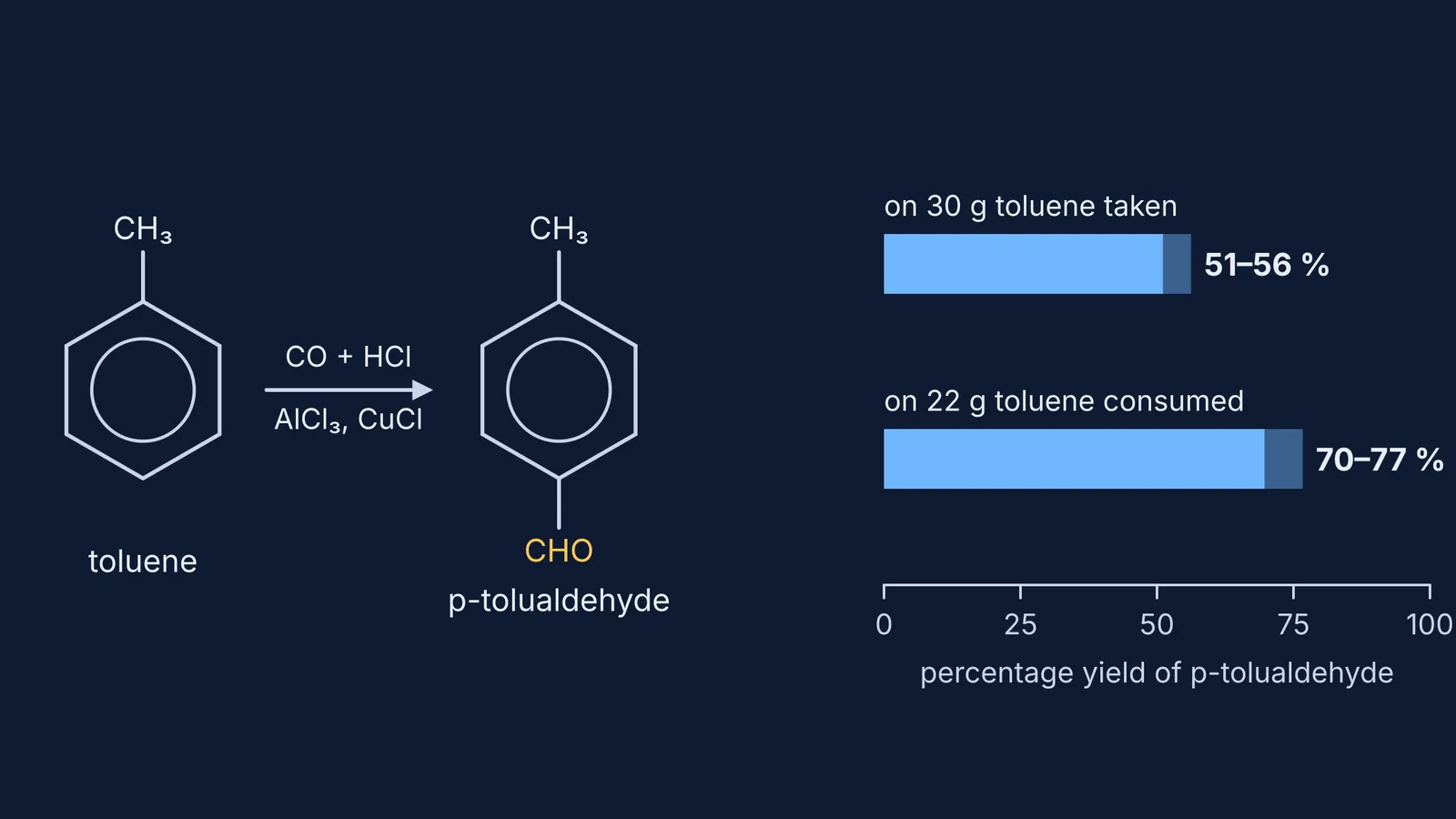
C₇H₈ + CO → C₈H₈O (toluene → p-tolualdehyde; atoms: 8 C, 8 H, 1 O on each side)
One caution. The paper gives no reason for anisole's failure, and simple activation arguments do not explain it, because the –OCH₃ group activates a ring more strongly than –CH₃ does. Treat "more activated rings react better" as a guide, not a law.
How do you calculate the yield from Gattermann's numbers?
The paper gives the masses. From 30 g of toluene they obtained about 20–22 g of pure p-tolualdehyde, and about 8 g of toluene came back unchanged. That second number lets you calculate the yield two ways.
Step 1: molar masses. Toluene, C₇H₈ = 7(12.011) + 8(1.008) = 92.14 g/mol. p-Tolualdehyde, C₈H₈O = 8(12.011) + 8(1.008) + 15.999 = 120.15 g/mol.
Step 2: mole ratio. One toluene gives one aldehyde, so the ratio is 1 : 1.
Step 3: yield on toluene charged. 30 g ÷ 92.14 g/mol = 0.326 mol. Theoretical aldehyde = 0.326 × 120.15 = 39.1 g. Yield = 20/39.1 to 22/39.1, that is 51–56 %.
Step 4: yield on toluene consumed. Toluene used up = 30 − 8 = 22 g = 0.239 mol. Theoretical aldehyde = 0.239 × 120.15 = 28.7 g. Yield = 20/28.7 to 22/28.7, that is 70–77 %.
Step 5: read the answer. Both numbers are correct. They answer different questions. The first asks how much of the starting material you turned into product. The second asks how cleanly the reaction worked on the toluene that actually reacted. Chemists often quote the second when unreacted starting material can be recovered, as here.
If you want more stoichiometry problems in this style, the Fermi Problem Library has a step-by-step solver that explains the reasoning at each line.
How is Gattermann–Koch different from the Gattermann reaction?
Three reactions carry his name.
Gattermann reaction (diazonium salts). A diazonium salt with copper powder and HCl or HBr gives an aryl chloride or bromide. It comes from his "Untersuchungen über Diazoverbindungen" (Berichte 23, 1890). The NDB says he simplified and extended Sandmeyer's method. The comparison with Sandmeyer's copper(I) salts is set out in Sandmeyer and Gattermann reactions: replacing the diazo group.
Gattermann–Koch reaction (1897). CO and HCl with AlCl₃ and CuCl put –CHO on an aromatic ring. Reagents and mechanism for the benzene case are covered in the Gattermann–Koch reaction from benzene to benzaldehyde.
Gattermann aldehyde synthesis (1898). A second aldehyde method, published in Berichte 31, that uses hydrogen cyanide in place of carbon monoxide. It is outside the NCERT syllabus. Just do not confuse it with Gattermann–Koch.
The quick test: a diazonium salt means the Gattermann reaction. CO + HCl means Gattermann–Koch.
Both carbon monoxide and hydrogen chloride are toxic gases, so this is chemistry to learn on paper, not to try. For practice that mixes named reactions with mechanism questions in JEE format, Fermi Test Prep for JEE Main and Advanced has an AI tutor that works through them with you.
Quick checklist
Formyl chloride falls apart into CO + HCl, so Gattermann–Koch feeds in CO and HCl directly.
The 1897 paper got no aldehyde from benzene or anisole before CuCl was added. Toluene, with CuCl, worked well.
Toluene gives p-tolualdehyde. The para position was proved by oxidation to p-toluic acid.
Yield on 30 g toluene taken: 51–56 %. On the 22 g consumed: 70–77 %.
Gattermann (diazonium, Cu powder) is not Gattermann–Koch (CO, HCl).