

On this page
Converting an aromatic ring into an aldehyde is a classic challenge in organic chemistry. The Gattermann-Koch reaction offers a direct route to achieve this, turning benzene into benzaldehyde by introducing a formyl group (—CHO).
For students preparing for Class 12 board exams or competitive tests like JEE and NEET, mastering this named reaction is essential. Understanding the specific reagents, the role of the catalyst, and how the mechanism works will help you tackle synthesis and conversion questions with confidence. If you need to map out where this reaction fits into broader synthesis pathways, you can explore the Concept Library for step-by-step topic clusters.
What is the Gattermann-Koch reaction?
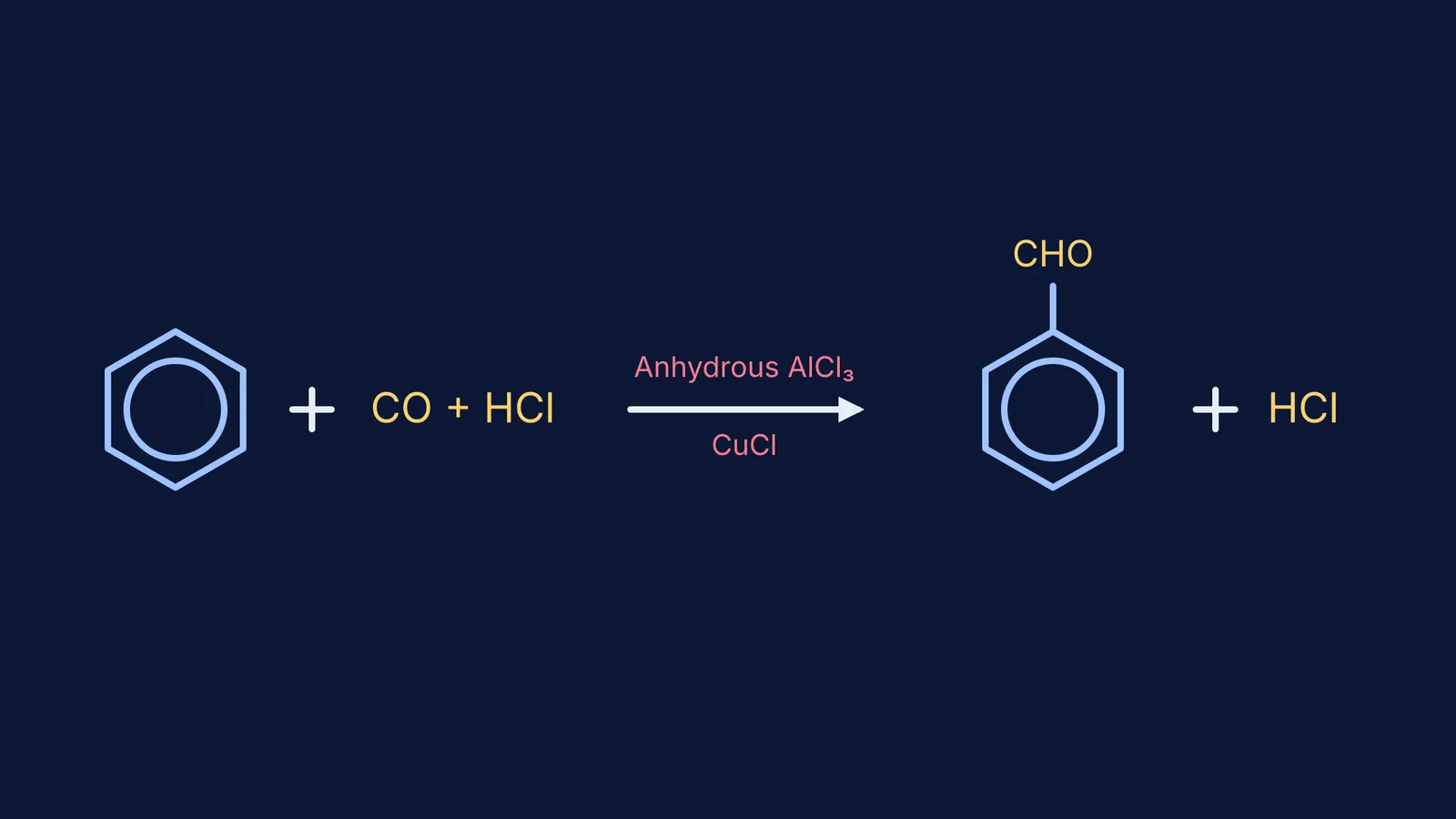
The Gattermann-Koch reaction is an organic substitution reaction used to synthesize benzaldehyde from benzene. When benzene is treated with carbon monoxide (CO) and hydrogen chloride (HCl) gas in the presence of a Lewis acid catalyst—typically anhydrous aluminium chloride (AlCl₃) and a trace amount of cuprous chloride (CuCl)—it yields benzaldehyde (Source).
The overall chemical equation is: Benzene + CO + HCl → Benzaldehyde + HCl
This process is a variant of Friedel-Crafts acylation, specifically designed to add a formyl group to the aromatic ring. Because formyl chloride (HCOCl) is unstable at room temperature, the combination of CO and HCl is used to generate the reactive electrophile directly in the reaction mixture.
How does the Gattermann-Koch reaction work?
The reaction proceeds via an electrophilic aromatic substitution pathway (Source). The mechanism involves three distinct steps:
Generation of the electrophile: Carbon monoxide reacts with hydrogen chloride and the anhydrous AlCl₃ catalyst. The Lewis acid helps protonate the carbon monoxide, producing a highly reactive formyl cation (HCO⁺), which acts as the electrophile.
Electrophilic attack: The electron-rich pi cloud of the benzene ring attacks the formyl cation. This temporary disruption of the ring's aromaticity creates a high-energy intermediate known as a sigma complex (or arenium ion).
Restoration of aromaticity: The [AlCl₄]⁻ complex acts as a base, pulling a proton (H⁺) from the sigma complex. The electrons return to the ring, restoring its stable aromatic state to form benzaldehyde, while simultaneously regenerating the AlCl₃ catalyst and HCl.
Where does it fit among benzaldehyde preparations?
Organic chemistry offers multiple pathways to synthesize aldehydes, and choosing the right one depends on your starting material. The Gattermann-Koch reaction is the method of choice when starting directly from a simple hydrocarbon like benzene.
If you are starting from other functional groups, different named reactions come into play:
From toluene: The Etard reaction uses chromyl chloride to oxidize the methyl group of toluene into an aldehyde.
From acid chlorides: The Rosenmund reduction converts an acyl chloride into an aldehyde using hydrogen gas and a poisoned palladium catalyst.
From nitriles: The Stephen reaction reduces a nitrile to an imine using stannous chloride and HCl, which is then hydrolysed to an aldehyde.
You can read more about these alternative methods in our guide to the Rosenmund, Stephen and Etard reactions: three routes to aldehydes. Additionally, if you need to modify the aromatic ring using diazonium salts, review the Sandmeyer and Gattermann reactions: replacing the diazo group.
What should you remember for exams?
When revising this reaction for exams, keep these critical details in mind to avoid common pitfalls:
Catalyst condition: The aluminium chloride must be *anhydrous*. Moisture will react with the Lewis acid, destroying its catalytic ability.
Limitation with phenols: The Gattermann-Koch reaction does not work well for phenols or phenol ethers because the oxygen atom coordinates strongly with the AlCl₃ catalyst. For adding a formyl group to phenol, the Reimer-Tiemann reaction is used instead.
Reagent generation: Remember that formyl chloride is not added directly; it is generated *in situ* using CO and HCl.
Related reductions: If a question asks you to reverse an aldehyde back to a hydrocarbon, you will need a completely different approach, such as Clemmensen vs Wolff-Kishner: reducing a C=O group to CH2.
By structuring your study around the starting material, the reagents, and the mechanism, you can quickly identify the Gattermann-Koch reaction in any synthesis sequence.


