On this page
In the spring and summer of 1873, Ferdinand Tiemann and Wilhelm Haarmann, two young chemists in Berlin, collected a substance from conifer trees. Their method: take freshly felled trunks, strip off the bark and scrape the wet layer underneath into a dish. From that sap they made vanillin, the molecule that gives vanilla its smell, without using a single vanilla pod. Their 1874 paper is also a clean lesson in deducing a structure from reactions, the skill behind Class 12 "identify the compound" questions.
Who was Ferdinand Tiemann?
Johann Karl Wilhelm Ferdinand Tiemann was born on 10 June 1848 in Rübeland in the Harz and died on 14 November 1899 in Meran, according to his entry in the Neue Deutsche Biographie (NDB, vol. 26, 2016). He trained as a druggist and pharmacist, then in 1869 joined August Wilhelm Hofmann's laboratory in Berlin. He stayed Hofmann's assistant until Hofmann's death, and Hofmann married Tiemann's sister Bertha. You can read about his teacher in August Wilhelm Hofmann and the amine chemistry you still study.
The NDB adds that Tiemann edited the Berichte of the German Chemical Society from 1882 to 1897, and calls him the founder of the chemistry of odorants. Besides vanillin he worked on terpenes, coumarin and the violet-scented ionones (1893).
How did Tiemann and Haarmann get vanillin from pine sap?
Their paper, "Ueber das Coniferin und seine Umwandlung in das aromatische Princip der Vanille" (Berichte 7, 608–623, 1874), is free to read in a scanned volume on the Internet Archive. The story runs in four steps.
The sap. At the time of wood formation, the cambial sap of conifers such as spruce, fir, pine and larch contains a glucoside called coniferin. They collected it in quantity in 1873, scraping the sap "practically, with a shard of glass".
The glucoside. Coniferin does not reduce Fehling's solution, "even after prolonged boiling". That fits a glycoside, where the sugar's reducing end is tied up in a bond, the same idea you meet for sucrose in Biomolecules.
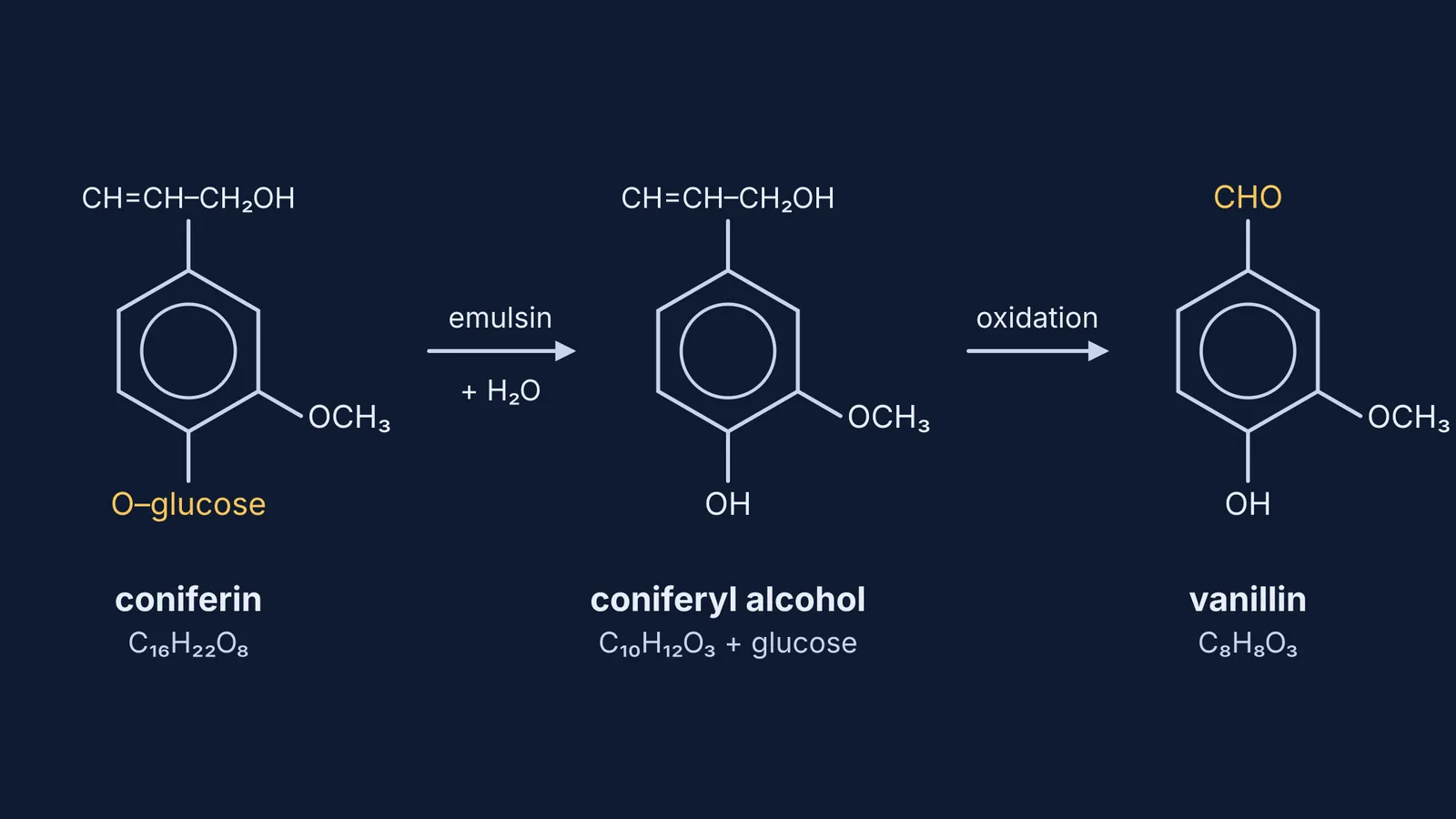
The split. The enzyme emulsin cut coniferin into glucose, which now did reduce Fehling's solution, and a crystalline "Spaltungsproduct" (splitting product) of formula C₁₀H₁₂O₃. Freshly made, this product was "completely odourless", yet after standing it began to smell faintly of vanilla.
C₁₆H₂₂O₈ + H₂O → C₆H₁₂O₆ + C₁₀H₁₂O₃ (16 C, 24 H, 9 O on each side)
The oxidation. Oxidising coniferin with acidified dichromate gave white needles with, in their words, "in high degree the characteristic smell and taste of vanilla". Every test they ran matched the vanillin from vanilla pods, a compound until then made, they wrote, "only by the life process of a single plant".
The NDB calls this the first laboratory preparation of an odorant. Haarmann founded a vanillin factory in Holzminden in 1875, which the NDB describes as the first to produce a synthetic aroma chemical. Today most synthetic vanillin is made from other starting materials, not coniferin.
How did Tiemann work out the structure of vanillin?
This is the worked example. You know only the formula C₈H₈O₃ and the reactions Tiemann reports. Build the structure one fact at a time.
Step 1: molar mass and composition. C₈H₈O₃ = 8(12.011) + 8(1.008) + 3(15.999) = 152.15 g/mol, which is 63.15 % C, 5.30 % H and 31.55 % O.
Step 2: degree of unsaturation. (2 × 8 + 2 − 8) ÷ 2 = 5. A benzene ring accounts for 4 (one ring, three C=C), which leaves 1 for a C=O.
Step 3: the ring and its pattern. Fusing vanillin with potassium hydroxide gave protocatechuic acid, 3,4-dihydroxybenzoic acid. So vanillin is a benzene ring carrying two oxygens next to each other and one carbon, with the carbon para to one oxygen and meta to the other.
Step 4: one free OH. Vanillin dissolves in alkali and forms salts, but only "one-atom" salts of formula C₈H₇MO₃, one metal per molecule. With no room for a –COOH group in C₈H₈O₃, the acidic hydrogen must be a phenolic –OH, and only one of the two ring oxygens carries it.
Step 5: the capped oxygen. Hot fuming HI splits off methyl iodide, but it also wrecked the rest of the molecule. Heating with dilute hydrochloric acid in sealed tubes worked better. On opening the tube, a gas escaped that burned "with a green-edged flame", chloromethane. So the second oxygen is capped by –CH₃:
C₈H₈O₃ + HCl → C₇H₆O₃ + CH₃Cl (8 C, 9 H, 3 O, 1 Cl on each side)
The other product was protocatechualdehyde, C₇H₆O₃.
Step 6: the carbon. The leftover carbon is a –CHO group. Vanillin reduces silver solutions, and the dealkylated product was an aldehyde.
Step 7: assemble. The 1874 paper stops at "the primary methyl ether of protocatechualdehyde" and does not say which of the two oxygens carries the methyl. The modern structure is 4-hydroxy-3-methoxybenzaldehyde: –CHO at C-1, –OCH₃ at C-3, –OH at C-4. The isomer with the two groups swapped, isovanillin, fits every step above equally well, so this deduction alone cannot settle which oxygen carries the methyl.
An exam-style version: "Compound X, C₈H₈O₃, gives a colour with neutral FeCl₃, a silver mirror with Tollens' reagent and CH₃I on heating with HI. Suggest a structure." The HI step is the basis of the Zeisel method for counting methoxy groups in vanillin.
If you want more structure-deduction problems like this, the Concept Library on beta.fermi.ai covers phenols, ethers and aldehydes concept by concept.
How is the Reimer–Tiemann reaction connected to vanilla?
The NDB says Karl Ludwig Reimer (1845–1883), another of Hofmann's students, found cheaper routes to vanillin starting from guaiacol, obtained from tree resin or clove oil. He joined the firm in 1876, and it became Haarmann & Reimer. Guaiacol is 2-methoxyphenol, so vanillin is guaiacol with a –CHO group para to the –OH. Which reaction Reimer used for that step is not stated in the sources we read.
What is documented is that in 1876 Reimer reported a new way to make aromatic aldehydes: phenol, chloroform and excess alkali gave salicylaldehyde (Berichte 9, 423). Reimer and Tiemann followed it with a longer paper (Berichte 9, 824). The 1876 English abstract in the Journal of the Chemical Society gives the equation:
C₆H₅ONa + 3NaOH + CHCl₃ → C₇H₅O₂Na + 3NaCl + 2H₂O (7 C, 9 H, 4 O, 4 Na, 3 Cl on each side)
It also reports two exam-worthy facts. The yield of salicylaldehyde was "always far below the theoretical amount", because the isomeric para-hydroxybenzaldehyde formed too, along with a red resin. And the abstract explains the reaction through "nascent formic acid" formed from chloroform by alkali. Today it is dichlorocarbene, :CCl₂, as explained in Reimer–Tiemann and Kolbe reactions of phenol, step by step.
For NCERT-style "write the equation" and "identify the compound" practice, Fermi's AI tutor for JEE prep works through these with you one step at a time.
Quick checklist
Coniferin, from conifer cambial sap, is a glucoside: no Fehling's test until it is split.
Emulsin gives glucose plus C₁₀H₁₂O₃ (coniferyl alcohol). Oxidation gives vanillin.
Vanillin, C₈H₈O₃: degree of unsaturation 5, one phenolic OH, one OCH₃, one CHO.
HI or hot HCl removes the methyl as CH₃I or CH₃Cl and leaves protocatechualdehyde.
Reimer–Tiemann gives salicylaldehyde plus some para isomer, in modest yield.