On this page
Ajwain (carom seed, Trachyspermum ammi) gets its sharp smell from an essential oil, and the main compound in that oil is thymol. Thymol is a phenol, so it sits right inside the Class 12 test that every student learns: phenols dissolve in sodium hydroxide but do not react with sodium bicarbonate. A kitchen spice turns out to be a good way to see why the test works, with real numbers instead of a memorised tick-mark.
What is in ajwain oil?
A 2024 paper in the International Journal of Seed Spices by Chauhan and colleagues, describing the new variety Gujarat Ajwain 3, gives the background. Steam distillation of ajwain seed yields about 2.5 to 4.5% essential oil, and its most important constituents are thymol (30 to 60%) and carvacrol. The paper also says that thymol separates from the oil as crystals, sold as "ajowian ka phul" or "sat ajwain". These are the white crystals you may have seen labelled ajwain ka phool.
The paper's own trial data, from the All India Coordinated Research Project on Spices (2020 to 2022), are more specific for Gujarat Ajwain 3 (code JA-17-06):
Volatile oil: 4.74% of the seed, the mean across four test centres.
Thymol: 48.17% of the oil, from profiling at ICAR-NRCSS Ajmer.
Other components: γ-terpinene 17.76%, p-cymene 13.78%, carvacrol only 0.89%.
So thymol content depends on the variety and the trial, and you should always quote the variety with the number.
What kind of compound is thymol?
PubChem's thymol record gives its name as 5-methyl-2-(propan-2-yl)phenol, formula C₁₀H₁₄O, molar mass 150.22 g/mol, melting point about 50 °C (49.6 to 51.5 °C). It is an OH group on a benzene ring, with an isopropyl group next to the OH (ortho) and a methyl group meta to it.
Carvacrol, the other phenol in the oil, has the same formula. PubChem names it 2-methyl-5-(propan-2-yl)phenol: the methyl and isopropyl groups have swapped places relative to the OH. Same formula, same groups, different positions on the ring: thymol and carvacrol are position isomers.
PubChem also lists thymol as a starting material for racemic menthol, made by hydrogenating its ring.
Why does thymol dissolve in NaOH?
Thymol is only slightly soluble in water: PubChem gives 0.9 g per litre at 20 °C. The same record says it is soluble in fixed alkali hydroxides. Hydroxide removes the phenolic proton and makes an ionic salt, sodium thymolate, which water dissolves easily:
C₁₀H₁₃OH + NaOH → C₁₀H₁₃ONa + H₂O
Check: C 10 = 10, H 14 + 1 = 13 + 2, O 2 = 2, Na 1 = 1, and both sides are neutral.
PubChem gives thymol's pKa as 10.62. Any phenol with a pKa near 10 is far stronger than water as an acid, so in strong alkali it ends up almost entirely as the anion.
Why does thymol not react with NaHCO₃?
The bicarbonate test asks a different question: is the compound a stronger acid than carbonic acid? If it is, it protonates HCO₃⁻, the carbonic acid formed breaks up, and CO₂ fizzes out. Carbonic acid has pKa₁ = 6.35. Thymol, at 10.62, is more than four pKa units weaker, so no CO₂ forms. The generic version of this ladder is in our post on which compounds react with Na, NaOH and NaHCO₃.
There is a second, quieter reason it stays undissolved. In bicarbonate solution almost all thymol remains neutral, and neutral thymol is barely soluble in water. The worked example below puts a number on this.
Thymol is also a weaker acid than phenol (pKa 9.99 at 25 °C, from PubChem's phenol record). The methyl and isopropyl groups push electron density into the ring by +I and hyperconjugation, which destabilises the phenoxide ion. The gap is 10.62 − 9.99 = 0.63 pKa units, so phenol's Ka is about 4.3 times thymol's. Our post on the acidity order of substituted phenols gives the same reasoning for p-cresol.
Worked example: how much thymol ionises, and how much is in 100 g of seed?
Part (a): fraction ionised. For an acid HA, the Henderson–Hasselbalch relation gives the fraction present as A⁻:
fraction ionised = 1 ÷ (1 + 10^(pKa − pH))
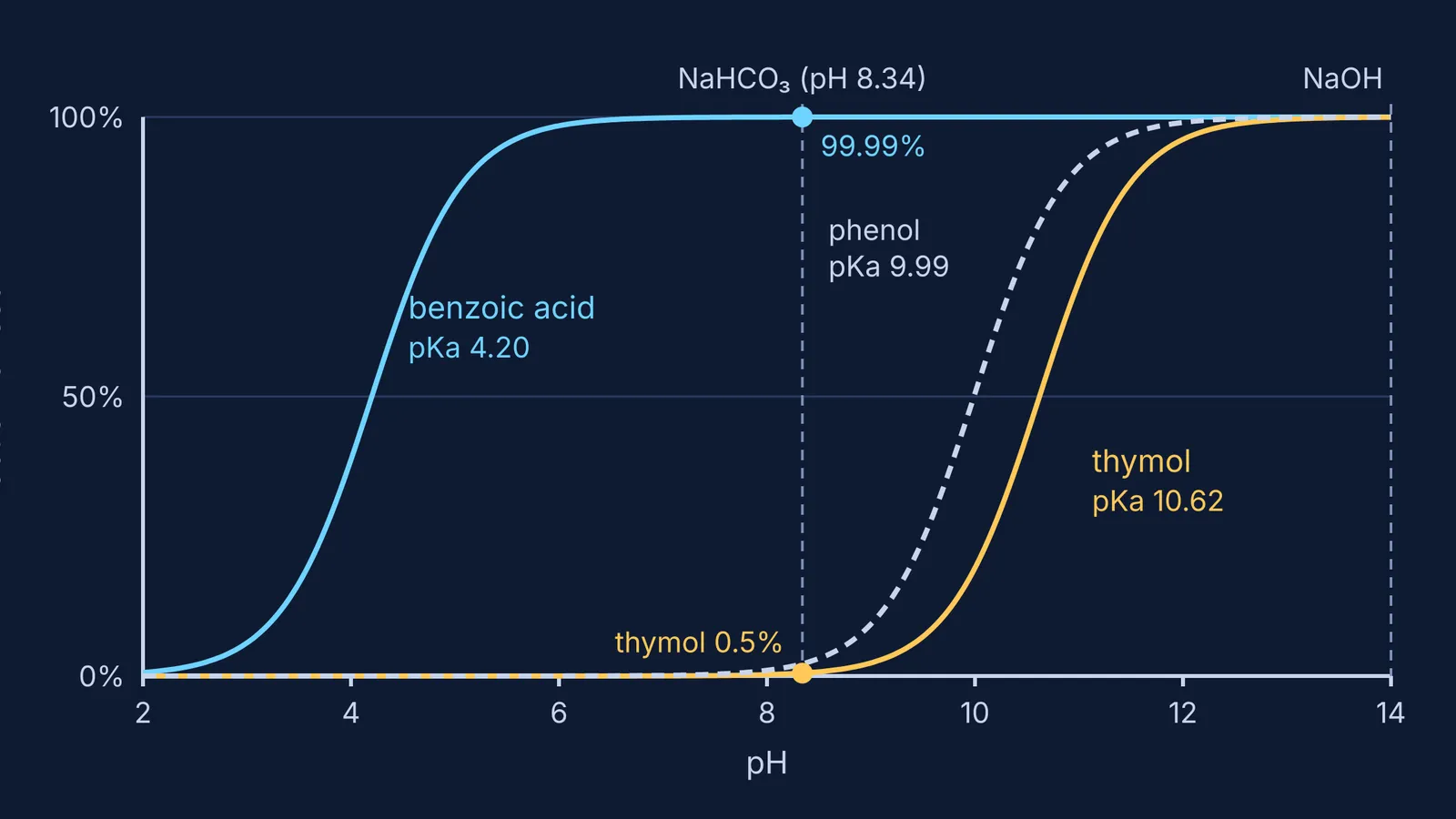
In NaHCO₃ solution. Its pH is about 8.34, from ½(pKa₁ + pKa₂) = ½(6.35 + 10.33); our post on the pH of sodium bicarbonate derives this. For thymol: 10^(10.62 − 8.34) = 10^2.28 = 190.5. Fraction ionised = 1 ÷ 191.5 = 0.52%. About 190 molecules stay neutral for every one that ionises.
Compare phenol (pKa 9.99) at the same pH: 2.2% ionised. Still no CO₂.
Compare benzoic acid (pKa 4.20, PubChem): 10^(4.20 − 8.34) is tiny, so it is 99.99% ionised. That is why a carboxylic acid dissolves and fizzes.
In 1 M NaOH (pH ≈ 14, with NaOH in excess): 10^(10.62 − 14) = 0.00042, so thymol is 99.96% ionised.
Part (b): from seed to thymol. Take 100 g of Gujarat Ajwain 3 seed and treat both percentages as mass percentages (an approximation; oil content is sometimes reported by volume).
Oil: 100 g × 4.74% = 4.74 g.
Thymol: 4.74 g × 48.17% = 2.28 g.
Moles: 2.28 ÷ 150.22 = 0.0152 mol.
NaOH needed to convert it all to sodium thymolate (1:1): 0.0152 mol, which is 15.2 mL of 1 M NaOH, or 0.61 g of NaOH.
Water needed to dissolve 2.28 g of neutral thymol at 0.9 g/L: 2.28 ÷ 0.9 = 2.5 L.
Steps 4 and 5 make the point: 15 mL of 1 M NaOH dissolves what would take about 2.5 litres of plain water.
Part (c): getting thymol back. In a lab separation question, add a strong acid to the alkaline layer: C₁₀H₁₃ONa + HCl → C₁₀H₁₃OH + NaCl. The neutral phenol comes out of solution. This is the textbook way to pull a phenol out of a mixture with neutral compounds; it is exam chemistry, not a description of how ajwain ka phool is made.
What should you write in the exam?
Test: "Thymol dissolves in aqueous NaOH, forming sodium thymolate, but gives no effervescence with NaHCO₃. So it is a phenol, not a carboxylic acid."
Reason: "Phenols (pKa about 10) are stronger acids than water but weaker than carbonic acid (pKa₁ 6.35). Carboxylic acids (pKa about 4 to 5) are stronger than carbonic acid."
Acidity order: benzoic acid > phenol > thymol, because the alkyl groups on thymol are electron-donating.
Isomerism: thymol and carvacrol are position isomers of C₁₀H₁₄O.
If equilibrium numbers like these trip you up, Fermi's AI tutor for JEE prep works through them with you, and the Fermi Problem Library has worked problems with a step-by-step solver that explains the reasoning.
Quick checklist
Write thymol's structure and name its two alkyl groups' positions.
Balance thymol + NaOH and say why the product dissolves.
Explain the NaHCO₃ test with pKa values, not just "phenols are weak".
Calculate the fraction ionised at pH 8.34 and pH 14.