On this page
Push the knee of two hinged bars that are almost in a straight line, and the far ends are forced apart with many times your push. That is the toggle, used in stone crushers, presses and clamps. Turn the same diamond of bars on its side, put a car on top, and you have a scissor jack, where the same rule works against you on the first turns of the handle. One formula, 1/(2 tan θ), explains both.
What is a toggle linkage?
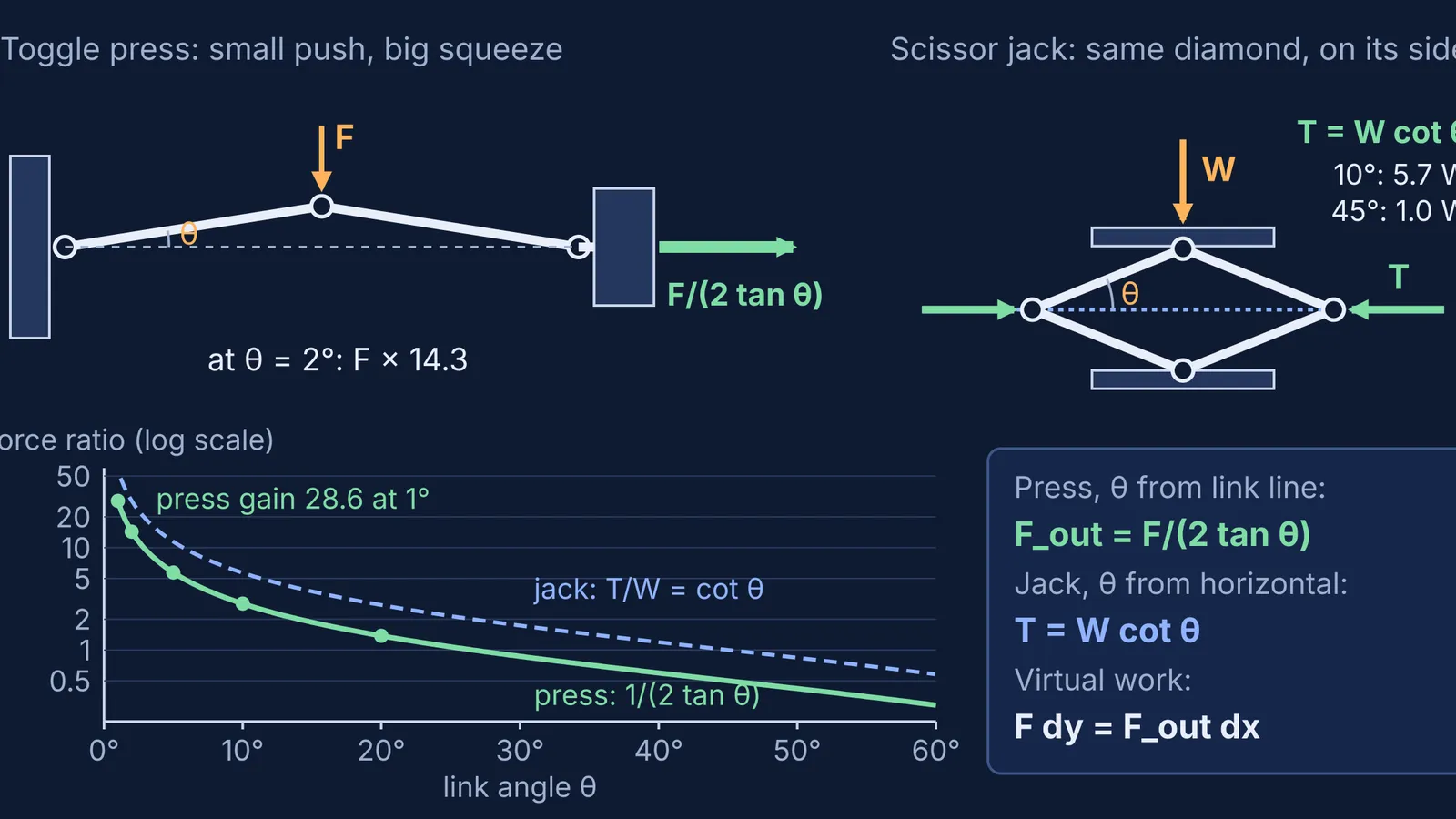
Take two links of length l joined at a knee. One end is pinned to a frame; the other drives a ram that slides along the line joining the ends. Each link makes an angle θ with that line. Push the knee with a force F at right angles to the line, and the links straighten and drive the ram outward.
Our screw jack post notes that a scissor jack's mechanical advantage changes with height, and the umbrella post calls the rib and stretcher a toggle linkage. Neither gives the force rule. Here it is.
How do you find the toggle's force gain by virtual work?
For a frictionless linkage, work in equals work out, the same balance behind levers and their mechanical advantage.
The knee sits a distance y = l sin θ off the line. The ends are x = 2l cos θ apart.
Change θ by a small dθ. The knee moves dy = l cos θ dθ. The ram moves dx = 2l sin θ dθ.
So the ram moves 2 tan θ times as far as the knee: dx = 2 tan θ dy.
Work in equals work out: F dy = F_out dx.
Therefore F_out = F/(2 tan θ).
Forces give the same answer: each link carries a thrust F/(2 sin θ), whose component along the line is F/(2 tan θ).
Worked example 1: how much does a press gain as the links straighten?
Put numbers into F_out/F = 1/(2 tan θ):
θ = 20°: gain 1.37
θ = 10°: gain 2.84
θ = 5°: gain 5.72
θ = 2°: gain 14.3
θ = 1°: gain 28.6
A 100 N push at θ = 2° becomes about 1,430 N on the ram. The price is movement:
At θ = 2°, dx = 2 tan 2° × dy = 0.070 dy. A 1 mm push on the knee moves the ram only 0.07 mm.
With links 0.2 m long, the distance between the ends is 2l cos θ. From θ = 5° to straight, it grows by 2 × 0.2 × (1 − cos 5°) = 1.52 mm. That is all the stroke left.
So a toggle gives a huge force over a tiny distance at the end of its travel, which is what a press needs to set a rivet. The gain is ideal: pin friction and link bending eat into it, most at small θ, and "infinite force at θ = 0" is a limit, not a design point.
Why does a stone crusher's toggle plate break on purpose?
In a jaw crusher, a swinging jaw squeezes rock against a fixed one. A toggle plate holds the bottom of the moving part, so the drive is a toggle linkage: the force it can apply rises sharply as its links come into line. A peer-reviewed kinematic study of the double-toggle jaw crusher by Oduori, Mutuli and Munyasi models the drive as a six-bar linkage and derives this ideal mechanical advantage.
That rising force is also the danger: if uncrushable steel enters the jaws, the linkage keeps multiplying force until something gives. Crusher maker McLanahan describes its jaw crusher toggle plate as designed to act like a fuse that protects the crusher from a tramp iron event. A cheap plate breaks so the frame and shafts do not.
Never approach a crusher while it is running; jams are for trained plant staff.
How is a scissor jack the same toggle turned on its side?
A car's scissor jack is a diamond of four links of length l, with the screw joining the two side pins and the load W on the top pin. Now θ is each link's angle from the horizontal.
Height of the top pin above the bottom pin: h = 2l sin θ.
Distance between the side pins: w = 2l cos θ.
Turning the screw pulls the side pins together with tension T. For a small dθ, the top rises dh = 2l cos θ dθ and the side pins close by 2l sin θ dθ.
Work in equals work out: T × 2l sin θ dθ = W × 2l cos θ dθ.
So T = W cot θ.
This is the toggle rule read from the other end. In the press you push across the links and gain force. In the jack the screw pulls along the nearly flat links and must supply the large force itself.
Worked example 2: why are the first turns of a jack the hardest?
All values here are round, illustrative numbers, not the rating of any real jack. Take W = 3,000 N on the jack, links l = 0.15 m, a screw pitch of 2 mm and a handle radius of 0.15 m.
Screw tension. T = W cot θ gives 17,000 N at θ = 10°, 5,200 N at 30°, 3,000 N at 45° and 1,700 N at 60°.
Height. At θ = 10°, h = 2 × 0.15 × sin 10° = 0.052 m, so the jack is nearly flat, 52 mm between pins.
Ideal handle force. One turn moves the screw one pitch, so F × 2πR = T × p. At 10°, F = 17,000 × 0.002/(2π × 0.15) = 36 N. At 45°, F = 6.4 N.
With friction. At an illustrative screw efficiency of 30%, the handle force is about 120 N at 10° and 21 N at 45°.
So the jack is hardest to turn just as the load starts to rise, and gets easier as it goes up.
Never get under a car held up only by a jack.
How does this show up in JEE problems?
JEE questions rarely name a toggle. They give a symmetric frame of light rods with a load and a string across it, and ask for the tension. The fast route is the one used here: write two lengths in terms of one angle, differentiate, and set work in equal to work out.
To practise statics problems like this, the Fermi Problem Library has a step-by-step solver that explains the reasoning. For a full plan, Fermi Test Prep offers personalised preparation for JEE Main & Advanced with an AI tutor, live classes, adaptive mocks, mentorship and a study plan that updates based on mastery.
Quick checklist
Toggle press: F_out = F/(2 tan θ), with θ from the line of the links.
Gain 2.84 at 10°, 5.72 at 5°, 28.6 at 1°; the stroke shrinks just as fast.
Virtual work: F dy = F_out dx, with dx = 2 tan θ dy.
Scissor jack: T = W cot θ, with θ from the horizontal; 5.7 W at 10°, equal to W at 45°.
Never go near a running crusher, and never go under a car held only by a jack.