

On this page
Anyone caught in a monsoon downpour knows the shock: a fierce gust strikes, and the canopy snaps backward into a useless funnel. Most people assume the wind simply catches under the rim like a sail. Yet umbrellas invert even when held completely level or tilted forward.
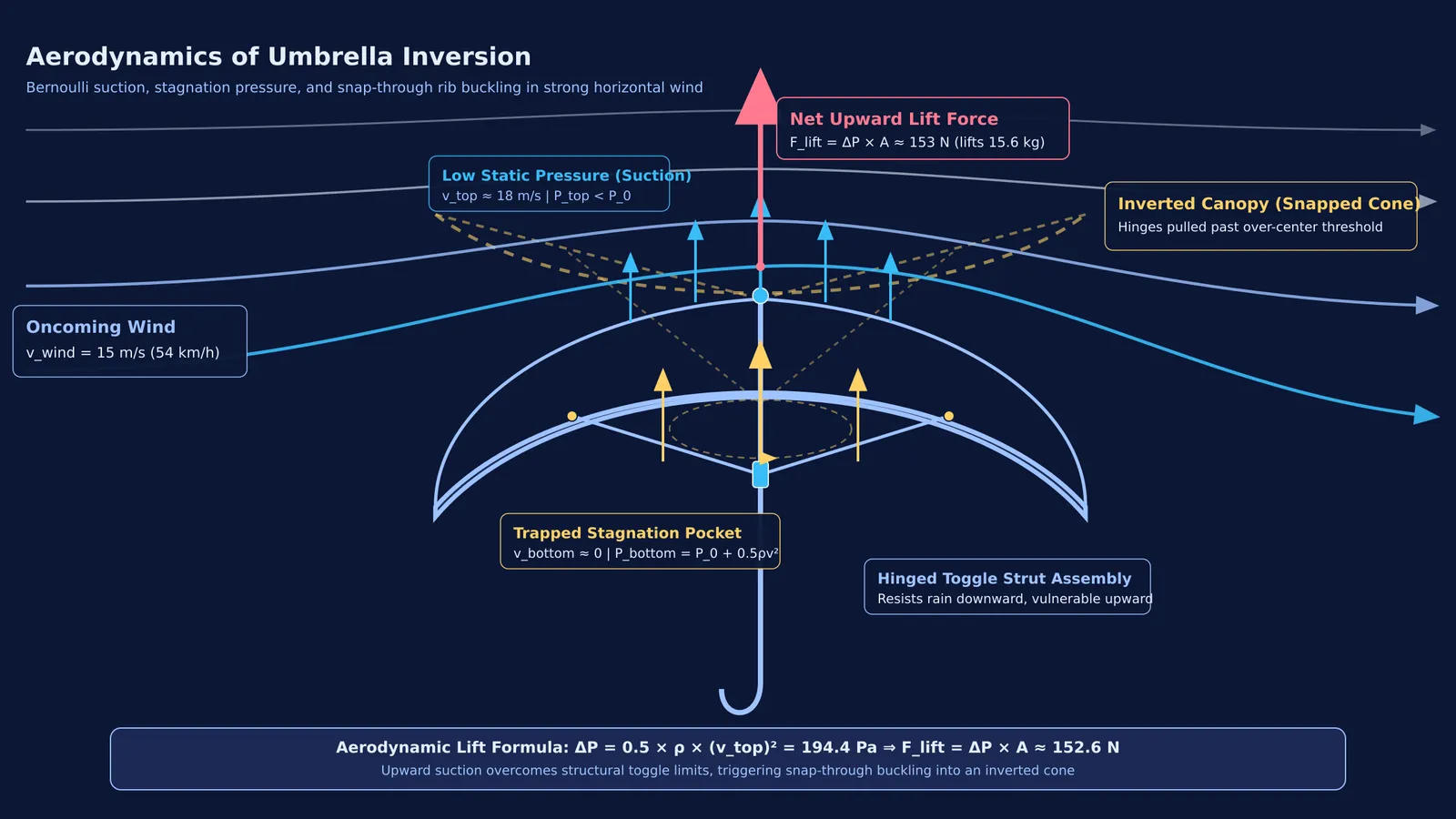
The real driver is aerodynamic suction. An open umbrella acts like an aerofoil. Horizontal wind accelerating over the curved canopy slashes air pressure on top, while air underneath remains near atmospheric pressure. This pressure difference turns a horizontal breeze into a powerful upward lift force.
Why does wind turn an umbrella inside out?
When wind strikes an open umbrella, it cannot pass through the fabric. Air divides into two paths: one stream flows over the arched convex top, and the other encounters the hollow underside.
The stream over the top is squeezed between the dome and the surrounding open atmosphere, accelerating across the peak. Meanwhile, the concave pocket underneath traps a cushion of slow-moving air. This separation creates a sharp imbalance between fast air skimming the fabric and stagnant air resting below it.
How does Bernoulli's principle create upward lift?
The physics of this pressure drop comes directly from Bernoulli's principle. In OpenStax University Physics, Bernoulli's equation expresses the conservation of mechanical energy for flowing fluids:
P + 0.5 × ρ × v² = constant
Here, P is static pressure, ρ is air density, and v is flow speed. Along a horizontal streamline across the canopy, higher speed requires lower static pressure.
As explained by the NASA Glenn Research Center, static pressure measures random molecular collisions against a surface, while dynamic pressure (0.5 × ρ × v²) represents directed motion. Because the convex dome crowds streamlines together, air accelerates over the peak (v_top > v_wind). Static pressure above the fabric (P_top) plunges below atmospheric pressure (P_0):
P_top = P_0 + 0.5 × ρ × (v_wind)² - 0.5 × ρ × (v_top)²
Beneath the canopy, air in the concave cavity stagnates to near-zero speed, raising underside pressure to P_bottom = P_0 + 0.5 × ρ × (v_wind)². Subtracting the top suction from bottom stagnation pressure yields the net upward pressure difference:
ΔP = P_bottom - P_top = 0.5 × ρ × (v_top)²
Applying Bernoulli's law to open curved surfaces often confuses students; see our review of fluid mechanics and Bernoulli mistakes. In *The Physics Teacher*, researcher Norman F. Smith emphasized that aerodynamic lift combines streamline curvature with this local pressure gradient. Physicist Chris Waltham showed that lift can equally be understood through Newton's third law: deflecting oncoming air downward produces an equal upward reaction force on the frame.
Worked example: How much lifting force hits a canopy?
To see why everyday gusts damage umbrella frames, consider aerodynamic equations from the NASA Glenn Research Center applied to a moderate monsoon squall:
Canopy diameter: 1.0 m (projected area A = π × r² ≈ 0.785 m²)
Air density at sea level (25 °C): ρ ≈ 1.2 kg/m³
Squall wind speed: v_wind = 15 m/s (54 km/h)
Accelerated crest speed: v_top ≈ 18 m/s
Pressure differential: The net static pressure difference equals the accelerated dynamic head:
ΔP = 0.5 × 1.2 kg/m³ × (18 m/s)² = 194.4 Pa (N/m²)
Net upward lift force: Multiplying pressure by projected area gives:
F_lift = ΔP × A = 194.4 N/m² × 0.785 m² ≈ 152.6 N
An upward force of 153 newtons equals the weight of a 15.6 kg mass pulling straight toward the sky. Holding an umbrella against a 54 km/h gust is physically equivalent to carrying a heavy bucket of water suspended upside down from the ribs.
Why do umbrella ribs snap upward instead of bending down?
Umbrellas are structurally asymmetric, engineered to bear downward loads from raindrops and fabric tension. Stretcher struts prop the ribs against collapsing downward.
Against upward lift, however, the frame is vulnerable. The rib-and-stretcher mechanism acts as a toggle linkage. When aerodynamic suction pulls the ribs upward, it reverses the bending moments at the hinges.
Once upward lift pulls the ribs past a horizontal tipping point, the linkage becomes unstable. Restoring torque reverses direction, causing the ribs to undergo snap-through buckling into an inverted cone. Historical investigations of fluid pressures established the roots of these force equations; explore how Daniel Bernoulli developed Hydrodynamica. Basic mechanics also governs how stress concentrates at hinged joints; see our guide on force and pressure fundamentals.
Tilting the umbrella backward worsens this effect: oncoming wind scoops directly into the cavity, increasing upward pressure and popping the ribs immediately.
How can you prevent an umbrella from flipping in heavy gusts?
You cannot turn off fluid dynamics, but three practical adjustments help protect your frame:
Point the apex into the wind: Angle the umbrella forward so oncoming wind glides smoothly over the dome rather than scooping underneath the rim.
Choose a vented double-canopy: Overlapping fabric vents allow trapped air underneath to escape into the low-pressure zone above, equalizing pressure across the canopy.
Prefer flexible fiberglass ribs: Fiberglass bends elastically without permanent yield, absorbing strong gusts where rigid metal hinges snap.
To see how fluid streamlines bend and how pressure distributions change over curved surfaces, explore interactive models in the Fermi Simulation Lab. When practicing fluid mechanics for Class 11 or JEE Main, the Fermi Problem Library provides step-by-step worked problems that explain the physical reasoning behind every step.


