On this page
A car weighs about 12,000 N, yet you can raise one corner with a screw jack by turning a handle with one hand. The trick is the inclined plane's trick, a long gentle path for a small force, wrapped around a cylinder. This post works out how much force the screw saves in an ideal world, how much friction takes back, and why that same friction is the reason the jack holds the car when you let go.
How is a screw an inclined plane?
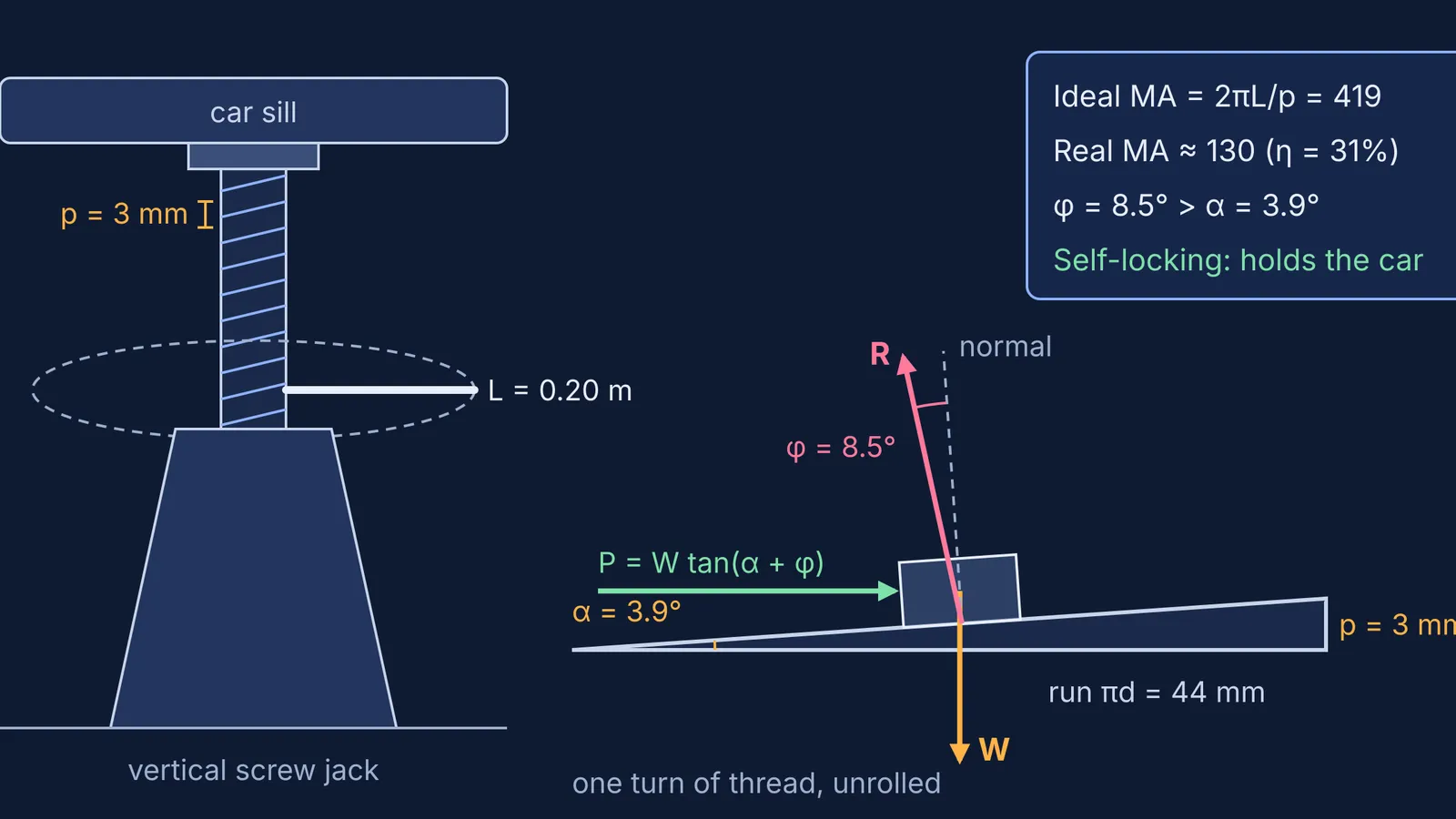
Roll a right-triangle of paper around a pencil and its sloping edge becomes a screw thread. Unroll one turn of a real thread and you get an inclined plane whose base is the circumference of the screw and whose height is the pitch p, the distance the screw rises in one full turn.
The angle of that slope is the thread angle α:
tan α = p / (πd)
where d is the mean diameter of the thread. A pitch of 3 mm on a 14 mm screw gives a run of π × 14 = 44 mm per turn, so the slope rises 3 mm over 44 mm. That is α = 3.9°.
The simple machines in work, energy and simple machines Class 9 key terms give the inclined plane a mechanical advantage of length over height. The screw is the same machine, with one extra lever on top: the handle.
What is the mechanical advantage of a screw jack?
Picture a simple vertical screw jack (a bottle or post jack), with a handle of radius L. In one full turn your hand moves along a circle of length 2πL, and the load rises by one pitch p. If nothing is lost to friction, work in equals work out:
Effort × 2πL = Load × p
So the ideal mechanical advantage (MA) is:
MA(ideal) = Load / Effort = 2πL / p
A long handle and a fine pitch both make it large. This is the same pitch that sets the least count of a screw gauge, as in positive or negative zero error in a screw gauge, but here it is used to multiply force rather than to measure length.
The folding jack in most car kits is a scissor jack. Its screw pulls on a linkage, so its MA changes with height. The numbers below are for a simple vertical screw, which keeps the physics clean.
How do you calculate the effort on a screw jack?
Here is a fully worked example. All values are round illustrative numbers, not the rating of any real jack.
Car mass 1,200 kg. One corner carries roughly a quarter of the weight (an illustrative split; real cars are heavier at the engine end).
Pitch p = 3 mm, mean thread diameter d = 14 mm, handle radius L = 0.20 m.
Coefficient of friction between the threads μ = 0.15 (illustrative, for lubricated steel).
Load. W = ¼ × 1,200 kg × 9.81 m/s² = 2,943 N.
Ideal MA. 2πL / p = 2π × 0.20 m / 0.003 m = 419. It has no unit, because metres cancel.
Ideal effort. 2,943 N / 419 = 7.0 N.
Thread angle. tan α = 0.003 / (π × 0.014) = 0.068, so α = 3.9°.
Friction angle. tan φ = μ = 0.15, so φ = 8.5°.
Real effort. Friction tilts the contact force back by φ, so the thread behaves like a slope of α + φ. The torque on the screw is W × (d/2) × tan(α + φ) = 2,943 × 0.007 × tan 12.4° = 4.54 N m. At the end of a 0.20 m handle that needs 4.54 / 0.20 = 22.7 N.
Efficiency. η = tan α / tan(α + φ) = 0.068 / 0.220 = 0.31, or 31%. Check: 7.0 N / 22.7 N = 0.31.
Real MA. 2,943 / 22.7 = about 130, not 419.
Now lift the car 10 cm:
Turns: 0.10 m / 0.003 m = 33.3 turns.
Hand travel: 33.3 × 2π × 0.20 m = 41.9 m.
Work you do: 22.7 N × 41.9 m = 951 J.
Work done on the load: 2,943 N × 0.10 m = 294 J.
The other 657 J becomes heat in the threads. That loss buys something useful.
Why does a screw jack not slip back down on its own?
When you let go of the handle, the load presses down on the thread and tries to slide down the slope. On a slope, a block stays put if the slope angle is less than the friction angle, which is the angle-of-repose idea. Here the slope is α = 3.9° and the friction angle is φ = 8.5°. Since φ > α, the load cannot drive the screw backwards. The jack is self-locking.
To lower the car you must turn the handle the other way and push. The torque needed is W × (d/2) × tan(φ − α) = 2,943 × 0.007 × tan 4.6° = 1.67 N m, which is 8.3 N at the handle.
You can see the trade-off by changing μ and keeping everything else the same:
μ = 0.15: φ = 8.5°, η = 31%, self-locking.
μ = 0.10: φ = 5.7°, η = 40%, still self-locking (5.7° > 3.9°).
μ = 0.05: φ = 2.9°, η = 58%, not self-locking. The car would turn the screw and run back down.
So a screw jack is deliberately inefficient. The lost work is the price of a jack that holds the car with your hands off.
How is a screw jack different from a hydraulic jack?
A hydraulic jack multiplies force with liquid pressure instead of a slope: a small piston pushes on oil, and the same pressure acts on a large piston. Pascal's law in hydraulic machines works that case. Both trade distance for force, and neither makes energy.
The model here is a simplified one. It treats the thread as square and ignores friction at the collar where the screw meets the load pad, which adds more effort in a real jack. Real V-threads have higher effective friction than square threads. The ideas are unchanged: MA = 2πL/p for the ideal case, η = tan α / tan(α + φ) with friction, and self-locking when φ > α.
If you want more friction-on-a-slope or machine problems worked through, the Fermi Problem Library has a step-by-step solver that explains the reasoning at each step.
One safety line, since this is about cars: never get under a car held up only by a jack.
Quick checklist
A screw is an inclined plane wrapped around a cylinder: tan α = p / (πd).
Ideal MA of a screw jack = 2πL / p.
With friction, effort at the handle = W × (d/2) × tan(α + φ) / L, where tan φ = μ.
Efficiency η = tan α / tan(α + φ).
Self-locking when φ > α; a self-locking screw has η below 50%.
Check every answer with work: effort × hand travel must be at least load × lift.