On this page
In NCERT salt analysis, the ammonium test ends with a brown precipitate with Nessler's reagent. Julius Nessler was not a career professor but a pharmacist who spent most of his life testing wine, soil and tobacco for farmers. The idea his reagent made routine, reading trace ammonia as a colour, sits behind a Delhi problem: Yamuna ammonia that forces water plants to cut output.
Who was Julius Nessler?
The biography below follows his entry in the Neue Deutsche Biographie (NDB vol. 19, 1999, by Friedel Timmermann and Sigrid Holtmannspötter). Translations from German are ours.
Born 6 June 1827 in Kehl, Baden; died 19 March 1905 in Karlsruhe.
He began an apothecary's apprenticeship in 1841, trained as a mechanic in Karlsruhe (1842–45), then returned to pharmacy, working in Alsace, Baden, Frankfurt and Paris.
He studied pharmacy in Freiburg and passed the state exam in 1854.
As assistant to Clemens von Babo he took his doctorate in 1856. The NDB says: "The ammonia test shown in his dissertation found its way into laboratories worldwide as 'Nessler's reagent'."
That work caught Robert Bunsen's eye, and Bunsen took him to Heidelberg as his assistant for two years.
We have not read the 1856 dissertation or Nessler's original recipe, so everything here about the reagent's origin rests on the NDB's one sentence.
What did Nessler do after the reagent?
On Bunsen's recommendation, the agricultural authority of Baden contracted Nessler in 1859 to set up an agricultural chemistry laboratory. He started it in his own flat with very little money, the NDB says. It grew into the state testing station that in 1968 became the LUFA Augustenberg.
In more than 40 years there he published about 800 papers. Nearly half deal with viticulture (fertilising and plant protection) and cellar practice; others cover tobacco, soils and Baden's peat. His titles include a book on the grape phylloxera (1875) and a paper on detecting free tartaric acid in wine (1879).
One 1868 title stands out: "On the determination of ammonia and nitric acid in very dilute solutions" (Zeitschrift für analytische Chemie 7, 415). We know only the title, from the NDB. "Very dilute" is where the reagent earns its place.
What does Nessler's reagent do with ammonia?
Nessler's reagent is an alkaline solution of potassium tetraiodomercurate(II), K₂[HgI₄]. The complex ion [HgI₄]²⁻ is tetrahedral: Hg²⁺ is d¹⁰, so there is no crystal-field reason to prefer a square planar shape. The NCERT procedure is in our guide to the test for the ammonium ion with NaOH, HCl fumes and Nessler's reagent.
Written ionically, the NCERT lab-manual equation is:
2[HgI₄]²⁻ + NH₃ + 3OH⁻ → HgO·Hg(NH₂)I + 7I⁻ + 2H₂O
Check: 2 Hg, 8 I, 1 N, 6 H, 3 O and a charge of −7 on each side.
Textbooks write the brown product in different ways: HgO·Hg(NH₂)I, Hg₂NI·H₂O, or the "iodide of Millon's base". All of these are modern formulations, not Nessler's own. The first two contain exactly the same atoms, Hg₂NIOH₂, so the mass arithmetic is the same: M = 560.1 g/mol.
Nessler's reagent contains mercury, which is toxic. It is handled only in supervised laboratories. Do not try to make or use it at home.
How much ammonia is in the Yamuna at Wazirabad?
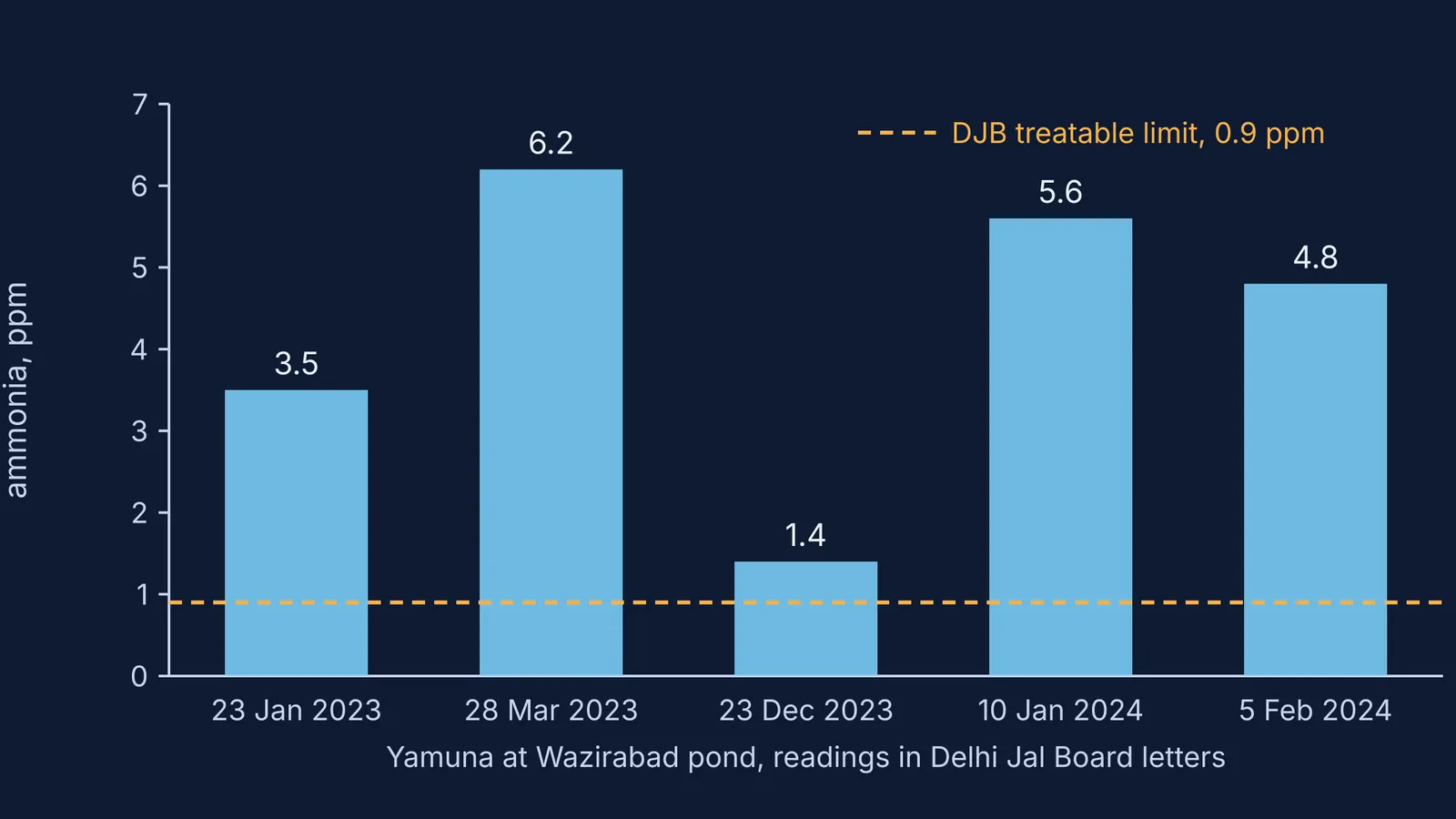
The Delhi Jal Board (DJB) filed a status report with the National Green Tribunal in Original Application No. 463 of 2023, in compliance with the Tribunal's order of 22 December 2023. Its annexed letters, written by DJB engineers to Haryana officials, report ammonia in the Yamuna at the Wazirabad pond:
3.5 ppm, "beyond treatable limit of 0.9 PPM" (letter of 23 January 2023)
6.2 ppm on 28 March 2023
1.4 ppm on 23 December 2023
5.6 ppm on 10 January 2024, with "about 40-50% curtailment of water production" at the Chandrawal and Wazirabad treatment plants
4.8 ppm on 5 February 2024, with about 30 % curtailment
Most letters give the limit as 0.9 ppm, which we use; one letter (28 December 2023) says "01 PPM", and some press reports use 1 ppm. A joint DJB and Haryana pollution board sampling on 12 February 2024 found ammoniacal nitrogen of 1.0 to 2.4 mg/L at four points on the DD-8 drain and the river.
Why cut output? Chlorine reacts with ammonia to form chloramines, so the chlorine demand climbs with the ammonia. The redox behind that is in breakpoint chlorination and the 7.6 to 1 ratio.
Worked example: from ppm to moles, and why trace ammonia shows up as a colour
Use M(NH₃) = 17.031 g/mol, M(N) = 14.007 g/mol and M(product) = 560.1 g/mol.
Step 1: ppm to mol/L. In dilute water, 1 ppm ≈ 1 mg/L. Taking 0.9 ppm as NH₃, 1 L holds 0.9 × 10⁻³ g ÷ 17.031 = 5.28 × 10⁻⁵ mol NH₃.
Step 2: reagent needed. The equation uses 2 [HgI₄]²⁻ per NH₃, so 2 × 5.28 × 10⁻⁵ = 1.06 × 10⁻⁴ mol [HgI₄]²⁻ per litre.
Step 3: product formed. At most 5.28 × 10⁻⁵ × 560.1 = 0.0296 g, or 29.6 mg, spread through a whole litre. At the 5.6 ppm of 10 January 2024: 3.29 × 10⁻⁴ mol/L of NH₃ and up to 184 mg of product per litre.
Step 4: why colour, not a weighable precipitate. A few tens of milligrams dispersed through a litre do not settle as a cake you can weigh. They turn the liquid yellow to brown, deeper as ammonia rises. That is colorimetry: the depth of colour is compared with standards of known strength, viewed through equal depths of liquid in matched tubes (Nessler tubes). In the dilute range, absorbance follows A = εcl, so colour depth is proportional to concentration. If a sample diluted from 10 mL to 50 mL matches a 1.12 ppm standard, the original held 1.12 × 50 ÷ 10 = 5.6 ppm.
Step 5: the unit trap. Water labs often report ammonia "as N" rather than "as NH₃". The factor is 17.031 ÷ 14.007 = 1.216. So 0.9 ppm as N would be 1.09 ppm as NH₃. The DJB letters just say "ammonia" in ppm and do not state the basis; the attached lab sheets label their column "Ammonical-Nitrogen", which suggests "as N", but we could not confirm that the letters use the same basis.
Where does this sit in your syllabus?
Salt analysis (NH₄⁺ as the zero group), Class 12 Coordination Compounds (K₂[HgI₄], tetrahedral [HgI₄]²⁻), Class 11 mole concept (ppm to mol/L) and Environmental Chemistry (water pollution).
A typical numerical: "River water contains 5.6 ppm NH₃. Find its molarity and the maximum mass of Nessler's product per litre." Answer: 3.29 × 10⁻⁴ mol/L and 184 mg.
For more ppm and mole-concept practice in the JEE pattern, Fermi Test Prep covers JEE Main and Advanced preparation with an AI tutor, and the Concept Library explains coordination compounds topic by topic.
Quick checklist
Julius Nessler (1827–1905): pharmacist, Bunsen's assistant, then 40+ years of agricultural testing in Baden; his 1856 dissertation gave the ammonia test (per the NDB).
Reagent: alkaline K₂[HgI₄]; [HgI₄]²⁻ is tetrahedral; it contains mercury, so supervised labs only.
2[HgI₄]²⁻ + NH₃ + 3OH⁻ → HgO·Hg(NH₂)I + 7I⁻ + 2H₂O, product M = 560.1.
0.9 ppm NH₃ = 5.28 × 10⁻⁵ mol/L; "as N" × 1.216 = "as NH₃".
DJB letters give a 0.9 ppm treatable limit and report 1.4 to 6.2 ppm at Wazirabad, with output cuts of about 30 % and 40–50 % on two dates.