On this page
Picture an office floor whose lighting is spread evenly across the three phases. On paper the neutral should carry almost nothing, because three equal currents 120° apart add to zero. Yet an electrician's clamp meter on the neutral can read more than on any phase. The reason is the shape of the current that LED drivers, phone chargers and computers draw. That current contains a part at 150 Hz, three times the supply frequency, and on a three-phase system those 150 Hz parts do not cancel. They add.
Why do balanced 50 Hz currents cancel in the neutral?
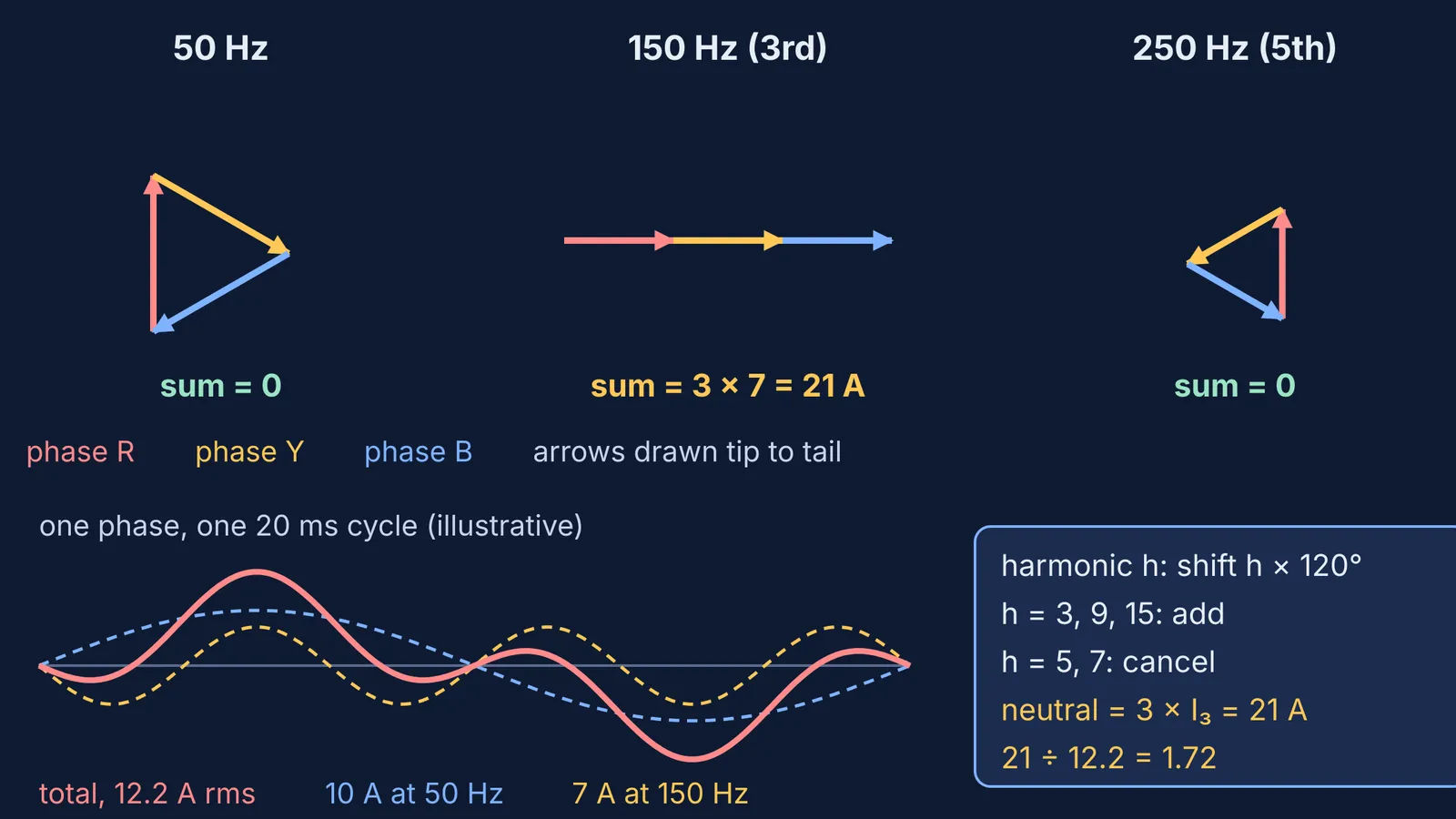
In a star-connected supply, each phase voltage reaches its peak one-third of a cycle after the one before, so the three phases are 120° apart. If each phase feeds the same resistive load, the three currents are also equal sinusoids 120° apart. Add them as phasors and they form a closed triangle: the sum is zero at every instant. The geometry, and why the line voltage is √3 × 230 V, is worked out in why a three-phase supply reads 400 V when each phase is 230 V.
With unequal loads the sum is no longer zero, but it stays below the largest phase current.
What is a third harmonic in an electric current?
A harmonic is a sinusoid at a whole-number multiple of the supply frequency. On a 50 Hz supply the third harmonic is at 150 Hz, the fifth at 250 Hz and the seventh at 350 Hz. Any repeating waveform, however odd its shape, can be written as a sum of these sinusoids. This is the same idea as the overtones of a guitar string, where the shape of the pluck decides which harmonics are present, as in which harmonics go missing when you pluck a string at L/3.
A simple LED driver or charger first turns AC into DC with a rectifier and a capacitor. The capacitor only takes current when the supply voltage rises above the capacitor's own voltage, which happens near each peak. So the current comes in short, tall pulses rather than a smooth sine wave. A pulse that is symmetric about the voltage peak contains a large third harmonic, plus smaller fifth, seventh and higher ones.
Why do third harmonics add instead of cancelling?
A 120° shift of a 50 Hz wave is a time shift of 20 ms ÷ 3 = 6.67 ms. That is exactly one full period of the 150 Hz wave: 3 × 120° = 360°. The three third harmonics end up in step with one another.
Do the same for each harmonic h. The shift is h × 120°:
h = 3: 360°, the same as 0°. In step, so they add.
h = 5: 600°, the same as 240°. Still a balanced set, so they cancel.
h = 7: 840°, the same as 120°. They cancel.
h = 9: 1080°, the same as 0°. They add again.
So the harmonics that are multiples of three (3, 9, 15 and so on), called triplen harmonics, add directly in the neutral. A Fluke application note on installation harmonics says the same thing: in a balanced three-phase system the neutral current comes mainly from the third harmonic, whose components from the three phases add in the neutral.
Worked example: how can 12 A per phase put 21 A in the neutral?
Each phase feeds identical LED lighting. Take each phase current to have 10 A rms at 50 Hz and 7 A rms at 150 Hz. The 7 A is an illustrative value: real drivers vary widely, and a real pulse also has fifth and higher parts, which this example leaves out.
Phase current. Two sinusoids at different frequencies add as squares in the rms: I = √(10² + 7²) = √149 = 12.2 A rms.
50 Hz part in the neutral. Three 10 A phasors 120° apart close into a triangle: 0 A.
150 Hz part in the neutral. The three 7 A third harmonics are in step, so they add directly: 3 × 7 = 21.0 A rms.
Compare. 21.0 ÷ 12.2 = 1.72. The neutral carries 72% more current than any phase.
Check by sampling. Adding the three phase waveforms point by point over one cycle and taking the rms of the sum gives 21.0 A as well.
The heating in a wire goes as I²R. For the same wire, 1.72² ≈ 2.96, so the neutral makes about three times the heat of a phase conductor.
How large can the neutral current get?
There is a neat upper limit. Suppose the current pulses of the three phases are so short that they never overlap in time. Then at every instant only one phase is conducting, and the neutral carries that one pulse. Squaring and averaging, the neutral's mean-square current is the sum of the three phases' mean squares, so its rms is √3 = 1.73 times the phase rms. The Leonardo Power Quality Initiative guide by Jan Desmet and Angelo Baggini, Neutral sizing in harmonic rich installations, quotes the same worst case, 1.73 times the phase current, and says neutral currents of up to 170% of phase currents occur in practice. Our 1.72 sits just below this limit.
Real installations are usually milder. A survey of US computer sites by Thomas Gruzs in IEEE Transactions on Industry Applications found that very high neutral currents are possible because triplen harmonics add, but only a low percentage of sites had neutral currents above the rated phase current. Drivers built with power-factor correction draw a much smoother current and so add far less third harmonic.
Why is a hot neutral a problem?
In most installations the protective devices watch the phase currents. Here every phase reads 12.2 A, well within a typical rating, while the neutral carries 21 A. Nothing trips, and the neutral runs hot. A loose or burnt neutral then brings its own trouble, described in why a broken neutral burns appliances.
This is why IEC 60364-5-52 has a rule for it. As the LPQI guide summarises, when third-harmonic current is above 15% of the phase current the cable must be derated, and above 33% the cable is sized on the neutral current instead of the phase current. Fluke's note adds that above 33%, the neutral current will be higher than the line current. That fits the arithmetic: 3 × 0.33 ≈ 1.
This post gives no wiring or testing instructions. Checking or changing a building's wiring, and measuring harmonics, is work for a licensed electrician or qualified staff.
To get comfortable with adding sinusoids as rotating arrows, the AC and phasor entries in the Concept Library go through the method step by step.
Quick checklist
Balanced 50 Hz phase currents are 120° apart and add to zero in the neutral.
Harmonic h is shifted by h × 120°. For h = 3, 9, 15 that is a whole number of turns, so they add.
Phase rms: √(I₁² + I₃²). Neutral rms from triplens: 3 × I₃.
10 A and 7 A give 12.2 A per phase and 21.0 A in the neutral, a ratio of 1.72.
Non-overlapping pulses give the ceiling of √3 = 1.73 times the phase current.
Wiring and measurement are for a licensed electrician.