On this page
A long-haul jet takes off with a large share of its weight in fuel. Most of that fuel is burned to carry the rest of the fuel. Double the fuel and you do not double the range, because the plane is heavier for the whole first part of the flight and burns faster while it is. Behind this is a short piece of JEE physics: a force balance that turns into a separable differential equation, dm/dt ∝ −m, whose answer is a logarithm.
What forces act on a plane in steady cruise?
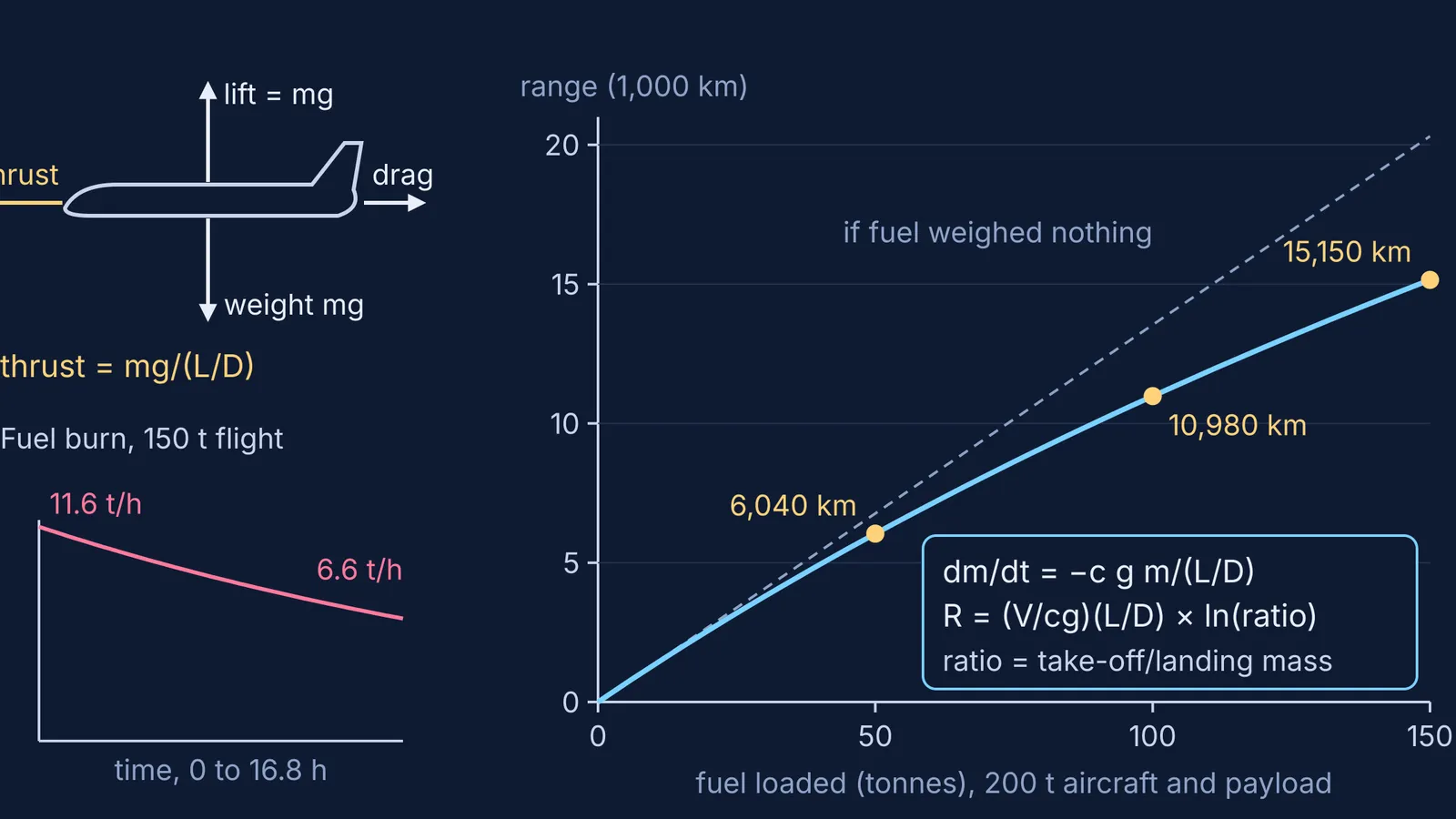
In level flight at constant speed nothing accelerates, so the forces balance in pairs. NASA's Beginner's Guide to Aeronautics sets it out: lift equals weight, thrust equals drag.
Divide the two equations. Lift/drag = weight/thrust, so
thrust = mg/(L/D)
L/D, the lift-to-drag ratio, measures how efficiently the wing turns drag into lift. A plane with L/D = 17 needs a thrust of only 1/17 of its weight to cruise. For more on where drag comes from, see why gliders have long thin wings and why passenger planes cruise at 35,000 feet.
How does a plane's weight change its fuel burn?
A jet engine burns fuel in proportion to the thrust it makes. The constant is the thrust-specific fuel consumption, c, defined in the same NASA guide as fuel mass flow divided by thrust. In SI it has units kg per newton-second.
Combine this with the force balance:
fuel burn rate = c × thrust = c m g/(L/D)
so dm/dt = −c g m/(L/D)
The burn rate is proportional to the mass itself. A plane at 300 t burns faster than the same plane at 210 t, simply because it needs more lift, so more drag, so more thrust. This is the same shape as radioactive decay or a capacitor discharging: the rate of loss is proportional to what is left.
How do you derive the range equation?
At constant speed V, distance x grows as dx = V dt. Replace dt in the equation above:
dm/dx = (dm/dt)/(dx/dt) = −c g m/(V L/D)
Separate the variables: dm/m = −[c g/(V L/D)] dx
Integrate from take-off mass m₀ at x = 0 to landing mass m₁ at x = R: ln(m₁/m₀) = −c g R/(V L/D)
Rearrange: R = (V/(c g)) (L/D) ln(m₀/m₁)
This is the Breguet range equation, the form given in MIT's unified engineering lecture notes. Check the units: c g has units (s/m)(m/s²) = 1/s, so V/(c g) is in metres. Good.
The factor in front, S = (V/(c g)) (L/D), is a length. Call it the scale length. Range is S times the logarithm of the mass ratio. The rocket equation has the same logarithm, for a different reason; compare it with how a rocket gains speed as fuel burns.
Worked example: does double the fuel give double the range?
The numbers below are round illustrative values, not data for any real aircraft; real values depend on the aircraft, engine and flight. Take V = 250 m/s (900 km/h), L/D = 17 and c = 1.6 × 10⁻⁵ kg/(N·s), which is about 0.57 lb of fuel per pound of thrust per hour. The aircraft plus passengers and cargo, without fuel, is 200 t (also illustrative).
Scale length: S = 250 × 17/(1.6 × 10⁻⁵ × 9.81) = 2.708 × 10⁷ m = 27,080 km.
With 50 t of fuel: R = 27,080 × ln(250/200) = 27,080 × 0.223 = 6,040 km.
With 100 t: R = 27,080 × ln(300/200) = 27,080 × 0.405 = 10,980 km.
With 150 t: R = 27,080 × ln(350/200) = 27,080 × 0.560 = 15,150 km.
Doubling the fuel from 50 to 100 t adds 82% to the range, not 100%. Tripling it adds 151%. If fuel weighed nothing, the burn rate would stay at its 200 t value and the range would grow in a straight line: 6,770 km for 50 t and 13,540 km for 100 t.
The burn rate itself, from c g m/(L/D):
At 300 t: 1.6 × 10⁻⁵ × 9.81 × 300,000/17 = 2.77 kg/s = 10.0 t per hour.
At 210 t: 1.94 kg/s = 7.0 t per hour.
So a plane near the end of a long flight burns about 30% less per hour than at the start, at the same speed.
That number is why airlines weigh "tankering": filling up at a cheap airport for the return leg too. The extra fuel is carried the whole first leg, and burns some of itself on the way.
What does the simple equation leave out?
The equation assumes V, L/D and c stay constant for the whole cruise. In practice:
As the plane lightens, the highest L/D happens at a lower air density, so long flights climb in steps to stay near it.
Take-off, climb and descent use fuel at different rates and are not in the formula.
Airlines must carry reserve fuel that is not meant to be burned, which adds to m₁.
c and L/D vary with altitude, speed and engine setting.
The equation still gives the right shape and is the standard first estimate in aircraft design.
How could JEE test this idea?
A JEE problem does not need the word "aircraft". It can give you any system where a quantity is lost at a rate proportional to itself and ask how far, or how long, something lasts. The method is the same each time: write the force or rate balance, separate variables, integrate with the right limits and check units.
The Fermi Problem Library has worked separable-equation problems with a step-by-step solver that explains the reasoning. If you are preparing for the exam itself, Fermi Test Prep offers personalised preparation for JEE Main & Advanced with an AI tutor, live classes, adaptive mocks, mentorship and a study plan that updates based on mastery.
Checklist before you move on:
Can you get thrust = mg/(L/D) from the two force balances?
Can you show dm/dt = −c g m/(L/D) and explain why heavier means faster burn?
Can you separate variables and integrate to R = (V/cg)(L/D) ln(m₀/m₁)?
Can you check that V/(c g) has units of length?
Can you explain why doubling the fuel gives less than double the range?