On this page
Look at a glider parked next to a small powered plane and the wings are the obvious difference. The glider's are long, thin and often wider than the plane's by several metres. The reason is a kind of drag that comes from making lift itself. You can work out how big it is with nothing more than Class 11 momentum and kinetic energy, and the answer depends on the square of the wingspan.
How does a wing hold a glider up?
A wing in steady flight pushes air downward. By Newton's third law the air pushes the wing up, and that upward force is lift. In level flight, or a steady glide, lift balances most of the weight, so a 400 kg glider needs about 400 × 9.81 = 3,924 N of lift.
Lift equals the rate at which the wing gives downward momentum to the air. If ṁ kilograms of air pass each second and each kilogram leaves with a downward speed w, then
L = ṁw
This is the same idea used for a hovering rotor in the air-momentum method for helicopter hover power. The difference is that the glider is moving forward, so it meets fresh air all the time and the mass flow depends on its speed.
How much air does a wing push down each second?
A simple model treats the wing as acting on a circular stream of air whose diameter equals the span b. The cross-section of that stream is πb²/4. At speed v, the volume swept each second is vπb²/4, so
ṁ = ρvπb²/4
where ρ is the air density, about 1.225 kg/m³ at sea level. Notice what is in this formula: the span, not the wing area. A wing that is wide from tip to tip handles a big stream of air even if the wing itself is narrow.
Where does induced drag come from?
Giving air a downward speed leaves kinetic energy behind it. Each second the wing leaves ½ṁw² of kinetic energy in the air. That energy has to come from somewhere, and in a glider it comes from the glider's own motion: a drag force D, doing work at the rate Dv. Set the two equal and use w = L/ṁ:
Dv = ½ṁw² = L²/(2ṁ)
Put in ṁ = ρvπb²/4 and divide by v:
D = 2L²/(πρv²b²)
This is induced drag, the drag of making lift. It is not friction. The FAA's Glider Flying Handbook, chapter 3 describes the same thing from a different angle: the wing tilts the airflow downward, the total lift vector tilts back with it, and the backward component of lift is induced drag.
Three things follow from the formula.
D ∝ 1/b². Double the span and induced drag falls to a quarter.
D ∝ L². A heavier glider pays more, in proportion to the square of its weight.
D ∝ 1/v². Induced drag falls as speed rises. The FAA handbook says the same: flying faster, the wing makes the same lift at a smaller angle of attack, which reduces induced drag.
The last point is the opposite of ordinary air resistance, which grows with speed. Real total drag is the sum of the two, which is why total drag is lowest at some speed in the middle.
How much drag does an 18 m wing save over a 9 m wing?
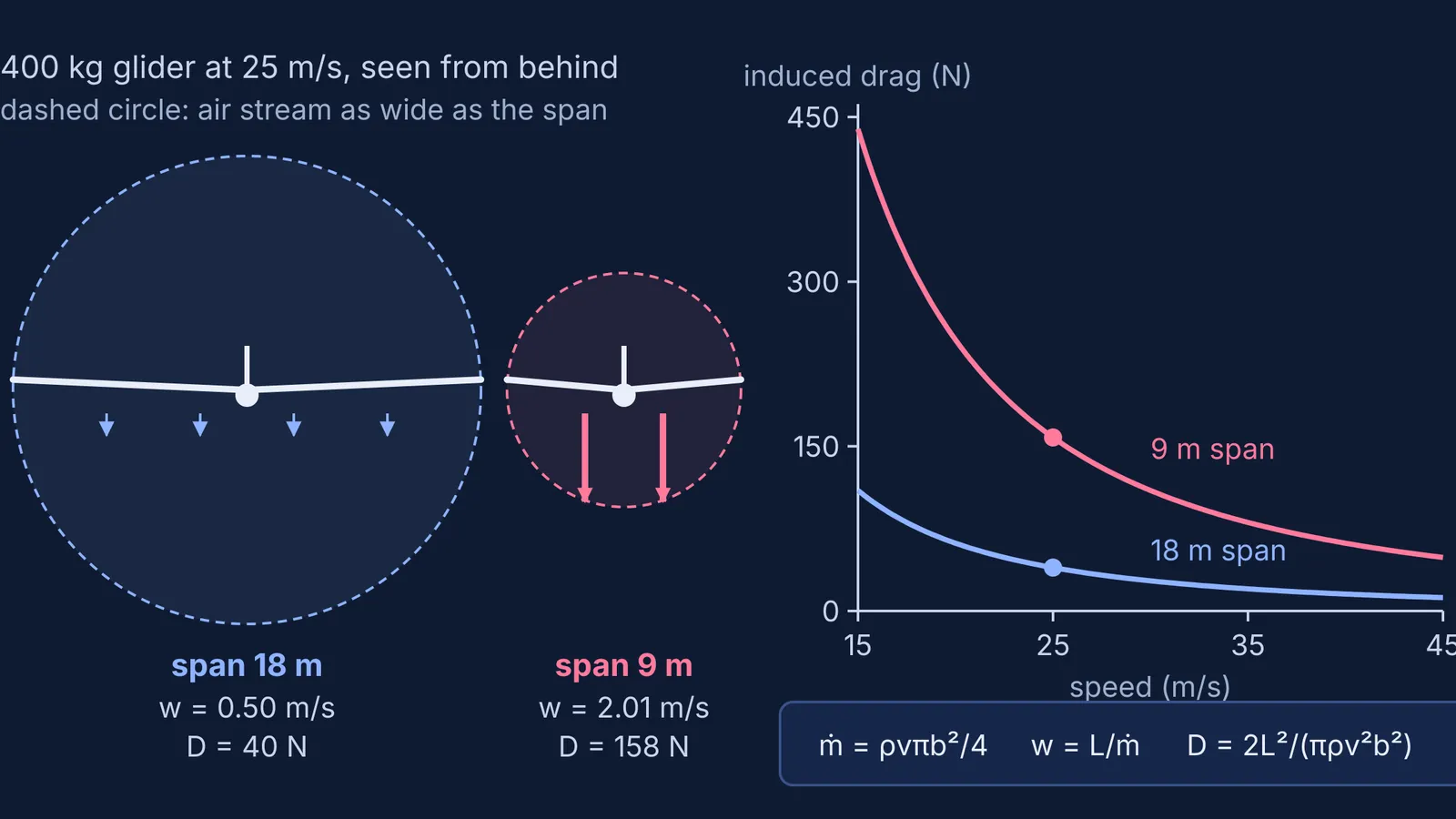
Worked example (illustrative round numbers). A 400 kg glider flies at 25 m/s (90 km/h) at sea level, ρ = 1.225 kg/m³. Compare an 18 m span with a 9 m span.
Lift needed. L = 400 × 9.81 = 3,924 N.
Mass flow, 18 m span. ṁ = 1.225 × 25 × π × 18²/4 = 7,793 kg/s.
Downward speed. w = L/ṁ = 3,924/7,793 = 0.50 m/s.
Power left in the air. ½ṁw² = ½ × 7,793 × 0.50² = 988 W, about 0.99 kW.
Induced drag. D = 988/25 = 39.5 N. The formula 2L²/(πρv²b²) gives the same, as it must.
Now the 9 m span. ṁ = 1,948 kg/s, a quarter as much air. w = 3,924/1,948 = 2.01 m/s, four times faster. Power = ½ × 1,948 × 2.01² = 3.95 kW, and D = 158 N.
Check the units: kg/m³ × m/s × m² gives kg/s for ṁ; N divided by kg/s gives m/s for w; watts divided by m/s gives newtons for D.
Halving the span quartered the air handled, quadrupled the downward speed and, because energy goes as w², quadrupled the drag. The 18 m glider gets about 99 newtons of lift for each newton of induced drag; the 9 m glider about 25.
The same glider at other speeds, with the 18 m span: 61.7 N at 20 m/s, 39.5 N at 25 m/s and 20.2 N at 35 m/s. Faster flight means less induced drag.
One more way to see the cost. In a glide, the drag power comes from losing height at a rate P/(mg). Induced drag alone would make the 18 m glider sink about 988/3,924 = 0.25 m/s, and the 9 m version about 1.0 m/s. Parasite drag adds to both. How glide ratio and thermals then decide how far a glider goes is covered in how a glider flies without an engine.
Is the stream-tube model the real answer?
It is a model, but a good one. The full theory, Prandtl's lifting-line theory, gives the induced drag coefficient as C_Di = C_L²/(πAR e), where AR is the aspect ratio and e is a span efficiency factor. NASA's Beginner's Guide to Aeronautics gives e = 1.0 for an elliptic lift distribution and about 0.7 for a rectangular wing. Converting coefficients to forces, this becomes D = 2L²/(πρv²b²e). With e = 1 it is exactly the stream-tube result. Real wings fall between the two NASA values, so their induced drag is somewhat higher than the ideal. With e = 0.7 the 18 m glider's 39.5 N would become about 56 N.
Why are real glider wings so long and thin?
Because span is what cuts induced drag, glider designers stretch it as far as strength and weight allow. The FAA handbook's aspect-ratio figure compares a glider with a 51 ft (15.5 m) span, aspect ratio 11.85 and glide ratio 22:1, with one of 86.9 ft (about 26.5 m) span, aspect ratio 39 and glide ratio 60:1. It notes that glider wings have a high aspect ratio, which gives lift at low angles of attack with minimal induced drag. It also says winglets improve efficiency by changing the airflow near the tips and reducing induced drag.
The swirling air left behind each wingtip, and how birds in a V use the rising part of it, is explained in why birds fly in a V shape.
If momentum flux or the energy step felt shaky, the Concept Library explains each idea one at a time.
Quick checklist
Lift = rate of giving downward momentum to air: L = ṁw.
Mass flow through a stream as wide as the span: ṁ = ρvπb²/4.
Induced drag × speed = kinetic energy left in the air per second.
D = 2L²/(πρv²b²): halve the span, four times the drag.
Induced drag falls as speed rises, unlike ordinary air drag.
Real wings: divide by a span efficiency e below 1.