On this page
Stand under a hovering helicopter and you feel why it stays up: a strong wind blowing straight down. The rotor takes still air from above and throws it downward. By Newton's third law the air pushes back up on the rotor, and that push is the thrust. If you can work out how much air moves and how fast, you can estimate both the thrust and the power the engine must supply. Engineers call this momentum theory, and it needs only Class 11 mechanics.
How does a rotor push enough air to hold a helicopter up?
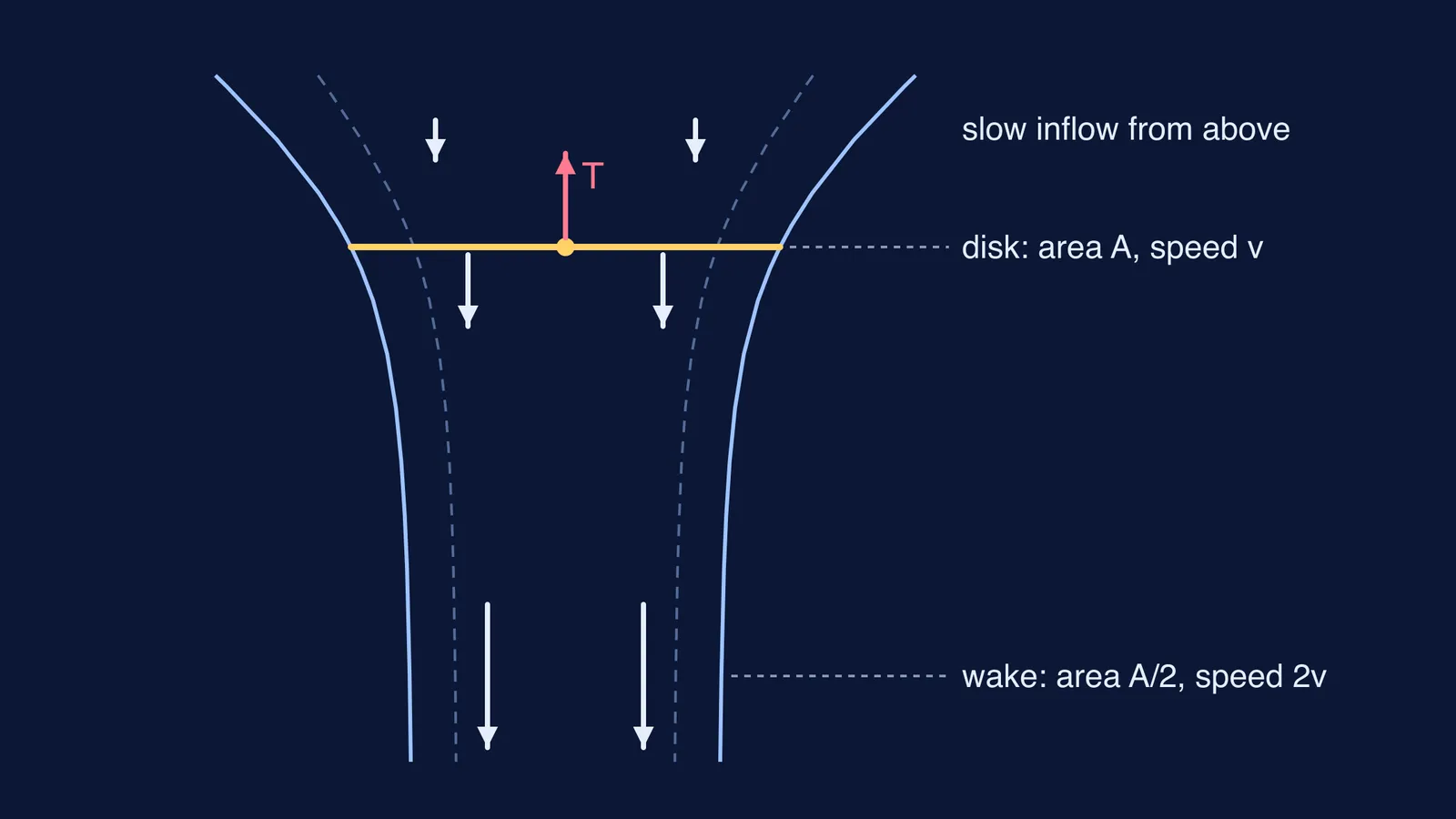
Momentum theory treats the rotor as an actuator disk: a thin disk of area A that adds momentum and energy to the air passing through it, as set out in L. Sankar's Georgia Tech helicopter aerodynamics notes. Air crosses the disk at the induced velocity v. Using momentum and Bernoulli's equation together, the notes show that the downwash in the far wake is twice the induced velocity at the disk, so the moving column of air narrows as it speeds up.
Thrust is the rate at which the rotor gives momentum to the air. The mass flow through the disk is ṁ = ρAv, and each kilogram leaves with speed 2v, so:
Thrust: T = ṁ × 2v = 2ρAv²
Induced velocity in hover: v = √(T / 2ρA)
In a steady hover, thrust equals weight, so T = mg. This is the same force-equals-rate-of-change-of-momentum idea behind the rocket thrust formula u dm/dt, except that a rotor pushes on air it takes from outside instead of fuel it carries.
What power does a helicopter need to hover?
Power is the rate of giving kinetic energy to the air. Each second, ṁ kilograms leave at 2v, so P = ½ṁ(2v)² = 2ṁv² = Tv. Substituting v gives the ideal hover power:
P = T × √(T / 2ρA) = T^(3/2) / √(2ρA)
Real rotors need more than this. The figure of merit (FM) is the ideal power divided by the actual power, and for most rotors it lies between 0.7 and 0.8, according to the Georgia Tech notes.
Worked example: how much power does a Robinson R22 need to hover?
The R22 is a small two-seat helicopter. Its Pilot's Operating Handbook lists a main rotor diameter of 25 feet 2 inches, a maximum gross weight of 622 kg for the Beta II, and a maximum continuous engine rating of 124 BHP. Standard sea-level air has a density of 1.225 kg/m³.
Thrust: T = mg = 622 × 9.81 ≈ 6,100 N.
Disk area: the diameter is 7.67 m, so R = 3.84 m and A = πR² ≈ 46.2 m².
Induced velocity: v = √(6,100 / (2 × 1.225 × 46.2)) = √53.9 ≈ 7.34 m/s.
Downwash far below: 2v ≈ 14.7 m/s, about 53 km/h.
Air moved: ṁ = ρAv ≈ 1.225 × 46.2 × 7.34 ≈ 416 kg every second.
Ideal power: P = Tv ≈ 6,100 × 7.34 ≈ 44.8 kW, about 60 hp.
Real rotor power: with FM between 0.7 and 0.8, P ≈ 56 to 64 kW, or 75 to 86 hp.
Sanity check: 124 BHP is about 92 kW, which leaves power for the gearbox, a climb margin and the tail rotor, which cancels the main rotor's torque.
What does momentum theory leave out?
The Georgia Tech notes list its simplifying assumptions and say actual power will be higher because the theory neglects these losses:
Steady, incompressible, inviscid flow, so no viscous losses.
Uniform flow across the disk and in the far wake.
No swirl in the wake.
No tip losses or compressibility effects.
Air density matters too. At 35 °C and sea-level pressure, dry air has a density of about 1.1455 kg/m³. Since ideal power varies as 1/√ρ, the R22's ideal hover power rises by about 3%, to roughly 46.3 kW. Higher altitude lowers density further and raises power again.
How do weight and rotor size change hover power?
The ideal power formula from the Georgia Tech notes, P = T^(3/2) / √(2ρA), gives two rules worth remembering for a viva or a JEE-style estimate:
Double the weight and the ideal power rises by 2^(3/2), about 2.8 times, not 2.
Double the rotor diameter (four times the area) and the ideal power halves.
Moving a lot of air slowly costs less power than moving a little air fast, because the power per newton of thrust is just v. The same reasoning applies to the four propellers of a drone.
Try it yourself. The R22 handbook gives a minimum gross weight of 417 kg. Repeat the steps for that weight; you should get an ideal power of about 25 kW.
If a step goes wrong, for example you use v instead of 2v for the wake speed, the Fermi Problem Library has worked problems with a step-by-step solver that explains the reasoning rather than printing an answer. To revise the momentum ideas underneath, each concept has its own lesson in the Fermi Concept Library.