

On this page
Watch a camera drone at a wedding hang still, then swing round to face the couple without drifting. It has no rudder and no tail rotor. Everything it does comes from changing how fast four motors spin.
How does a drone lift off with four propellers?
Each propeller pushes air downwards, and by Newton's third law the air pushes the propeller upwards with an equal and opposite force called lift, as NASA's student guide The Science Behind Quadcopters explains. NASA Glenn Research Center states the law as: "Whenever one object exerts a force on another object, the second object exerts an equal and opposite force on the first" (NASA Glenn).
The drone's total lift is the sum of its four propellers' lifts. If total lift is more than the drone's weight, it climbs; if the two are equal, it hovers; if lift is less, it sinks. A flight mechanics lecture from TU Graz adds the second condition: a drone hovers only when lift exactly balances gravity and the torque is precisely cancelled.
Why do drone propellers spin in opposite directions?
A spinning propeller drags on the air, and the air twists back on the propeller and on the motor bolted to the frame. That twist is a torque, and by the third law it tries to rotate the body the opposite way to the blades. A single-rotor helicopter cancels it with a tail rotor, which we explain in why helicopters need a tail rotor.
A quadcopter cancels it with pairs. In the NASA guide, two propellers spin clockwise and two counterclockwise, so the clockwise and counterclockwise torques cancel. The propellers that share a direction sit diagonally opposite each other.
But identical propellers spun opposite ways would send air from two of them upwards, so engineers use two blade shapes angled oppositely, and both push air down, the guide notes.
How does a drone turn, tilt and move forward?
The NASA guide describes three kinds of movement, each made by changing motor speeds.
Up and down: speed up or slow down all four equally. Total lift changes and the torques stay balanced.
Tilt and travel: speed up the propellers on one side, slow the other side, or both. The drone tilts, part of the lift now points sideways, and it moves towards the side with less lift.
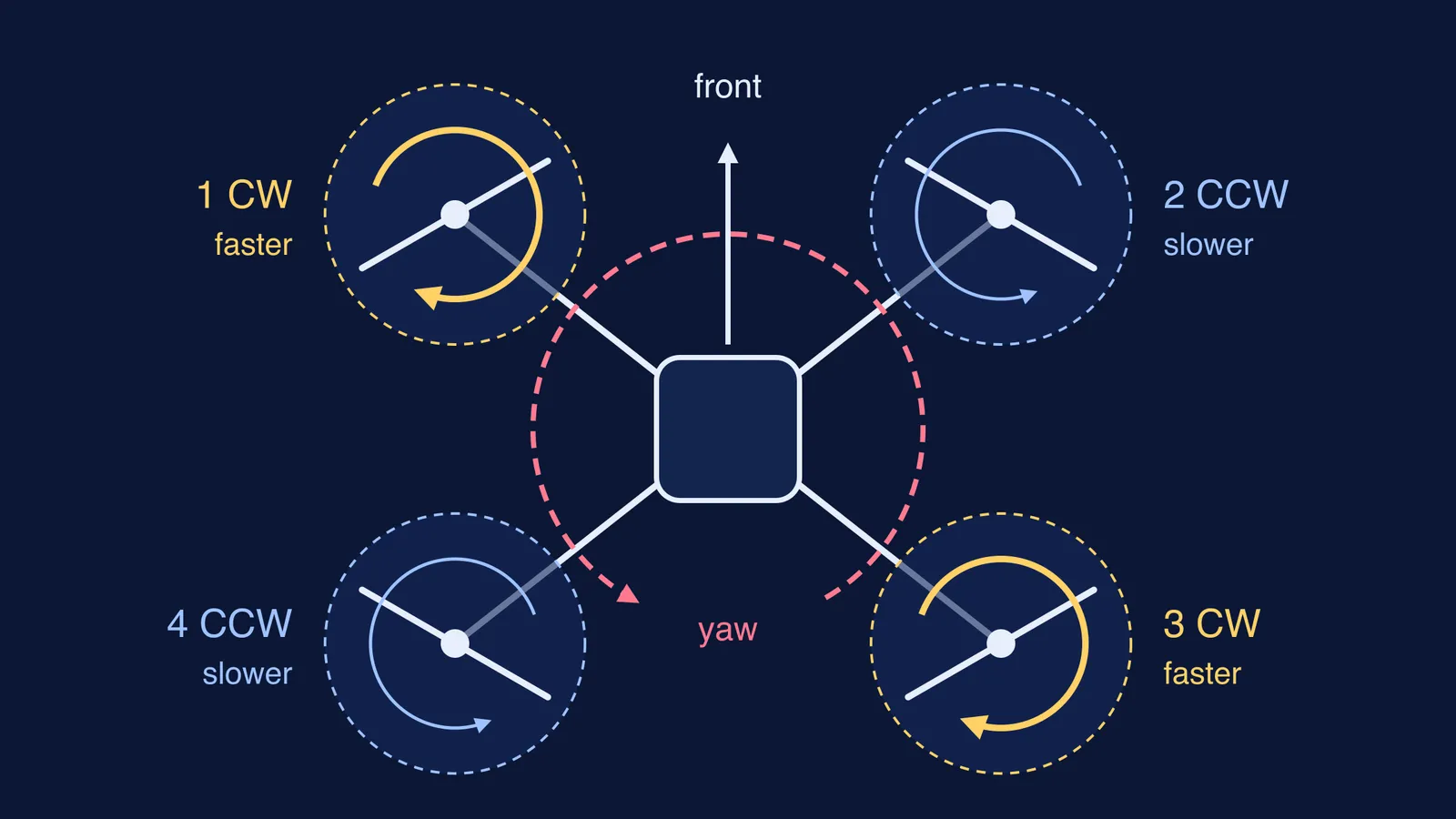
Turning on the spot (yaw): speed up the clockwise pair and slow the counterclockwise pair. Total lift stays the same, but the counterclockwise reaction torque on the body now wins, so the drone turns counterclockwise. Swap the pairs to turn the other way.
The TU Graz lecture adds two details. A drone cannot purely pitch or roll: every tilt also produces a sideways acceleration. And holding exactly equal thrust on all four rotors is practically infeasible, so a control loop measures drift and acts against it; attitude control runs on a microcontroller at 250 to 1,000 times a second.
Worked example: what will the drone do?
Use the drone from the NASA guide. It weighs 4 N. Propeller 1 is front-left, 2 front-right, 3 back-right and 4 back-left, and 1 and 3 spin clockwise. Take the four lifts and run three checks.
Add all four. More than 4 N means up, exactly 4 N means no vertical movement, less means down.
Compare sides: front (1 + 2) against back (3 + 4), and left (1 + 4) against right (2 + 3). The drone moves towards the side with less lift.
Compare diagonals: clockwise pair (1 + 3) against counterclockwise pair (2 + 4). If 1 + 3 is bigger, the drone turns counterclockwise; if 2 + 4 is bigger, it turns clockwise.
Try lifts of 1.2, 0.8, 1.2 and 0.8 N for propellers 1 to 4. The total is 4 N, so height holds. Front and back are 2 N each, and so are left and right, so there is no drift. The clockwise pair gives 2.4 N against 1.6 N, so the drone turns counterclockwise on the spot. That is pure yaw, the move in the diagram above.
Now try 0.8, 0.8, 1.2 and 1.2 N. The total is still 4 N and the diagonals balance, but the back pair is stronger, so the nose dips and the drone moves forward. NASA's rules let lift stand in for torque: a faster propeller makes more of both.
How does this connect to your physics syllabus?
A hovering drone is a neat equilibrium problem: net force zero and net torque zero at the same time. If you mix up which force pairs with which, read how to identify action-reaction pairs. If you want to build one, how to build a drone as a student project covers the parts and the rules.
The Fermi Simulation Lab has interactive simulations for ideas like this, and the Fermi Problem Library has worked problems with a step-by-step solver that explains the reasoning, for when a torque question trips you up.
Next time a drone turns on the spot, listen for which pair of propellers sounds higher.


